


A vetted debt-collection agency can convert qualifying overdue invoices into cash faster, which directly reduces days sales outstanding. It works best on debts that are aged, sizeable enough to justify the fee, and stuck with an unresponsive debtor. If that describes your ledger, the immediate next step is to gather your case documents and request a vetted match through DebtCollect.org or an agency you already trust.
TL;DR:
- Delaying referral is advisable for low-value, small, or recently overdue debts, while high-value accounts should be referred promptly after internal efforts fail.
- Agencies typically follow a process involving initial demand, phone contact, negotiation, and only legal escalation if necessary, with success fees being the most common fee structure.
- Compliance requires checking that agencies follow FCA guidelines, especially regarding debtors in repayment plans and adhering to pre-court protocols.
- Proper preparation of case files, including invoices, communication logs, and debtor details, is crucial to speed recovery and increase success rates.
- Using vetted agencies through a matching platform reduces procurement time, improves placement accuracy, and ensures FCA-aligned practices for ethical, effective collection.
Table of Contents
- When to send overdue invoices to a collection agency
- How agencies work and common fee models you should expect
- Legal and regulatory guardrails to follow before and during collection
- How to prepare an invoice case before referral
- Managing the agency relationship and governance while protecting customers
- Expected outcomes, costs and the practical impact on days sales outstanding
- Why a vetted match matters for ethical, effective recovery
- How to get started with DebtCollect.org’s vetted agency match
- Sources
- FAQ
When to send overdue invoices to a collection agency
Not every late payment needs outside help. A debtor who has gone quiet for 60 to 90 days, ignored two or more reminders, or has a pattern of repeat lateness is a stronger candidate for referral than a client who is simply a few days behind and still communicating.
A quick triage helps you prioritise a backlog rather than referring everything at once:
- High value or strategic accounts: refer promptly once internal reminders fail, since the fee is more likely justified against a large balance.
- Mid-value accounts: give internal collections one more attempt, then refer if there is no payment plan after some time.
- Low-value accounts: weigh staff time against likely recovery. Bundling several small debts to one agency can be more efficient than chasing each alone.
Guidance on referral triggers and timing is covered in more depth in our collections referral guide, which sets out invoice age bands and value thresholds for different debt classes.
How agencies work and common fee models you should expect
Most agencies follow a similar sequence: a written demand, then phone contact, then negotiation, and only then legal escalation if the debtor still refuses to engage. Understanding this sequence helps you set realistic timelines for when cash might actually land.
Fee structures vary, but three models dominate:
-
Contingency or success fee: a percentage of whatever is recovered, paid only on success.
-
Fixed placement fee: a set charge regardless of the eventual recovery.
-
Assignment: rare, where the agency buys the debt outright at a discount.
Commissioning a debt collection agency is a common approach for creditors, and agencies typically charge a percentage of amounts recovered, usually without taking assignment of the debt, according to HMRC’s VAT guidance on debt collection services.
The same guidance notes that agencies usually return uncollected debts, which means a first placement that fails often leads to secondary placement with a different agency rather than the debt being written off outright.
Legal and regulatory guardrails to follow before and during collection
Before referring a debt, it helps to know what you are legally entitled to claim and what conduct rules bind the agency acting on your behalf.
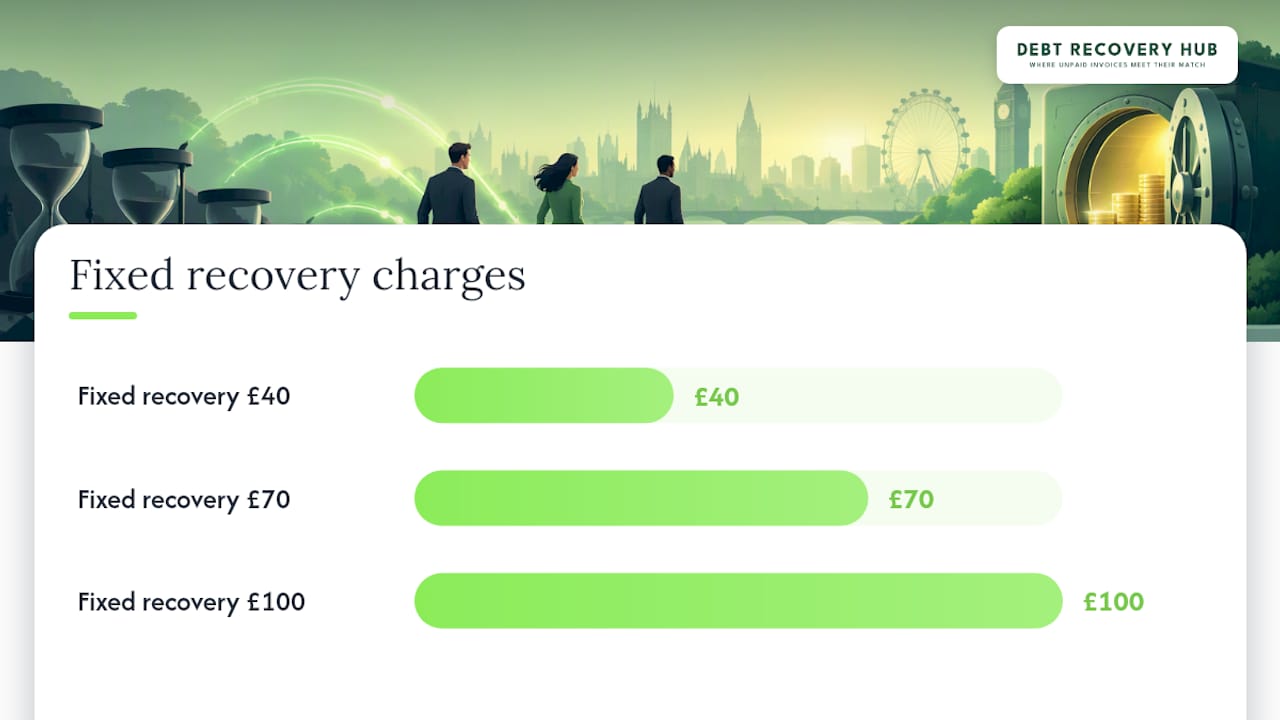
Under the Late Payment of Commercial Debts (Interest) Act, businesses can add statutory interest plus a fixed recovery charge on top of the original invoice. The charge scales with debt size:
| Debt size | Fixed recovery charge |
|---|---|
| — | £40 |
| — | £70 |
| — | £100 |
Reasonable additional recovery costs can also be claimed where they exceed the fixed amount. Our guide to late payment compensation walks through how to apply these figures, and our interest calculation guide covers the statutory interest rate itself.
Agencies operating under FCA oversight are expected to treat debtors in arrears with forbearance. Under CONC 7.3, firms should generally suspend active pursuit while a debtor is genuinely developing a repayment plan, commonly for around 30 days. This protects debtors from unfair pressure while still moving the case towards resolution.
- Check that any agency you use can demonstrate FCA-aligned practices before you sign a contract.
- Follow the Pre-Action Protocol for Debt Claims before court action, including the Letter of Claim and its Reply Form timelines, since skipping these steps risks procedural penalties even when the debt is genuinely owed.
How to prepare an invoice case before referral
Agencies work faster and recover more when the file they receive is complete. Missing paperwork is one of the most common reasons a placement stalls in its first weeks.
- Gather the original invoice, the underlying contract, and any delivery or performance evidence that proves the debt is owed.
- Compile a communications log showing every reminder, call, and email sent to the debtor, with dates.
- Note the debtor’s current contact details and, where known, any banking information relevant to payment.
- Flag any disputed elements of the invoice or prior concessions you have already offered, so the agency does not repeat them.
- Confirm the VAT treatment and any interest calculation you expect the agency to pursue alongside the principal.
- Set out your desired outcome (full payment, an instalment plan) and the minimum net recovery you would accept.
Pro Tip: Package the file as if a stranger has thirty seconds to understand the debtor’s history, since that is roughly how much attention a busy caseworker gives a new file on day one.
Our invoice recovery guide has templates for the communications log and referral summary if you are assembling this for the first time.
Managing the agency relationship and governance while protecting customers
Referring a case is not the end of your involvement. A short contract review and some ongoing oversight keep the arrangement working in your favour.
- Confirm the contract’s scope, reporting cadence, and the KPIs you will use to judge performance.
- Check liability and forbearance clauses so you know how the agency will handle a debtor who proposes a repayment plan.
- Annotate your own records the moment a case is referred, so nobody in your business chases the same debtor separately.
- Agree handback triggers in advance: at what point does an unsuccessful placement return to you or move to a second agency.
- Review KPIs on a set schedule, monthly for active portfolios, to check the agency’s impact on your financial control and your DSO and confirm the fee still represents value.
Government guidance on using third-party agencies reinforces this approach, recommending clear monitoring, defined handback arrangements, and specific protections for vulnerable debtors throughout the process. Our guide to outsourcing collections covers the practical mechanics of setting this up.
Expected outcomes, costs and the practical impact on days sales outstanding
Cost matters more for smaller businesses than the headline fee percentage suggests. Research into the impact of late payments found that average annual costs of using debt collection agencies are proportionally higher for micro businesses than for larger firms when measured against turnover. A small firm chasing a handful of large invoices feels the fee far more than a larger company spreading the same cost across a bigger book.
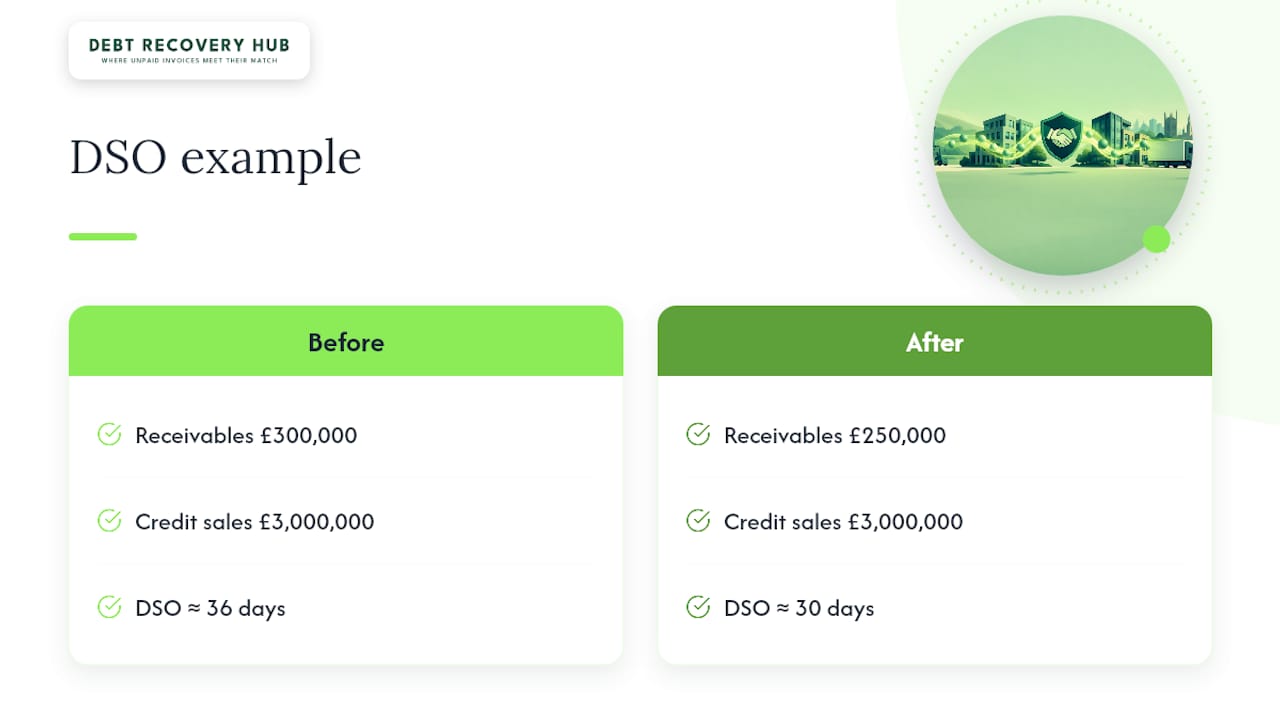
DSO arithmetic makes the impact concrete. DSO is calculated as accounts receivable divided by total credit sales, multiplied by the number of days in the period. Say a business has £300,000 in receivables against £3,000,000 in annual credit sales: that gives a DSO of roughly 36 days. If an agency recovers £50,000 of aged receivables that were otherwise sitting unpaid, receivables drop to £250,000, moving DSO to around 30 days, a six-day improvement from that single placement.
The size of the effect depends on how much of your aged debt is genuinely collectable and how quickly the agency works through the file, which is why prioritising the right accounts matters more than the fee percentage alone.
Why a vetted match matters for ethical, effective recovery
Handing a case to the wrong agency wastes weeks and can expose a business to compliance risk if the agency’s methods fall short of FCA expectations. DebtCollect.org matches creditors to agencies based on debt type, amount, age, and location, which improves placement accuracy from the outset.
That vetting, combined with guidance aligned to FCA standards, reduces the risk of poor practice reaching your debtors and cuts the procurement time a business would otherwise spend researching agencies alone.
— Jack
How to get started with DebtCollect.org’s vetted agency match
Chasing the right agency yourself means researching fee structures, checking regulatory standing, and hoping the fit works out. DebtCollect.org removes that guesswork by matching your case to agencies vetted for your debt type, size, age, and location, so you spend your time on the business rather than on procurement.

Start by gathering the documents covered earlier: invoice, contract, communications log, and your desired outcome. Submit those case details through a matching platform, and you will receive agency matches suited to your specific debt rather than a generic list. From there you review the matched agencies, confirm placement, and the agency proceeds under FCA-aware guidance with KPI monitoring built into the relationship.
If your overdue invoices sit in a trading relationship, our business debt recovery service is the most direct starting point for a case brief.
Sources
This guide draws on GOV.UK late payment legislation, FCA CONC 7.3, the Pre-Action Protocol for Debt Claims, and published late payment research.
FAQ
What is days sales outstanding and why does it matter?
Days sales outstanding measures the average number of days it takes a business to collect payment after a sale, calculated as receivables divided by credit sales and multiplied by the number of days in the period. A rising DSO usually signals cash flow strain, since money owed to the business is taking longer to arrive.
What causes a high DSO in the first place?
High DSO is typically driven by loose credit policies, unclear invoicing or payment terms, slow internal follow-up on overdue accounts, and debtors who are genuinely unable or unwilling to pay on time. Each of these compounds the others, so a single overdue account can sit for months without escalation.
How much does a debt collection agency typically charge?
Most agencies charge a contingency or success fee, a percentage of the amount recovered, rather than assignment of the debt, according to HMRC guidance. Exact percentages vary by agency and debt type, which is why matching to the right agency for your case matters.
Can I still claim interest and costs after using an agency?
Yes. Under the Late Payment of Commercial Debts Act, businesses can claim statutory interest plus a fixed recovery charge of £40, £70, or £100 depending on the debt’s size, in addition to the principal owed.
How does DebtCollect.org choose which agency to recommend?
DebtCollect.org matches creditors to agencies based on the debt’s type, amount, age, and location, following a detailed intake of case information. That approach is designed to avoid the guesswork of contacting agencies at random and to improve the chances of a faster, compliant recovery.