



Yes, recovering money from a phoenixed company is often possible, but it depends entirely on what evidence you can gather and how fast you move. Your best first steps are contacting the liquidator or administrator immediately, checking whether the new company breaches the prohibited name rules under section 216, and preserving every scrap of paperwork showing asset transfers. A platform such as DebtCollect.org can then match you with a specialist agency once you know what kind of case you’re actually holding.
TL;DR:
- The fastest way to recover money from a phoenix company is by acting within a few weeks, primarily by contacting the liquidator and gathering strong documentation of asset transfers.
- Recovery relies heavily on evidence of prohibited name breaches under section 216 of the Insolvency Act, which creates strict liability for directors and has a five-year window after liquidation.
- Legal claims for asset transfers or misconduct can take several months to years, especially if fraudulent trading or director disqualification is involved.
- A case-matching service helps creditors connect with specialized agencies for complex or contested cases, saving time and ensuring appropriate legal or collection action.
- Delay and aiming too high for proving fraud are common pitfalls; fast action on straightforward breaches under section 216 usually yields better chances of recovery.
Table of Contents
- What counts as phoenix company debt recovery under UK law?
- What should you do first to protect your claim?
- When should you bring in a specialist agency or solicitor?
- What creditors get wrong about chasing phoenix companies
- Where to read the official guidance next
- Get matched with the right agency for your phoenix case
- Sources
- FAQ
What counts as phoenix company debt recovery under UK law?
Phoenixing itself is not automatically illegal. A company can fail, sell its assets through a proper insolvency process at market value, and reopen under new ownership without anyone breaking the law. That’s a legitimate rescue, often via a pre-pack administration, and Gov draws a clear line between this and abusive phoenixism, where directors strip value out of a failing business specifically to dodge creditors before relaunching under a fresh name.
The distinction matters because your recovery route depends on which one you’re dealing with. Three statutory tools do most of the heavy lifting:
- Section 216 and 217 of the Insolvency Act 1986. Section 216 bans a director from using a “prohibited name” (one too similar to the failed company’s) for five years after insolvent liquidation. Breach it, and section 217 creates automatic personal liability for the new company’s debts, with no need to prove fraud.
- Transactions at undervalue and preferences. If assets moved to the new entity for less than they were worth, or one creditor got paid ahead of others shortly before liquidation, a liquidator can apply to unwind the deal.
- Misfeasance and wrongful or fraudulent trading. These target directors personally where they’ve breached their duties or kept trading while insolvent, though they carry a heavier evidential burden than a straightforward s.216 breach.
Pro Tip isn’t needed here, but it’s worth flagging that s.216 has three narrow exceptions (court leave, prescribed creditor notice, and a successor-company carve-out). The director generally has to prove one applies, which tilts the odds towards creditors.
What should you do first to protect your claim?
Move on these in order, and don’t let more than a few weeks slip by before you start:
- Contact the liquidator or administrator appointed to the failed company. They have a statutory duty to investigate the collapse, and evidence you hand over about suspicious transfers can trigger a formal antecedent recovery investigation.
- Register your claim formally with the office-holder so you’re recognised in any distribution.
- Pull together every document you have: invoices, contracts, bank transfer records, delivery notes, and correspondence with the directors, especially anything showing when assets or contracts moved to the new entity.
- Check Companies House for the new company’s incorporation date and director appointments in the 12 months before the old company entered liquidation. Same trading address, same phone number, same staff and same suppliers are all signs of business continuity that support a s.216 claim.
- Report to the Insolvency Service and HMRC if you suspect misconduct. Both bodies can act even where your individual claim is modest.
Pro Tip: Contemporaneous records beat memory every time. A dated email or an old invoice showing the same trading address under both company names is often worth more to a liquidator than a lengthy witness statement written months later.
Liquidator investigations typically take several months, and straightforward statutory claims (like a prohibited name breach) usually resolve faster than fraud allegations, which can drag on for a year or more once court proceedings start.
When should you bring in a specialist agency or solicitor?
Some phoenix cases are simple enough to handle through the liquidator alone. Others aren’t. Bring in specialist help when you’re facing:
- A contested claim where the new company denies any connection to the old one.
- Complex or layered asset transfers across multiple related companies.
- Cross-border elements, where assets or directors have moved outside the UK.
- Suspected director misconduct serious enough to warrant a disqualification referral or personal claim under s.217.
Insolvency solicitors handle director actions, antecedent recovery applications, and court proceedings where a liquidator’s own resources or mandate fall short. Specialist collection agents pursue book debts directly using commercial debt recovery techniques suited to defunct-company cases. Costs and timelines vary hugely depending on complexity, from a few weeks for an uncontested statutory demand to well over a year for litigated director claims.
This is where a case-matching approach earns its place. Rather than cold-calling agencies and hoping one understands phoenix cases, you provide the debt type, amount, age, and the specific facts of the closure, and get matched with a vetted agency that actually works this kind of case. A dedicated phoenix companies debt recovery resource walks through what to expect once you’re matched, including what information the agency will ask you to brief them on first.
What creditors get wrong about chasing phoenix companies
Delay is the single biggest self-inflicted wound. Every week you wait, the trail of bank transfers, correspondence, and director movements gets colder, and liquidators have less to work with when you finally hand over evidence.
The second mistake is aiming too high. Creditors often want to prove deliberate fraud, when a prohibited name breach under s.216 gets there faster and with far less to prove. Fraudulent trading claims demand you establish intent; a s.217 claim just needs you to show the name overlap and that the director knew the old company failed. One is a strict liability trap for the director. The other is a multi-year court battle.
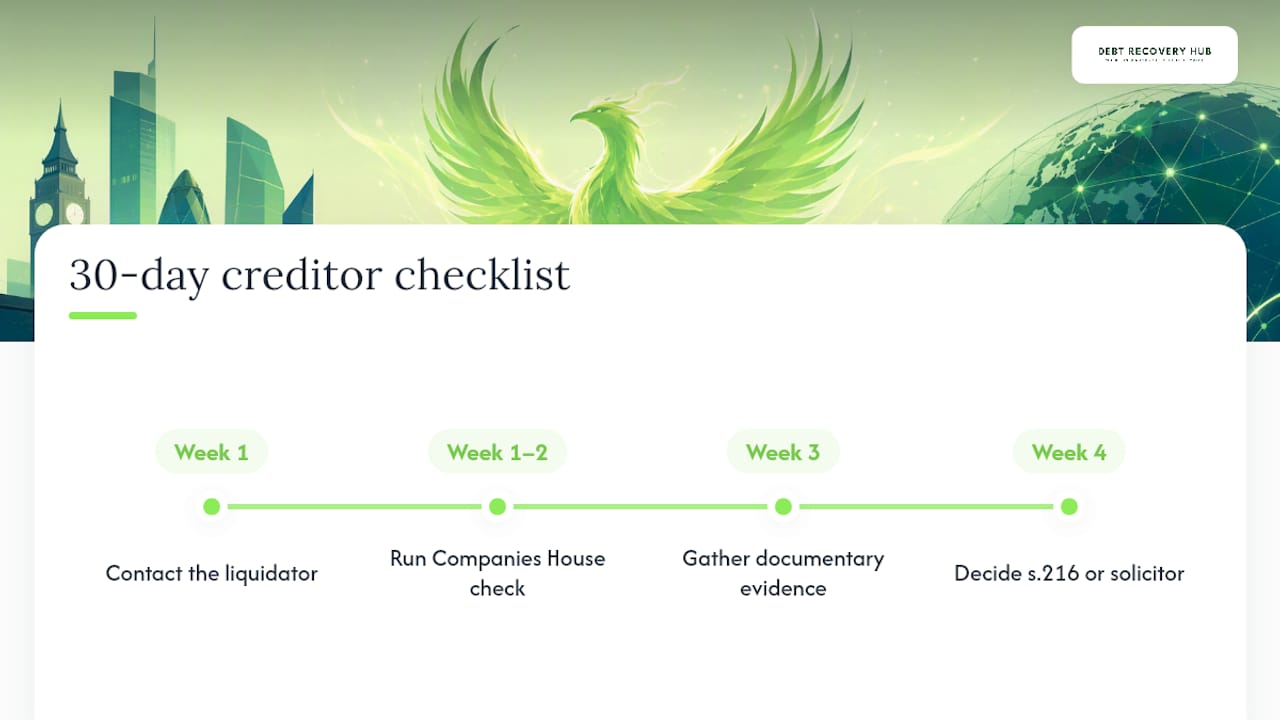
Here’s a rough 30-day checklist: contact the liquidator in week one, run a Companies House check on the new entity and its directors in week one or two, gather your documentary evidence by week three, and decide whether you’re dealing with a s.216 case or something that needs a solicitor by week four. Miss that window and your leverage starts to erode.
— Jack
Where to read the official guidance next
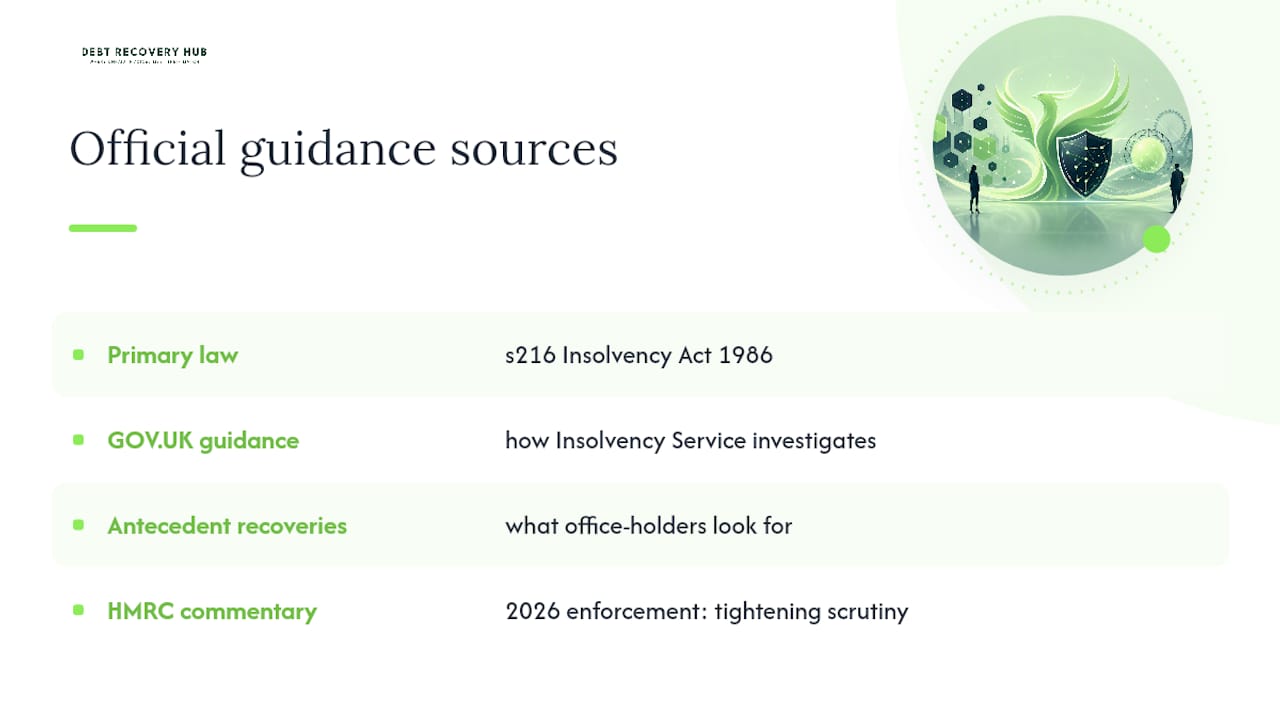
For the primary law, read section 216 of the Insolvency Act 1986 directly, since practitioner summaries sometimes simplify the exceptions. GOV.UK’s phoenix companies guidance explains how the Insolvency Service decides what to investigate. The antecedent recoveries technical guidance sets out exactly what office-holders look for when unwinding undervalue transfers. Recent practitioner commentary on 2026 HMRC enforcement trends is worth reading too, since scrutiny of phoenix arrangements has been tightening.
Get matched with the right agency for your phoenix case
A case-matching service is an alternative to blindly ringing round agencies hoping one understands phoenix cases: you describe the debt, the closure, and the evidence you’ve already gathered, and get matched to a vetted agency built for exactly that scenario, instead of a generalist collector learning insolvency law on your file.

That matters most for business debt recovery cases involving closed companies, where the right agency needs to know how to work alongside a liquidator, read a Companies House filing, and spot a s.216 breach without you having to explain insolvency law from scratch. If your debt sits with a company that’s already dissolved rather than merely relaunched under a new name, the process differs again, and it’s worth checking the distinction before you brief anyone. Fill in the details of your case on DebtCollect.org’s business debt recovery page and get matched with an agency suited to phoenix cases specifically, rather than starting from zero with a generic collector.
This article is general information, not a substitute for advice from a qualified lawyer. Consult a qualified legal professional about your own circumstances before acting on anything here.
Sources
FAQ
Can you still recover a debt if the old company was dissolved, not liquidated?
Dissolution doesn’t automatically wipe out the debt, but it usually makes the company unenforceable until it’s restored. A creditor can apply for restoration to resume action, which is a separate process from chasing a phoenixed successor.
Is there a time limit on pursuing a phoenixed company?
Ordinary contract debts generally fall under the six-year limitation period in England and Wales, but the s.216 prohibited name restriction only applies for five years after the original insolvent liquidation. Acting sooner rather than later preserves both your evidence and your options.
When should I sue a director personally rather than chase the company?
Sue the director directly once you can show a s.216 name breach, since s.217 creates automatic joint liability without you needing to prove fraud. Save fraudulent or wrongful trading claims for cases where there’s no clean prohibited name breach but clear evidence of deliberate wrongdoing.
What does it cost to pursue a phoenix company debt?
Costs vary by route: reporting to a liquidator is free, a solicitor-led director claim can run into thousands of pounds depending on complexity, and agency-led recovery through Debtrecoveryhub’s matching service depends on the individual agency’s terms, available on request once you’re matched via Business Debt Recovery.
Should I contact the Insolvency Service or the liquidator first?
Contact the liquidator or administrator first, since they hold the statutory duty to investigate and can escalate to the Insolvency Service themselves. Reporting directly to the Insolvency Service alongside this speeds things up if you already suspect serious director misconduct.