

UK businesses can charge statutory interest on overdue invoices at 8% plus the Bank of England base rate, under the Late Payment of Commercial Debts (Interest) Act 1998. You must actively claim it on a separate invoice referencing the original: something like “Statutory interest of [rate]% applies from [date] under the Late Payment of Commercial Debts (Interest) Act 1998, referencing Invoice #[number].”
TL;DR:
- Businesses must actively claim statutory interest on overdue invoices using a separate invoice referencing the original, with the rate set at 8% plus the Bank of England base rate.
- The base rate for interest calculation is locked in twice a year, on June 30 and December 31, and must be updated accordingly to avoid errors.
- Fixed compensation for late payment ranges from £40 to £100 depending on the invoice amount, and all interest claims must be transparently itemized.
- Contract clauses can only override statutory interest if they provide a genuinely equivalent remedy, not just a punitive penalty.
- Consistent wording and timely reminders improve recovery and reduce disputes, but in persistent cases, professional collection agencies should be engaged.
Table of Contents
- What is late payment interest wording, and when does it apply?
- How do you calculate statutory interest correctly?
- Wording templates for contracts, invoices and reminders
- How do you issue interest and compensation correctly?
- What are the legal limits on late payment interest clauses?
- Practical tips for using late payment wording without losing clients
- Why wording discipline changes recovery outcomes
- When wording and reminders aren’t enough
- Sources
- FAQ
What is late payment interest wording, and when does it apply?
Statutory interest isn’t a contractual add-on. Every UK business-to-business contract carries an implied right to charge it, whether or not your terms mention interest at all, under the Late Payment of Commercial Debts (Interest) Act 1998. You don’t need to have written anything into your contract for the right to exist.
A payment counts as late the day after whichever due date applies:
- The date agreed in your contract or terms of business.
- If no date was agreed, 30 days after the customer received the invoice or after the goods or services were supplied, whichever is later, according to Gov.
Public authorities face slightly different rules and shorter default periods in some contracts. There’s one important carve-out: a contract can exclude statutory interest only if it substitutes a “substantial remedy” of genuinely equivalent value. A clause that just says “no interest applies” without offering something comparable is likely to be unenforceable.
How do you calculate statutory interest correctly?
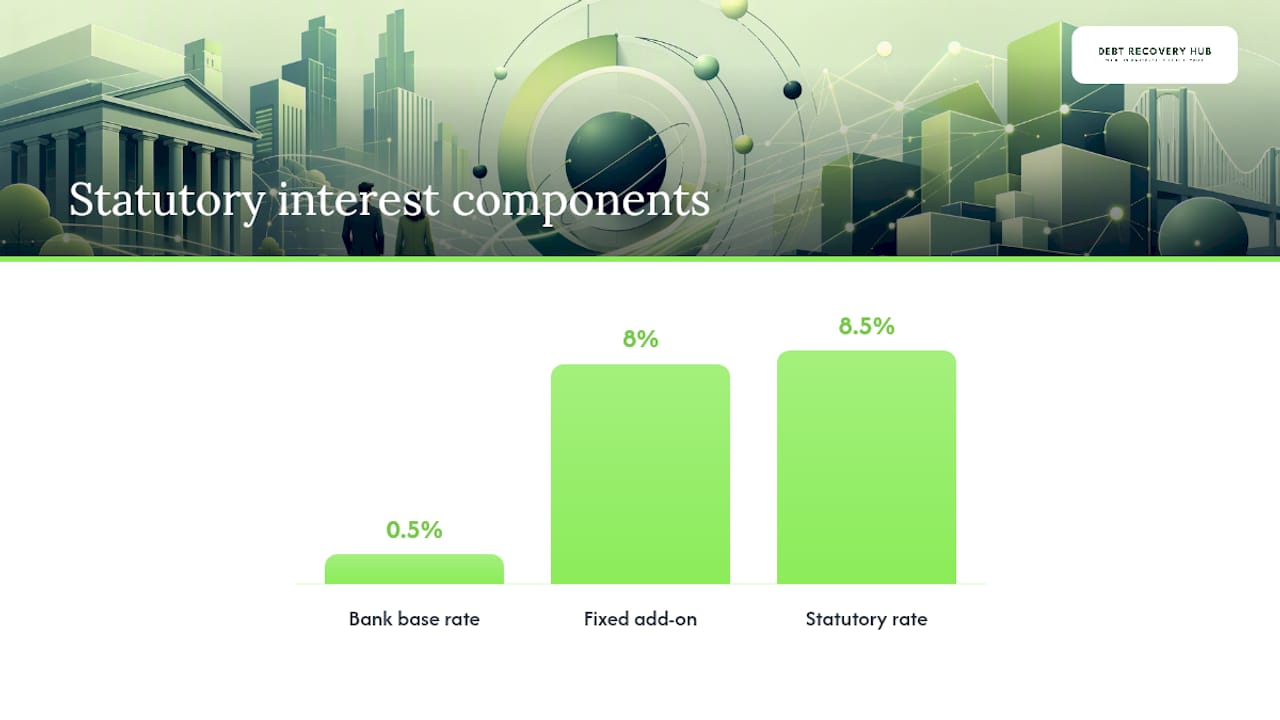
The rate isn’t fixed. It moves with the Bank of England base rate, but not continuously. The Small Business Commissioner’s guidance confirms the applicable base rate is locked in twice a year: the rate in force on 31 December applies for the first half of the following year, and the rate on 30 June applies for the second half. Using today’s rate on a debt from six months ago is a common and avoidable mistake.
Work through it like this:
- Identify which half of the year the due date falls in, and take the base rate from the relevant lock-in date (31 December or 30 June).
- Add 8% to that base rate to get your annual statutory interest rate.
- Apply that annual rate to the total invoice amount, including VAT, as the Small Business Commissioner recommends.
- Divide by 365 to get a daily figure, then multiply by the number of days overdue.
| Element | Figure |
|---|---|
| Debt amount | £1,000 |
| Base rate | 0.5% (Bank of England base rate) |
| Statutory rate (8% + base) | 8.5% |
| Annual interest | £85 |
| Daily interest | around twenty-three pence per day |
You can claim statutory interest for a substantial period after the due date, so an old unpaid invoice isn’t necessarily a lost cause.
Wording templates for contracts, invoices and reminders
Copy-paste wording only works if it’s placed correctly. Here’s what fits where.
Contract clause (statutory right):
“In the event of late payment, the Supplier reserves the right to charge statutory interest under the Late Payment of Commercial Debts (Interest) Act 1998, together with fixed compensation for recovery costs.”
Contract clause (substituted remedy, use with caution): if you want to set your own rate instead of the statutory one, you need wording that offers a genuinely comparable remedy, not a punitive one:
“Late payments will incur interest at [X]% per annum, representing a reasonable pre-estimate of the Supplier’s likely loss, in substitution for statutory interest under the 1998 Act.”
Invoice footer template:
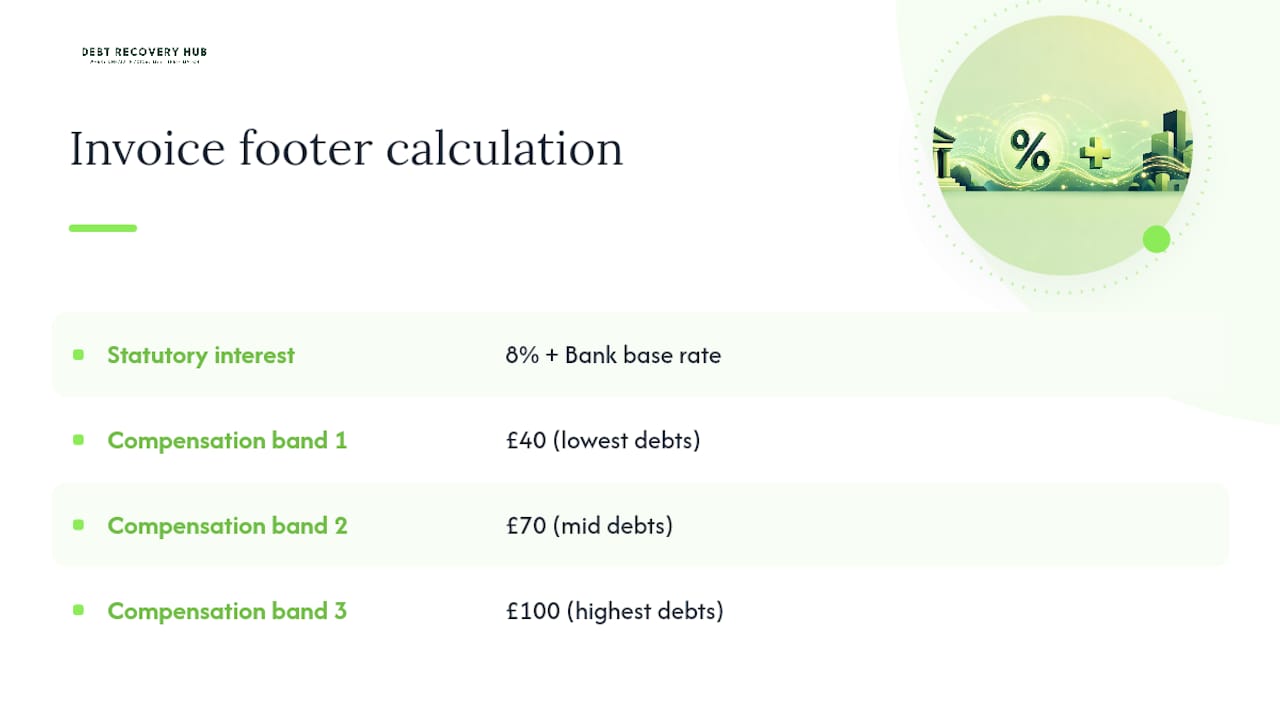
“Payment due within 30 days. Late payment will incur statutory interest at 8% plus the Bank of England base rate, plus fixed compensation of £40, £70 or £100 depending on debt value, under the Late payment common framework.”
First reminder: “Our records show Invoice #[number] remains unpaid, [X] days past the due date of [date]. Please arrange payment promptly to avoid statutory interest charges.”
Final notice: “Despite previous reminders, Invoice #[number] remains unpaid. We will now issue a separate invoice for statutory interest and compensation under the 1998 Act.”
Pro Tip: Never bury interest charges inside the original invoice total. Courts and clients both respond better when the calculation is shown separately and transparently, which is also what the Small Business Commissioner recommends.
How do you issue interest and compensation correctly?
Getting the wording right means nothing if the administration is sloppy. Follow a consistent process every time:
- Issue a separate interest invoice rather than adding a line to the original. This keeps VAT and reconciliation clean and makes the claim unambiguous.
- Reference the original invoice number and its due date directly on the interest invoice.
- Show your working: days overdue, the base rate used, the resulting annual rate, and the total interest owed.
- Add the correct fixed compensation tier, £40 for debts under £1,000, £70 for £1,000 to £9,999.99, or £100 for £10,000 and above, per GOV.UK’s framework.
- Keep a dated copy of every reminder and invoice sent. It matters if the case ends up in court.
What are the legal limits on late payment interest clauses?
A contract can only override statutory interest if it offers a “substantial remedy”. That’s a legal test, not a marketing phrase. The alternative remedy has to genuinely compensate the creditor to a similar degree, or the exclusion clause risks being struck out entirely, restoring the statutory rate anyway.
This is also where bespoke penalty clauses come unstuck. Setting a punishing interest rate to deter late payment sounds appealing, but legal practitioners warn that clauses designed to punish rather than compensate can be ruled unenforceable penalties. A defensible rate has to look like a reasonable pre-estimate of loss.
If a debtor disputes your interest charge:
- Send a written rebuttal referencing the 1998 Act and your calculation method.
- Offer mediation for disputes where the relationship is worth preserving.
- Consider the small claims track for debts under £10,000.
- Remember the six-year time limit on claiming statutory interest.
Practical tips for using late payment wording without losing clients
Consistency does more work than aggression. A staged cadence, a gentle reminder at 7 days, a firmer one at 15, formal notice at 30, and interest applied at 45, signals professionalism rather than personal frustration.
Building this into your standard Terms of Business, rather than deciding case by case, depersonalises enforcement. It’s just policy, not a judgement on the client.
Pro Tip: If a debtor stops responding to reminders altogether, that silence is usually the clearest signal to stop chasing yourself and bring in professional support.
Why wording discipline changes recovery outcomes
Vague invoice terms invite vague excuses. When wording spells out the exact rate, the legal basis, and the compensation owed, debtors have far less room to argue they didn’t know the consequences of paying late.
Cases with clear, consistent interest wording tend to arrive in better shape, with fewer disputes over amounts owed and cleaner paper trails. The platform’s role is narrower than giving legal advice. It matches businesses and individuals with vetted collection agencies based on the debt’s type, age, and value, so that when wording and reminders alone haven’t worked, the handover to a professional is faster and better informed.
Good wording buys you leverage. It doesn’t replace the need to act when that leverage runs out.
— Jack
When wording and reminders aren’t enough
Templates and statutory interest clauses solve most late payment problems. Some debts don’t respond to either, a debtor who’s gone quiet, a dispute that’s dragged past 90 days, or an invoice large enough that chasing it yourself isn’t worth the time it eats up.

At that point, it becomes practical to gather the details of your case—debt type, amount, age, and location—and seek to be matched to agencies vetted for exactly that kind of recovery. In practice, that means:
- You submit case details once instead of repeating them to multiple agencies.
- You get matched with agencies suited to your specific debt type and value, not a generic shortlist.
- The handover to the collection agency is faster because the groundwork is already done.
If a debtor has stopped responding to your interest invoice and final notice, visit the debt collection page to see how the matching process works and start your case.
Sources
- Late Payment of Commercial Debts (Interest) Act 1998
- Gov
- Interest Calculator guidance — Small Business Commissioner
- Practical implications of penalty clauses — Pinsent Masons
This article is general information, not a substitute for advice from a qualified financial advisor. Consult a qualified financial professional about your own circumstances before acting on anything here.
FAQ
How do I word an interest clause for late invoices?
State the statutory basis directly: “Statutory interest of [rate]% applies from [date] under the Late Payment of Commercial Debts (Interest) Act 1998,” and reference the original invoice number on a separate interest invoice.
What is the acceptable late payment fee in the UK?
Fixed compensation is £40 for debts under £1,000, £70 for debts between £1,000 and £9,999.99, and £100 for debts of £10,000 or more, with additional reasonable recovery costs claimable if they exceed those sums per GOV.UK’s framework.
What are the new late payment rules in the UK?
The core statutory right, 8% plus the Bank of England base rate, remains the standing rule under the 1998 Act; always check GOV.UK for the current base rate and any framework updates before invoicing.
Can I charge my own interest rate instead of the statutory one?
Only if your contract offers a substituted remedy that’s a genuinely reasonable pre-estimate of loss; punitive rates risk being struck out as unenforceable penalties.