



In the UK, most recruitment fee disputes turn on whether the agency was the effective cause of the hire, not who sent the CV first. Protect your position by preserving every record of contact, checking whether your terms of business were properly incorporated before the introduction, opening a factual dialogue with the other side, and taking specialist advice early if the sum at stake justifies it.
TL;DR:
- Most UK recruitment disputes focus on whether the agency was the effective cause of the hire, not who first sent the candidate’s CV.
- Quickly exporting logs, email threads, and interview records within two weeks strengthens an agency’s legal position before disputes escalate.
- Effective cause involves demonstrating active efforts like arranging interviews and managing negotiations, rather than just the first introduction.
- Evidence should include original CV timestamps, email chains, ATS activity, and documented interactions to prove involvement convincingly.
- Securing written acceptance of clearly drafted terms of business before candidate introductions reduces dispute risk and clarifies qualifying periods.
Table of Contents
- What to do in the first 7 to 14 days of a disputed fee
- What the effective cause principle means in practice
- Back-door hires, fee fights and timing disputes
- Building the evidence that proves you were the effective cause
- Terms of business: drafting to reduce dispute risk
- Negotiation, mediation and litigation: choosing the right route
- How fee structures and disputes vary by sector
- Where third-party agencies fit into fee disputes
- Legal remedies beyond the effective cause test
- Author perspective: lessons from handling recruitment fee disputes
- When a specialist recovery partner helps with fee recovery
- Sources
- FAQ
What to do in the first 7 to 14 days of a disputed fee
Speed matters. The longer you wait to lock down your paper trail, the weaker your position becomes if the case ends up in front of a solicitor or a judge.
- Export everything now. Pull ATS logs, the full email thread, CV attachments with their original timestamps, and calendar invites for interviews.
- Build a bare timeline. Note the date of first introduction, each interview, the offer date, the confirmed start date, and the invoice due date.
- Send a short factual notice. Ask the client or rival agency to clarify their position, without accusing anyone of bad faith at this stage.
- Decide whether to write it off or escalate. If the fee is small and the evidence thin, a write-off may cost less than pursuing it. If the sum is substantial and your paper trail is solid, escalate to a specialist rather than letting it drift.
Pro Tip: Screenshot ATS entries the day you notice a dispute brewing. ATS records can be edited or overwritten by client-side users with admin access, so a static export dated at the point of dispute carries far more weight later.
What the effective cause principle means in practice
UK courts consistently reject a strict “first to introduce” rule. Instead, they ask which agency’s efforts actually and substantially brought about the hire, a test known as effective cause. Sending a CV first counts for little if another agency then did the real work of getting the candidate hired.
Activity that tends to demonstrate effective causation includes:
- Arranging and coordinating interviews between candidate and client
- Negotiating salary, start date, or contract terms on the candidate’s behalf
- Managing the process end to end, including feedback loops and offer handling
- Maintaining a live, documented relationship with the candidate right up to placement
Contracts often try to shortcut this test with clauses stating that any introduction within a set period triggers a fee regardless of who closed the deal. Courts will look at these clauses, but they will not automatically override a genuine effective cause argument if the facts point elsewhere. Drafting can shift risk. It cannot rewrite what actually happened.
Back-door hires, fee fights and timing disputes
Most disputes fall into a small number of recognisable patterns, and knowing which one you’re in shapes your entire strategy.
- Back-door hires. The client hires a candidate directly, sometimes after a short cooling-off period, apparently to sidestep the agency fee entirely.
- Fee fights. Two agencies both introduced the same candidate, often through different routes, and both claim to be the effective cause.
- Timing disputes. The client argues the hire falls outside the qualifying period, commonly six months from introduction, or that the role or engagement type (permanent versus contractor) differs from what was originally introduced.
Back-door hires are the most emotionally charged and the hardest to prove, because the client has every incentive to claim they “always knew” the candidate or found them through another route. Fee fights, by contrast, often resolve faster once both agencies compare timelines side by side.
Building the evidence that proves you were the effective cause
The paper trail decides most of these disputes long before anyone sets foot in a courtroom. A clear, chronological export from your ATS and mailbox, annotated with dates and context, is what negotiators and courts find genuinely persuasive.
Records worth assembling:
- CVs with original send timestamps, not re-saved copies
- The full email thread, including internal notes if they show your involvement
- ATS entries showing status changes at each stage
- Calendar invites for interviews you arranged
- Interview notes and any feedback you relayed between parties
- Offer correspondence and confirmation of start date
Two weaknesses show up again and again. Agencies send speculative CVs before the client has accepted terms of business, which undermines the incorporation argument later. And agencies rely on vague, undated notes rather than a proper chronology, which makes the timeline look assembled after the fact rather than contemporaneous.
Pro Tip: Number every document in your bundle and cross-reference it against your timeline. A solicitor reviewing a scattered folder of emails will charge you for the hours it takes to reconstruct what you could have organised in twenty minutes.
Terms of business: drafting to reduce dispute risk
Binding terms only work if the client actually accepted them before the introduction happened, and that single point causes more disputes than almost anything else.
Clauses worth including:
- A clear qualifying period, defining how long after introduction a hire still triggers a fee
- Wording that addresses back-door hires and substitution, closing the obvious loophole where a client waits out a short window
- Rebate or replacement clauses that set out what happens if a placed candidate leaves early
Incorporation matters as much as the wording itself. Present your terms of business before sending any CVs, not after. Ask for written acceptance or a signature, and follow up with an email that records that acceptance in plain terms, since a verbal nod or an unread attachment rarely holds up if challenged. Practitioners consistently flag that speculative CVs sent without prior acceptance of terms weaken an agency’s position from the outset.
One caveat: fee clauses drafted as a deterrent rather than a genuine pre-estimate of loss risk being struck down as unenforceable penalties. If you’re setting a punitive back-door fee, get it drafted by someone who understands penalty clause law, not a template you found online.
Negotiation, mediation and litigation: choosing the right route
Most disputes never reach a courtroom, and that’s usually the right outcome for everyone involved.
- Negotiate first. Present your timeline plainly, propose a staged settlement if cash flow is the client’s real objection, and keep the tone factual rather than adversarial.
- Consider mediation. Courts actively encourage it, and legal commentary consistently notes that settlement often beats litigation on cost and certainty alike.
- Escalate to litigation only when needed. Small claims suits fit smaller, well-evidenced sums; the county court handles larger or more contested cases. To succeed, you must prove a valid contract was incorporated, that you provided the services described, and that the client refused payment, and that’s a meaningfully higher evidential bar than most agencies expect going in.
Instruct a solicitor once the sum owed clearly outweighs likely legal costs, or once the client stops responding altogether.
How fee structures and disputes vary by sector
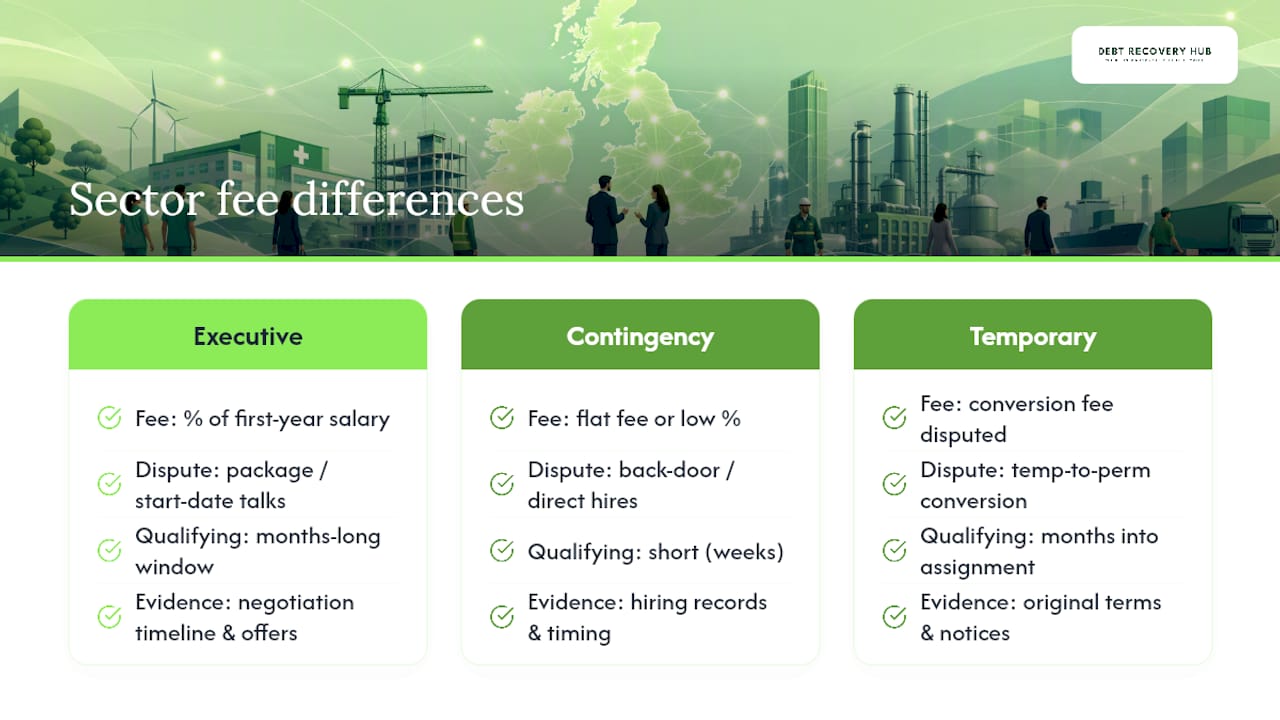
Recruitment fee disputes don’t look the same across every sector, and that shapes both the risk and the right response.
In executive search and senior technical hiring, fees are usually a percentage of first-year salary, often between moderate and high percentages, and the sums at stake are large enough that clients fight harder and lawyers get involved sooner. Effective cause arguments in this space often hinge on protracted negotiation over package and start date, which agencies handle personally over months rather than weeks.
Contingency recruitment in high-volume sectors like retail, hospitality, and warehousing tends to run on flat fees or lower percentages, and back-door hires are far more common because the financial incentive to sidestep the agency is proportionally bigger relative to the fee itself. Qualifying periods in these sectors are often shorter, sometimes just a few weeks, because turnover is naturally higher.
Temporary and contractor placements bring a different problem entirely: the dispute often isn’t about who introduced the worker but whether a temp-to-perm conversion triggers a separate fee, and whether that fee was clearly set out in the original terms. IT and engineering contracting sees this constantly, because clients frequently convert a contractor to permanent staff months into an assignment and assume the original agency relationship has simply lapsed.
Understanding which category your placement falls into helps you predict how the other side will argue and what evidence will actually move the conversation.
Where third-party agencies fit into fee disputes
Fee fights almost always involve a third agency somewhere in the chain, whether that’s a rival contingency firm, a subcontracted sourcing partner, or an RPO provider working alongside the client’s in-house team.
When two agencies both claim the same placement, the client is often caught in the middle and simply wants clarity on who to pay. That puts pressure on both agencies to produce their timeline quickly, and the agency that responds with a clean, dated evidence bundle usually gets taken more seriously than the one still gathering documents a week later. Where a placement moved through a subcontracted arrangement, such as one agency introducing a candidate to a master vendor who then presented them to the end client, the effective cause analysis has to trace the whole chain, not just the final introduction.
This is also where automated record-keeping earns its cost. Tools built around recruitment automation that log every candidate interaction automatically make it far easier to produce the kind of timestamped evidence courts want, rather than reconstructing a timeline from memory once a dispute has already started.
Legal remedies beyond the effective cause test
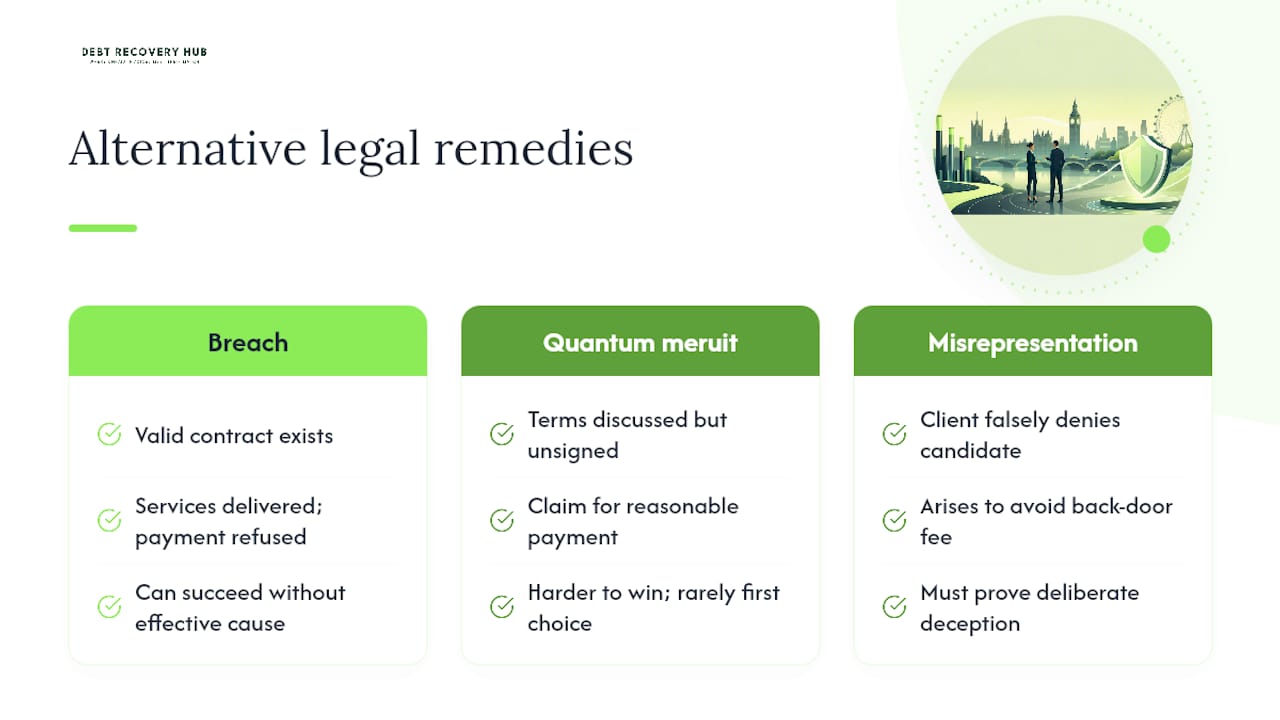
Effective cause dominates the case law, but it isn’t the only route to recovery, and other legal principles come into play depending on the facts.
Where a valid contract exists and its terms were properly incorporated, a straightforward breach of contract claim can succeed even without a detailed effective cause argument, provided you can show the services were delivered and payment was refused. Quantum meruit, a claim for reasonable payment for work done even without a fully agreed contract, occasionally surfaces where terms were discussed but never formally signed, though it’s a harder argument to win and rarely the first choice. Misrepresentation claims can arise where a client falsely denies knowledge of a candidate to avoid a back-door hire fee, though proving deliberate deception rather than genuine confusion is difficult.
Beyond individual case outcomes, wider international guidance from the ILO on recruitment fees shows how differently jurisdictions treat these costs, useful context for agencies operating across borders, though it addresses labour policy rather than UK contract law. For most UK disputes, the practical remedy remains the same: prove incorporation, prove effective cause or breach, and negotiate before litigating.
Author perspective: lessons from handling recruitment fee disputes
The pattern that repeats most often isn’t a weak legal argument. It’s a missing paper trail. Agencies lose winnable disputes because they never wrote down the moment terms were accepted, then find themselves arguing effective cause with nothing but memory to back it up. Document early, negotiate honestly, and litigate only when the numbers justify it.
— Jack
When a specialist recovery partner helps with fee recovery
A specialist recovery partner is the practical next step when negotiation has stalled and the sum owed justifies bringing in expert help rather than absorbing the loss. A recruitment-specific recovery approach investigates back-door hire allegations, assembles ATS logs and correspondence into a proper evidence bundle, and negotiates directly with the client before any referral to legal action, which matters because generic debt collection methods rarely understand effective cause arguments the way a recruitment-focused partner does.

Specialist services connect agencies with vetted debt collection specialists matched to the specific type, size, and age of the debt, so you’re not gambling on whichever generic agency answers the phone first. Deciding whether to use a specialist usually comes down to a simple comparison: the cost of recovery against the size of the fee you’re chasing. If your evidence is solid and the sum is meaningful, start by reviewing debt collection options suited to recruitment disputes, or explore recruitment-specific recovery routes built around exactly this kind of case.
Sources
For deeper detail on the legal test itself, read Sherrards on the effective cause principle and Menzies Law’s breakdown of common dispute scenarios. For step-by-step recovery guidance, see Debtrecoveryhub’s guide to backdoor hire recovery and general advice on recovering unpaid invoices.
- Navigating Recruitment Agency Fee Disputes: The Effective Cause Principle – Sherrards
- Blog: Recruitment agency fee disputes – Menzies Law
- Recruitment Agency Fees: How to Resolve Disputes Over Unpaid Fees – Richardson Lissack
- Global study on recruitment fees and related costs: Second edition – ILO
FAQ
What are typical recruitment fees in the UK?
Fees vary widely by sector, from flat rates in high-volume contingency recruitment to percentages of first-year salary, often 15 to 25%, in executive and specialist search.
How can clients avoid recruitment agency fees legitimately?
Read and understand terms of business before any CV is shared, agree a clear qualifying period upfront, and avoid hiring a previously introduced candidate through an informal or delayed route, since that’s exactly what back-door hire clauses are designed to catch.
Who can I complain to about a recruitment agency?
You can raise a formal complaint directly with the agency first, and if that fails, contact the Recruitment and Employment Confederation or seek independent legal advice on your specific contract terms.
What should I do if a client is refusing to pay my agency fee?
Preserve your evidence immediately, send a clear written notice setting out the timeline and amount owed, and consider negotiation or mediation before litigation, escalating to a specialist recovery route such as Debtrecoveryhub’s services if talks stall.