


In England and Wales, you generally have six years from the invoice’s due date to start a court claim before the debt becomes statute-barred. Scotland typically applies a five-year period, and Northern Ireland mirrors the six-year rule. A part payment or a signed acknowledgement can restart that clock, but once a debt is genuinely statute-barred, no later payment or promise brings it back to life.
TL;DR:
- The limitation period for enforcing unpaid invoices is six years in England and Wales, five years in Scotland, and six years in Northern Ireland, starting when payment is due.
- A debt cannot be revived after it becomes statute-barred, even if the debtor makes a partial payment or writes an acknowledgment; only timely written recognition can restart the clock.
- Proper documentation, such as signed acknowledgments or specific partial payments, is crucial to preserve the ability to enforce a debt within the limitation period.
- Court actions must be initiated before the limitation period expires; once elapsed, enforcement is impossible, but informal requests for payment remain lawful.
- Connecting with specialized collection agencies through matching services is advisable for debts still within the enforceable time frame, especially when dealing with cross-border or disputed cases.
Table of Contents
- What does “statute-barred” actually mean for your invoice?
- How long is the limitation period across the UK?
- When does the clock actually start ticking?
- Can a part payment or a promise restart the limitation clock?
- What to do right now if an old invoice is unpaid
- What happens once a debt is statute-barred?
- When your claim is still live: matching with the right recovery route
- Editorial perspective: when chasing an old invoice is worth it
- Get your enforceable invoices moving before the clock runs out
- Sources
- FAQ
What does “statute-barred” actually mean for your invoice?
A limitation period is the window the law gives you to sue someone for money they owe you. Miss it, and the debt does not disappear. It simply becomes unenforceable through the courts, meaning the debtor still owes you, but a judge will refuse the claim if you try to enforce it.
That distinction trips people up constantly. Business owners assume a statute-barred debt is written off entirely, so they stop chasing it and sometimes even write it off in their accounts before checking whether it might still be collectable through negotiation.
Three things worth knowing before you go further:
- The debt remains morally and technically owed, even though a court won’t enforce it.
- You can still ask for voluntary payment, but you cannot threaten legal action to get it.
- Writing off an unenforceable debt for tax purposes has its own rules, so check with your accountant before assuming you can simply claim the loss.
Pro Tip: Don’t assume every old invoice is dead. Some debtors pay statute-barred debts anyway, particularly if the relationship matters to them or they didn’t realise the time limit had passed.
How long is the limitation period across the UK?
The clock varies depending on which nation’s law governs your contract, and that detail catches out plenty of businesses trading across borders within the UK itself.
- England and Wales: The limitation period is six years from when the cause of action accrues, under Limitation Act 1980, section 5. This applies to most simple contract debts including standard commercial invoices.
- Scotland: The typical limitation period is five years under the Prescription and Limitation (Scotland) Act 1973, operating under the legal concept of negative prescription which differs in mechanics and some triggering events from other UK regions.
- Northern Ireland: Generally follows the six-year limitation approach similar to England and Wales.
Which regime applies isn’t always obvious. If your contract includes a governing law clause, that clause usually decides. Without one, courts look at where the contract was made, where the goods or services were delivered, and where the parties are based. If you regularly invoice clients north of the border, it’s worth checking your terms and conditions state which law governs the agreement, because assuming English rules apply to a Scottish debtor can mean you miscalculate your deadline by a full year.
When does the clock actually start ticking?
The general rule is straightforward: the limitation period starts when payment becomes due, not when you issued the invoice or completed the work. For a standard invoice with 30-day payment terms, the limitation period generally starts on the day payment becomes due, which is shortly after the invoice date.
Three common scenarios cause confusion:
- A single invoice with fixed terms. Say you invoice on 1 March 2026 with 30-day terms. Payment falls due on 31 March 2026, and that’s your accrual date. The limitation period runs to 31 March 2032.
- Ongoing supply or project work. Each invoice for each delivery or milestone typically has its own accrual date. If you supplied goods monthly across a two-year contract, the invoice from month one may become statute-barred years before the invoice from month twenty-four, even though they relate to the same commercial relationship.
- Instalment agreements. Where a debtor agreed to pay in instalments, each missed instalment can trigger its own “appropriate date” for limitation purposes, rather than the whole balance accruing on one date.
That last point matters enormously for businesses with long-running client relationships. One insight from the Small Business Commissioner is worth repeating here: a later payment against a later invoice does not automatically preserve your right to claim on an earlier, unrelated invoice unless there’s clear evidence the payment was linked to that older debt.
Can a part payment or a promise restart the limitation clock?
Yes, and this is where a lot of creditors either give up too early or rely on evidence that won’t hold up in court. Under the acknowledgment and part payment provisions of the Limitation Act, a fresh accrual date can be triggered by either a part payment or a written acknowledgement of the debt.
What actually counts as a valid acknowledgement is narrower than most people expect:
- A signed letter admitting the debt is owed.
- A signed email from someone with authority to speak for the debtor, explicitly confirming the amount owed.
- A part payment made against the specific invoice or debt in question, with a clear paper trail.
Vague verbal promises rarely count. Practitioners consistently find that oral assurances like “we’ll sort it soon” don’t meet the statutory bar; courts want something written, attributable to a real person, and specific about the debt. An email from an accounts department admitting the balance and proposing a repayment plan is far stronger evidence than a phone call you noted down yourself.
There’s a hard limit here too: a debt that has already gone statute-barred cannot be revived by any later acknowledgement or payment. If the six years has run out, a debtor who then emails admitting they owe you the money does not reopen your right to sue. The Limitation Act is explicit on this point.
Pro Tip: Keep every acknowledgement in writing and dated. If a debtor calls to admit the debt, follow up with an email summarising the call and ask them to confirm. That single habit can add years back onto your limitation clock.
What to do right now if an old invoice is unpaid
If you’ve got an invoice sitting unpaid and you’re not sure how much runway you have left, work through this in order.
- Pull together your paperwork first. Gather the original invoice, the underlying contract or purchase order, all dated correspondence, and any bank records showing partial payments. The Small Business Commissioner treats this record-keeping as the primary defence against losing your right to recover a debt, and it’s the first thing any solicitor or agency will ask for.
- Send a formal letter before action. This is a standard pre-litigation step that sets out the debt, the amount owed, and a deadline to pay before you escalate. It also creates a clear paper trail showing you were actively pursuing the claim, which matters if timing ever becomes contentious.
- Weigh up small claims versus a full County Court claim. Claims up to £10,000 in England and Wales typically go through the small claims track, which is cheaper and less formal. Larger or more complex claims may need the standard County Court process, with higher court fees and more procedural steps.
- Check your realistic timeline. Issuing a claim is quick, often within days once your paperwork is ready, but service on the debtor and any defended hearing can add weeks or months. If your limitation period will expire soon, avoid leaving the paperwork until the last moment.
- Plan for enforcement if you win. A judgment isn’t the same as getting paid. If the debtor doesn’t settle voluntarily after a court order, you may need to consider enforcement options such as a warrant of control or third-party debt order.
Pro Tip: If you’re within six months of the limitation deadline and haven’t yet issued proceedings, treat it as urgent. Courts don’t extend limitation periods for creditors who simply ran out of time to prepare.
Gov.uk’s late payment guidance also sets out expected payment terms for commercial contracts, which is useful context if you’re deciding whether to claim statutory interest alongside the principal debt.
What happens once a debt is statute-barred?
Once the limitation period expires, your legal options narrow sharply. You cannot issue a court claim, and you cannot obtain a County Court Judgment to enforce the debt. Any attempt to threaten court action for a barred debt is not just pointless, it can expose you to a complaint for harassment or misleading debt collection practice.
What you can still do:
- Approach the debtor informally and ask for voluntary payment, without any threat of legal enforcement.
- Negotiate a reduced settlement, since some debtors would rather pay something than have the matter hanging over them.
- Write the debt off for accounting purposes, though the tax treatment depends on your circumstances and is worth confirming with your accountant.
Statutory interest and compensation under late payment rules follow the same limitation clock as the principal debt. If the underlying invoice is statute-barred, any interest that accrued on it is barred too. There’s no separate, longer window for claiming interest after the main debt has expired.
When your claim is still live: matching with the right recovery route
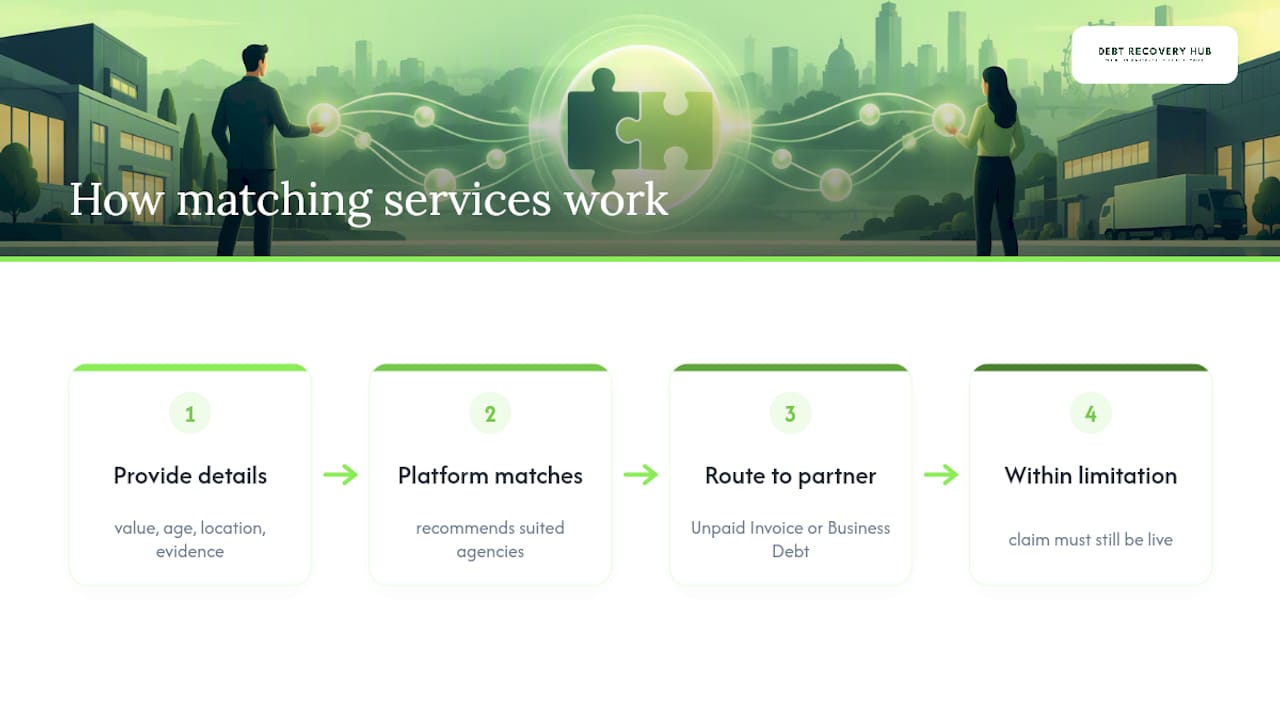
If your invoice sits within the limitation period, the practical challenge shifts from “can I claim?” to “who’s best placed to recover it?” That’s where a matching service earns its keep. Debtrecoveryhub connects businesses and individuals with vetted collection agencies chosen against the specific debt type, amount, age, and location involved, rather than leaving you to cold-call agencies and hope one fits.
That matters most for debts with some complexity: cross-border elements, disputed amounts, or a debtor who’s gone quiet. Where the law itself is uncertain, such as borderline accrual dates or a contested acknowledgement, get legal advice before committing to a recovery route. A matching platform speeds up finding the right agency; it doesn’t replace a solicitor’s judgment on a genuinely disputed limitation question.
Editorial perspective: when chasing an old invoice is worth it
Pursuing an ageing invoice only makes sense when the maths works in your favour. Strong written evidence, a debtor who’s still solvent and trading, and a debt comfortably within the limitation window all tip the balance towards action.
The opposite combination, thin paper trail, a debtor showing signs of insolvency, and a claim edging close to six years old, usually means your time is better spent elsewhere. Recovery costs money and attention even when you win, and a judgment against a company with no assets is worth exactly nothing. Running your unpaid invoices through a proper triage process before committing to legal costs saves far more than it costs, because it forces you to be honest about which debts are actually collectable rather than which ones simply annoy you the most.
— Jack
Get your enforceable invoices moving before the clock runs out
There are other routes here, chasing the debtor yourself, instructing a solicitor directly, or simply writing the invoice off, but each has a real cost in time, legal fees, or lost revenue. A matching service can help by connecting you with collection agencies based on the debt’s type, amount, age, and location, rather than leaving you to guess which agency suits your case.

At intake, you’ll provide the details that matter, invoice value, how long it’s been outstanding, the debtor’s location, and any evidence of acknowledgement or part payment. The platform uses those details to recommend agencies suited to your specific case rather than a generic shortlist. This works best for claims still within the limitation period, particularly commercial debts, corporate recoveries, or cases with a cross-border element that need specialist handling. Where the legal position is genuinely unclear, get advice from a solicitor first; the platform is built to route you to the right recovery partner once you know your claim is still live.
If your invoice is enforceable now, start with Unpaid Invoice Recovery or, for larger commercial claims, Business Debt Recovery, and get matched with an agency built for your specific case.
Sources
For the primary legal text, see the Limitation Act 1980 on legislation.gov.uk, and the Prescription and Limitation (Scotland) Act 1973 for Scottish cases. For practical guidance, consult gov.uk’s late payment framework and the Small Business Commissioner.
This article is general information, not a substitute for advice from a qualified lawyer. Consult a qualified legal professional about your own circumstances before acting on anything here.
- Limitation Act 1980, section 5
- Limitation Act 1980 — acknowledgment and part payment
- Small Business Commissioner — interest calculator guidance
- Gov
FAQ
How long do you legally have to pay an invoice in the UK?
There’s no single statutory deadline for paying an invoice; it depends on the payment terms agreed between the parties. Gov.uk’s late payment guidance notes that commercial enterprises can generally expect payment within 60 days unless a different term was agreed, and public authorities are expected to pay within 30 days.
Can a 20-year-old debt be collected in the UK?
Almost certainly not through the courts. Under the Limitation Act 1980, most simple contract debts become statute-barred after six years in England and Wales, so a debt that old cannot be enforced through legal action. You can still ask the debtor to pay voluntarily, but you cannot threaten court proceedings.
What is the statute of limitations for invoices in the UK?
In England and Wales, it’s generally six years from the invoice’s due date under Limitation Act 1980, section 5. Scotland typically applies a five-year period, and Northern Ireland follows the six-year approach used in England and Wales.
What is the six-year debt rule in the UK?
The six-year rule refers to the general limitation period under the Limitation Act 1980 for simple contract debts, including most unpaid invoices, running from when payment first became due. Once six years pass without a claim being issued or the clock being restarted by a written acknowledgement or part payment, the debt becomes unenforceable in court.
Does Debtrecoveryhub help with invoices close to the limitation deadline?
Yes, Matching services can connect businesses with collection agencies suited to pursuing invoices that remain within the limitation period. Where the deadline is genuinely close or disputed, get legal advice first to confirm your claim is still live before starting the recovery process.