



Recovering a debt from an overseas debtor is often possible, but success depends heavily on jurisdiction, the debtor’s assets, and how well you’ve documented the claim. If the debt is recent and undisputed, send a formal demand within days. If it’s aged or the debtor disputes it, gather your evidence first and speak to a specialist before you act. Remedies like the European Account Preservation Order, freezing orders, and judgment recognition may come into play later, but only if you’ve moved fast enough to protect them.
TL;DR:
- Moving quickly and gathering comprehensive evidence greatly increases the chances of successful cross-border debt recovery before assets are moved or the statute of limitations expires.
- The jurisdiction and law clauses in contracts, along with local limitation periods, determine the legal approach and timing for enforcement actions in each country.
- Legal remedies such as the European Account Preservation Order enable swift freezing of bank assets within the EU, but enforcement relies on identifying and targeting specific accounts.
- For debts under a few thousand pounds, settling amicably or engaging local agents often costs less and takes less time than formal court procedures abroad.
- Using an automated matching platform with case details reduces guesswork and speeds up connecting with suitable recovery specialists in relevant jurisdictions.
Table of Contents
- What is the process for overseas debtor recovery?
- What legal remedies exist for cross-border debt enforcement?
- What documents and evidence do I need before acting?
- When should you bring in a specialist recovery partner?
- How long does overseas debt recovery take, and what does it cost?
- How Debtrecoveryhub helps you find the right recovery partner
- What actually determines success in overseas debt recovery
- Ready to start recovering an overseas debt?
- Where to check the legal detail yourself
- Sources
- FAQ
What is the process for overseas debtor recovery?
Speed matters more than most creditors realise. Delay lets debtors move money, dissolve companies, or simply disappear, and it can also erode your legal position if limitation periods start running out.
Start by classifying the debt. Is it disputed or undisputed? Is the debtor still trading, or has the business gone quiet? These two questions shape everything that follows.
- Make first contact. Use the debtor’s own language where possible, keep the tone firm but professional, and ask factual questions: has the invoice been received, is there a dispute, when can payment be expected?
- Send a formal written demand (letter before action). Include the amount owed, the original invoice or contract reference, a clear deadline, and a statement of intended next steps if payment isn’t made. Send it by a method that creates proof of delivery, such as tracked post or a read-receipt email.
- Decide whether to escalate. Check any jurisdiction or governing law clause in your contract, confirm the limitation period in the debtor’s country, and assess whether you have enough evidence to support a claim or an asset-preservation request.
A few practical checks before escalating:
- Does the contract specify which country’s courts have jurisdiction?
- Has the limitation period for this debt type already started running?
- Do you have enough paper trail to prove the debt is owed and undisputed?
Intrum’s guide to recovering commercial debt abroad recommends this same sequence: classify, document, diagnose the reason for non-payment, then demand formally before ever reaching for legal action. Settlement resolves far more overseas cases than litigation ever does, and it’s usually cheaper and faster.
What legal remedies exist for cross-border debt enforcement?
Once amicable contact fails, the legal toolkit becomes more technical, and choosing the right tool depends entirely on where the debtor and their assets sit.
Within the EU (except Denmark), the European Account Preservation Order lets a creditor freeze funds in a debtor’s bank account in another member state without giving prior notice. That surprise element is the whole point. It stops debtors moving money the moment they sense a claim is coming. Your Europe’s guidance on the EAPO sets out how to apply and how a debtor can later contest or appeal the order once it’s in place.
Regulation (EU) No 655/2014 governs the EAPO’s scope and safeguards. Courts can require the creditor to post security against wrongful use, and the order doesn’t apply to insolvency proceedings. It works best when you can point to a specific bank or account, even just a strong hint of one; a vague request for “any assets anywhere” tends to get far less traction.
Outside EAPO territory, freezing orders and worldwide injunctive relief remain available through domestic courts, but only once you’ve identified where the assets actually are. For recognition and enforcement of judgments, the Brussels Recast Regulation and the Lugano Convention cover much of Europe, while arbitral awards travel further thanks to the New York Convention, which is why arbitration clauses appeal to parties who expect enforcement difficulties from the outset.
None of this changes the underlying reality: a judgment or award only has value once it can be matched to a real, attachable asset. Jones Day’s analysis of global enforcement is blunt about this. Enforcement succeeds only where assets can be located and lawfully seized, so asset tracing has to run alongside, not after, any court process.

What documents and evidence do I need before acting?
Courts, specialist agencies, and asset-preservation applications all want the same core file, so build it early rather than scrambling once you’re under time pressure.
- The original contract or purchase order, including any jurisdiction or governing law clause
- Invoices, delivery notes, and proof of acceptance of goods or services
- A full communications log, including every chase, reply, and promise to pay
- Bank details for the payment that should have been made
- Any hints about the debtor’s own bank, such as an IBAN or BIC used in previous transactions
- Company filings or registry checks confirming the debtor still exists and trades
Check the limitation period that applies in the debtor’s jurisdiction, not your own; these deadlines vary widely, and missing one can end a legally sound claim before it starts. Preserve electronic records now, since emails, invoices, and system logs have a habit of disappearing when someone leaves a job or a server gets migrated.
Pro Tip: If you suspect the debtor is winding down or moving assets, commission a corporate intelligence check or asset trace before you send the formal demand, not after. Once a debtor knows you’re coming, evidence and assets both tend to move.
When should you bring in a specialist recovery partner?
Weigh the debt’s value against the realistic cost of chasing it. A £2,000 invoice rarely justifies foreign litigation, but it might justify a modest success-fee referral to a local agent who already knows the market.
Jurisdiction complexity, evidence gaps, and the age of the debt all push the decision toward specialist help. A debt that’s eighteen months old with a thin paper trail needs different handling than a fresh, undisputed invoice.
Providers generally fall into a few categories:
- Local collection agents who understand the debtor’s language, culture, and court system
- International recovery platforms that match cases to vetted local experts
- Law firms handling formal litigation or enforcement
- Arbitration specialists, useful where contracts include an arbitration clause
Pricing usually follows a success-fee model, a fixed quote for defined legal steps, or a mix of both. Complexity, disputed facts, and multiple jurisdictions all push fees higher. A decent international recovery service should offer local-language outreach, an honest enforceability assessment before you spend money on court action, and transparent reporting throughout.
How long does overseas debt recovery take, and what does it cost?
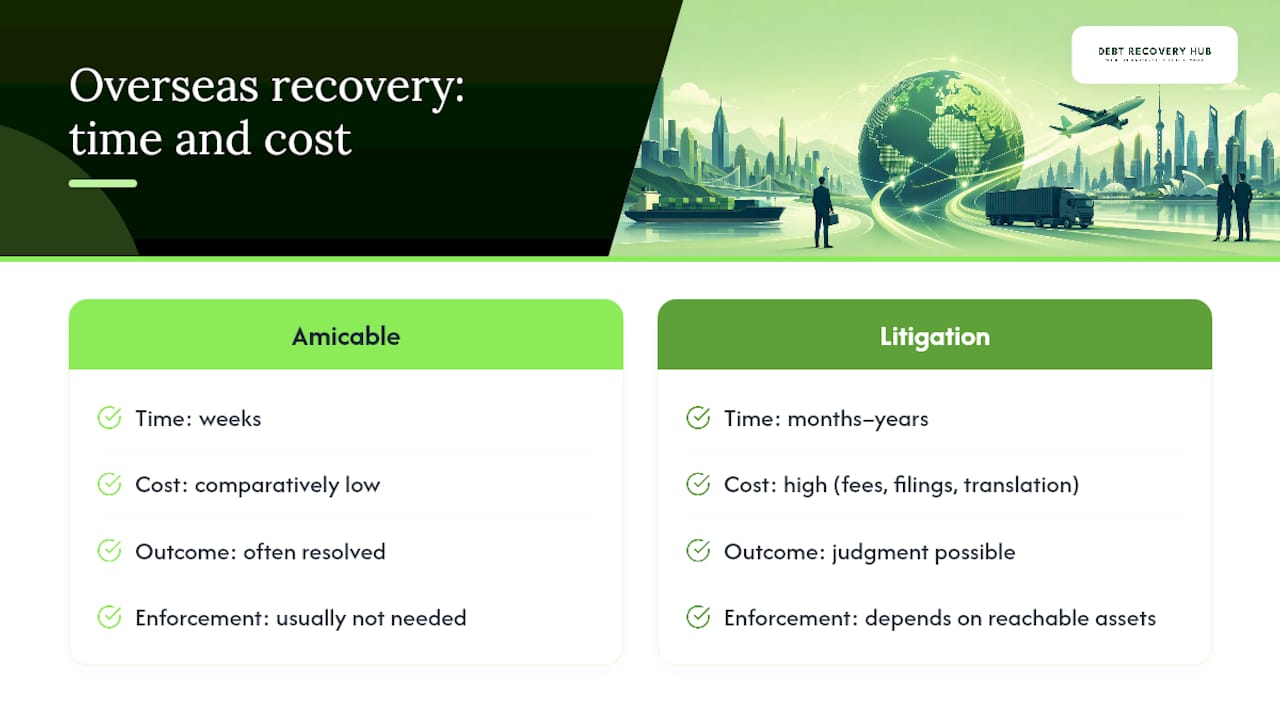
Amicable recovery, contact plus a formal demand, typically resolves within a matter of weeks and costs comparatively little. Many overseas disputes end here once the debtor realises you’re organised and serious.
Legal escalation is a different proposition entirely. Litigation or arbitration abroad can run from several months to a few years, with costs driven up by local counsel fees, translation, court filing costs, and separate enforcement proceedings once judgment is won.
That last point trips people up constantly: winning in court is not the same as getting paid. Enforcement depends entirely on whether the debtor has assets somewhere you can legally reach, which is why asset tracing and enforcement planning needs to start early rather than after you’ve already spent months in court.
Debt age matters just as much as legal strategy. The longer an invoice sits unpaid, the more a debtor’s circumstances, and their willingness to cooperate, tend to deteriorate.
How Debtrecoveryhub helps you find the right recovery partner
Chasing an overseas debtor alone often means guessing which agency actually handles your case type, your debt size, or your target country. A suitable platform can remove that guesswork by matching your case to vetted debt collection agencies based on debt type, amount, age, and location.
That matters most when the case is genuinely complicated: an aged invoice, a debtor in a jurisdiction you’ve never dealt with, or simply no existing local contacts to call. Rather than approaching agencies blind, you submit case details once and get matched with agencies suited to that specific situation, which tends to speed up the initial response and improve the odds of a properly handled recovery.
What actually determines success in overseas debt recovery
Every case I’ve looked into comes back to the same two factors: how early the creditor moved, and how solid their paperwork was. Businesses that wait months before sending a formal demand consistently do worse, regardless of how strong their legal position looked on paper.
The mistakes are predictable. Creditors delay because international recovery feels intimidating, they chase with weak or informal evidence, or they pursue the wrong jurisdiction entirely because nobody checked the contract clause first. An evidence-first approach beats an aggressive one every time, and knowing when to hand a case to a specialist is a skill in itself, not an admission of failure.
— Jack
Ready to start recovering an overseas debt?
If you’ve read this far, you already know the two things that matter most: acting quickly and having your paperwork in order. What you don’t need is to spend weeks researching agencies one by one, hoping you’ve picked one that actually handles your debt type and your debtor’s country. An alternative to that guesswork is to submit your case details once, covering debt type, amount, age, and location, and get matched with vetted agencies suited to that situation, rather than contacting providers at random and hoping for the best.

The intake takes a few minutes and asks for details such as contract terms, invoices, communication history, and the debtor’s location. From there, the aim is to connect you with an agency that can begin work faster, handle the case ethically, and report back transparently. If your claim involves a debtor outside the UK, start with the international debt recovery guide, or head straight to the business debt recovery page to submit your case now.
Where to check the legal detail yourself
For the EAPO itself, use the official EU application form and read Regulation 655/2014 in full before applying.
This article is general information, not a substitute for advice from a qualified financial advisor. Consult a qualified financial professional about your own circumstances before acting on anything here.
Sources
- European Account Preservation Order online form
- Cross-border debt recovery (EAPO) – Your Europe
- Regulation (EU) No 655/2014 establishing a European Account Preservation Order
- How to recover a commercial debt abroad: a step-by-step guide | Intrum
- Global enforcement and asset recovery: recognition and enforcement of judgments and arbitral awards | Jones Day
FAQ
Can overseas debt be enforced in the UK?
Yes, if a foreign judgment qualifies for recognition under the relevant framework, such as the Brussels Recast Regulation or Lugano Convention, or if you obtain a UK judgment against a debtor with reachable UK assets. Enforcement still depends on locating assets you can legally attach.
Can I be chased for debt in another country?
Yes. Creditors can pursue debtors across borders using local agents, court proceedings in the debtor’s country, or EU-wide tools like the European Account Preservation Order where the case qualifies.
What happens if I don’t pay my debt and leave the country?
The debt itself doesn’t disappear, and creditors can often still pursue recognition of a judgment or use enforcement mechanisms in the country you’ve moved to, though the practical difficulty and cost of doing so rise sharply with distance and jurisdictional complexity.
Can I ignore a debt collection letter from abroad?
Ignoring a formal demand rarely makes the debt go away and can weaken your position if the creditor later applies for a freezing order or court judgment. Responding, even to dispute the amount, is almost always the safer route.