





If a company owes you £750 or more and has ignored a formal demand, you can apply to court to have it wound up. Act on the 21-day statutory demand clock immediately, keep every proof of service, and treat the petition as a last resort. It’s a genuine enforcement lever, not a guaranteed route to your money.
TL;DR:
- A winding-up petition can be filed once a company owes at least £750 and demonstrates inability to pay through insolvency or unresolved judgments.
- Proper service of a watertight statutory demand and proof of service are crucial, as defects can reset the legal timeline and cause petition failure.
- Gazette advertising is a mandatory step that can freeze the company’s bank accounts quickly, often prompting settlement before court hearings.
- A court order results in a liquidator who distributes assets in order, often leaving unsecured creditors with little or nothing.
- Petitioning is best suited for large, well-documented debts with assets; smaller or contested cases are more effectively handled through negotiations or collection agencies.
Table of Contents
- When can you present a winding-up petition for debt?
- How do you prepare and present the petition?
- What happens during the court process and Gazette advertising?
- What does a winding-up order mean for creditor recovery?
- How do you respond to a winding-up petition?
- What should creditors check before filing?
- When is a petition the right call, and when isn’t it?
- How Debtrecoveryhub gets you paid without the court queue
- Where to check the official rules
- Sources
- FAQ
When can you present a winding-up petition for debt?
A creditor can present a winding-up petition once the debt meets the £750 statutory threshold and the company cannot show it can pay. That threshold sits in section 123 of the Insolvency Act 1986, which sets out the tests for “inability to pay debts.”
The most common route is the statutory demand: serve a written demand for the sum owed, then wait three weeks. If the company hasn’t paid, secured, or come to a satisfactory arrangement within those 21 days, the law treats it as unable to pay, regardless of what its bank balance actually shows.
Section 123 also recognises other triggers beyond the statutory demand:
- An unsatisfied judgment: you’ve won a County Court Judgment, sent the bailiffs or High Court enforcement officers in, and execution came back empty-handed.
- Cash-flow insolvency: the company demonstrably cannot pay debts as they fall due, even without a formal demand behind it.
- Balance-sheet insolvency: liabilities exceed assets, including contingent and prospective liabilities.
Standing to petition isn’t limited to trade creditors. Contributories (shareholders, in certain circumstances) and the official receiver can also petition, though the vast majority of petitions come from unpaid creditors chasing invoices, loans, or judgment debts.
How do you prepare and present the petition?
Before you touch Form Comp 1, the statutory demand has to be watertight. It needs the exact sum owed, the basis of the debt, and a clear statement of the 21-day deadline. Get any of that wrong and a court can treat the whole demand as defective, which resets your clock to zero.
Once the three weeks have passed with no payment, here’s the practical sequence:
- Complete Form Comp 1 (the petition itself) and Form Comp 2, which confirms the details, then file at the appropriate court.
- Pay the required deposit at presentation. Courts will not accept a petition without proof of that payment attached, so the receipt has to travel with your filing, not follow it.
- Assemble your evidence pack, including the original statutory demand, proof of service (a process server’s certificate is far stronger than your own witness statement), invoices, contracts, and any correspondence showing the company acknowledged the debt.
- Document every date, especially service of the demand and any subsequent communication, because timing disputes are the single most common reason petitions get challenged.
If there’s been a gap between the demand expiring and the petition being issued, be ready to explain it. Courts don’t automatically penalise delay, but an unexplained six-month silence invites the company to argue you’ve waived the demand or that circumstances have changed.
Pro Tip: Keep the statutory demand, the certificate of service, and the deposit receipt in one file from day one. Practitioners see more petitions stumble on a missing proof of service than on the underlying debt itself.
What happens during the court process and Gazette advertising?
Once the court accepts your petition and deposit, it seals a copy and fixes a return day, the date the petition will actually be heard.
- The petitioner must serve that sealed copy on the company at least 14 days before the return day, giving the company genuine notice to prepare a response.
- After service, the petition must be advertised in The Gazette. This isn’t a formality: banks routinely monitor Gazette notices, and an advertised petition can freeze the company’s accounts overnight, long before any order is made.
- The deposit acts as a gatekeeping fee. Courts will not process presentation without it, and it covers part of the costs an appointed liquidator will later incur.
- At the hearing itself, the court weighs the evidence and either makes a winding-up order, dismisses the petition, or adjourns it, often to allow negotiation or to test a genuine dispute.
That Gazette advertisement is often the moment reality bites for a struggling company: reputational damage and frozen banking arrangements can force a settlement faster than the court date itself.
What does a winding-up order mean for creditor recovery?
If the court makes the order, an insolvency practitioner is appointed as liquidator, taking control of the company’s assets, bank accounts, and books. Their duty is to the creditors as a whole, not to whoever petitioned.
- The liquidator realises assets (sells them, collects debts owed to the company, pursues any misconduct claims) and distributes proceeds in strict statutory order.
- Secured creditors and the liquidator’s own costs get paid first; unsecured trade creditors sit near the back of the queue.
- Your deposit isn’t automatically yours back. It’s absorbed into the costs of the liquidation process and only refunded in limited circumstances.
- Winding-up success does not guarantee recovery of the debt — a company can be wound up with no assets left to distribute at all.
In practice, many unsecured creditors recover nothing or a small fraction of what they’re owed, because by the time a company reaches the petition stage, secured lenders and HMRC have often already exhausted the available assets. A petition works best as pressure, not as a repayment plan.
How do you respond to a winding-up petition?
If you’re a director facing a petition, the clock is brutally short. You (or a supporting/opposing creditor) must deliver a notice of intention to appear by 4pm on the business day before the hearing, stating the amount and nature of your interest and whether you support or oppose.
- Check the paperwork first. Was the statutory demand served correctly? Is the debt actually owed, disputed, or already paid? Defective service or a genuine dispute are strong grounds to challenge.
- Open negotiations immediately. A payment plan, security over an asset, or an offer to compound the debt can persuade the creditor to withdraw before the return day.
- Consider an injunction to restrain advertisement if the debt is genuinely disputed, or apply for an adjournment if you need more time to arrange funds.
- Instruct a solicitor or insolvency practitioner urgently. Petition timelines leave almost no room for a slow response.
Pro Tip: Never ignore a petition hoping it disappears. Silence past the return day is how directors lose control of the process entirely.
What should creditors check before filing?
Petitioning is expensive, public, and irreversible once advertised, so a quick self-audit first saves wasted costs.
- Confirm the exact sum owed and gather invoices, contracts, and correspondence proving it.
- Serve the statutory demand properly and keep certified proof of service.
- Set aside funds for the court deposit; never file without holding the receipt.
- Check whether the company is already in another insolvency process, and weigh cheaper alternatives first.
| Step | Why it matters |
|---|---|
| Verify debt and evidence | Weak proof is the top reason petitions fail |
| Serve statutory demand correctly | Defective service resets the 21-day clock |
| Secure the deposit | Courts reject filings without proof of payment |
| Check for other proceedings | Avoids wasted costs on a company already in liquidation |
When is a petition the right call, and when isn’t it?
Petitions punish non-payment, but they rarely enrich the creditor who files one. When the evidence is solid and the company genuinely has assets, presenting can force a settlement fast. When it doesn’t, negotiation, or routing the case through vetted collection specialists, often recovers more with far less exposure.
— Jack
How Debtrecoveryhub gets you paid without the court queue
An alternative to filing blind petitions is to use a platform that matches you with a vetted collection agency selected for your specific debt type, size, and sector.

Court action makes sense when the debt is large, well documented, and the company has assets worth chasing. For everything short of that, a specialist agency can apply structured pressure, negotiate payment plans, and escalate only when it’s genuinely worthwhile, without you fronting court fees on a case that might end in an empty liquidation. Debtrecoveryhub’s Business Debt Recovery service gathers your case details upfront and matches you to an agency suited to your exact situation, and the Legal Debt Recovery route covers cases where solicitor involvement is genuinely warranted. Submit your case details today to get matched with the right recovery partner for your debt.
Where to check the official rules
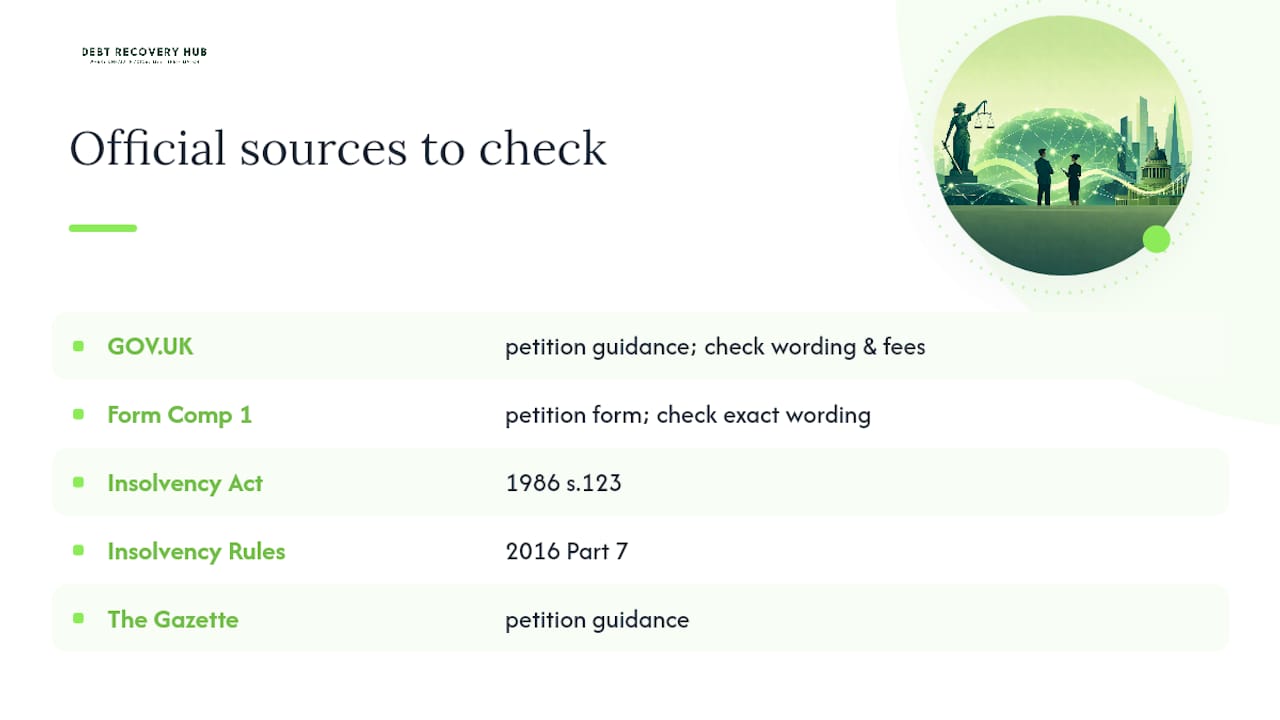
Verify exact wording and current fees directly: GOV.UK petition guidance and Form Comp 1, Insolvency Act 1986 s.123, Insolvency Rules 2016 Part 7, and The Gazette’s petition guidance.
This article is general information, not a substitute for advice from a qualified lawyer. Consult a qualified legal professional about your own circumstances before acting on anything here.
Sources
FAQ
How long until debt is wiped in the UK?
There’s no fixed point at which an unpaid business debt simply disappears. If a company is wound up and dissolved with no assets left, the debt effectively becomes unrecoverable in practice, but the legal debt itself isn’t “wiped” the way consumer debts can become statute barred after six years of no acknowledgement or payment.
What happens after 7 years of not paying debt in the UK?
For most consumer debts, the six-year Limitation Act period (longer in Scotland for some debt types) means a creditor generally can’t sue after that window closes if there’s been no payment or written acknowledgement. This doesn’t apply the same way to company insolvency; a winding-up petition can still proceed regardless of how long the debt has been outstanding, provided it’s still legally owed.
Are directors liable for HMRC debts?
Directors aren’t personally liable for a limited company’s HMRC debts in most circumstances, because the company is a separate legal entity. That protection can fail where there’s evidence of fraud, wrongful trading, or personal guarantees, which is why HMRC-driven winding-up petitions often trigger separate director conduct investigations.
How can I get my debts written off in the UK?
Debts owed by a company aren’t “written off” on request; they’re either paid, negotiated down through a settlement, or become irrecoverable if the company is dissolved with no assets. Creditors chasing unpaid invoices typically get further through structured negotiation or a matched collection agency than by waiting for a debt to lapse.