




A winding up petition is a court application, usually made by an unpaid creditor, that asks a judge to order a company into compulsory liquidation. If the court grants it, the company stops trading, an Official Receiver takes over, and directors lose control of the business.
If you’re a creditor, do this next: confirm the debt is undisputed and worth at least the legal threshold (currently £750), then budget for court and deposit costs before you file anything (currently £352 court fee plus a £2,600 petition deposit). If you’re a director facing a petition, get insolvency or legal advice today and stop making company payments outside the ordinary course of business. Once a petition is presented, Section 127 of the Insolvency Act 1986 can make those payments void, leaving directors personally exposed.
- Creditors: verify the £750 threshold and gather evidence before filing.
- Directors: freeze discretionary payments and seek advice within days of service, not weeks.
The process sits under the Insolvency Act 1986 and is administered through GOV.UK guidance and Companies House records.
Key Takeaways
A winding up petition is a last-resort legal remedy that can trigger compulsory liquidation, so both creditors and directors need to act on precise thresholds, tight timelines, and clear evidence.
| Point | Details |
|---|---|
| Know the threshold | Creditors need an undisputed debt of at least £750 before a petition is even an option. |
| Budget the full cost | Filing means a £352 court fee plus a £2,600 petition deposit, both non-refundable if the case fails. |
| Watch the timeline | Expect six to eight weeks from issue to hearing, with Gazette advertisement often causing the real commercial damage. |
| Directors must act fast | Section 127 can void payments made after presentation, so freeze discretionary spending and get advice immediately. |
| Consider the alternative | Debt Recovery Hub matches creditors with vetted collection agencies as a faster, less destructive route than a petition. |
Table of Contents
- Who can present a winding up petition?
- When is a petition the right move, and what comes before it?
- How does the court process actually work?
- What happens after a winding up order is made?
- How can a company oppose a winding up petition?
- What should creditors check before filing?
- A less destructive way to recover what you’re owed
- Sources
- FAQ
Who can present a winding up petition?
Not everyone can start this process. Under section 124 of the Insolvency Act 1986, the people entitled to petition include:
- Creditors owed money by the company
- The company itself, via its directors or members
- Individual directors, in limited circumstances
- Contributories (shareholders), usually where shares are fully paid up
- Certain regulators, including the Secretary of State in public interest cases
Most petitions rely on one of two grounds. The first, and by far the most common, is that the company is “unable to pay its debts” under section 123, typically proven by an unsatisfied statutory demand or a returned enforcement attempt. The second is the “just and equitable” ground, used less often and usually in shareholder disputes rather than debt recovery. HMRC remains one of the most frequent petitioners against companies with tax arrears, often after warning letters have gone unanswered for months.
When is a petition the right move, and what comes before it?
A petition should never be your opening move. Courts expect creditors to have tried reasonable recovery routes first, and they will look closely at whether the debt is genuinely owed and undisputed.
Before drafting anything, work through this checklist:
- Confirm the debt is undisputed, not subject to a genuine counterclaim, and worth at least £750
- Gather evidence: invoices, signed contracts, a statutory demand, or a county court judgment
- Document your recovery attempts, including dates of letters, calls, and any part payments
- Check the company’s trading status and whether other creditors are already circling
Budget carefully before you commit. Filing to wind up a company that owes you money currently costs a £352 court fee plus a £2,600 petition deposit, both payable upfront and non-refundable if the petition fails or is withdrawn.
A petition is also a blunt instrument. It’s advertised publicly, it can freeze the company’s bank accounts overnight, and any money eventually recovered gets shared among all creditors in the liquidation, not paid to you alone.

Pro Tip: If the debt is under a few thousand pounds or the company is still trading normally, a targeted debt collection approach almost always recovers more, faster, and without the reputational fallout of a public petition.
How does the court process actually work?
Once you’ve decided to proceed, the mechanics follow a fairly rigid sequence.
- Issue the petition using Form Comp 1, supported by Form Comp 2 confirming the details, filed with the Insolvency and Companies List or the relevant county court.
- Serve the petition on the company’s registered office, usually by personal delivery.
- Advertise in the London Gazette, typically at least seven business days after service and before the hearing. This step is often what triggers the real damage: banks freeze accounts, suppliers stop supplying, and credit insurers pull cover.
- Attend the hearing, where the court examines whether the debt is genuinely owed, undisputed, and unpaid.
The hearing can end three ways: dismissal (if the debt is disputed or the process was flawed), adjournment (often to allow negotiation or a proposal), or a winding up order.
From issue to hearing typically takes six to eight weeks, though it can move faster if urgency is shown. Directors facing an emergency, such as needing to pay staff or suppliers after presentation, can apply for a validation order to protect specific transactions from being voided.
What happens after a winding up order is made?
The consequences are immediate and hard to reverse. The company enters compulsory liquidation, the Official Receiver takes initial control, and directors lose all authority to run the business from that moment.
- Directors’ conduct in the run-up to insolvency gets investigated, and misconduct can lead to disqualification or personal liability
- Assets are gathered and sold, with proceeds distributed according to the statutory order of priority
- The presenting creditor doesn’t get paid first; recoveries are shared across all creditors, so a “successful” petition can still yield very little
- A copy of the order is sent to Companies House and becomes part of the public record permanently
That last point matters more than people expect. Even years later, the winding up order stays visible on the company’s public filing history, which can affect the credit profile of connected directors starting new ventures.
How can a company oppose a winding up petition?
Directors aren’t powerless once a petition lands, but the window to act is narrow. Courts take a dim view of petitions used to force payment on debts that are genuinely contested, and a pre-existing dispute is consistently the strongest defence available provided it predates the petition itself.
Other grounds worth exploring immediately:
- Genuine dispute: correspondence, contracts, or arbitration records showing the debt was contested before the petition was issued
- Payment or proposal: evidence the debt has been paid, or a credible CVA or administration proposal is already in motion
- Procedural defects: errors in service, advertisement, or the underlying statutory demand that justify a set-aside application
Build your evidence bundle fast: emails disputing the invoice, proof of payment, cashflow forecasts, and any formal proposal to creditors. At the hearing itself, options include applying to strike out the petition, seeking an adjournment to negotiate, or asking for an injunction restraining advertisement where the debt is clearly disputed.
Pro Tip: Once a petition is served, the clock genuinely doesn’t stop. Banks and key suppliers often react within days of Gazette advertisement, so get insolvency advice the same week you’re served, not after the hearing date arrives.
What should creditors check before filing?
Pulling together the right paperwork early saves weeks later. Assemble invoices, signed contracts, all correspondence, and proof of your recovery attempts, plus a statutory demand or judgment if one exists.
Before filing, weigh the alternatives properly:
- A statutory demand or judgment enforcement route
- Instructing a professional debt collection agency for a faster, lower-risk recovery
- Direct negotiation, particularly where the debtor is still viable and worth keeping as a customer
A failed petition wastes the £352 court fee and £2,600 deposit outright, and can expose the creditor to the company’s costs if the court finds the petition was misused. Sign off internally on the debt value, the commercial impact of pushing a customer into liquidation, and whether the budget for fees is actually worth the risk.
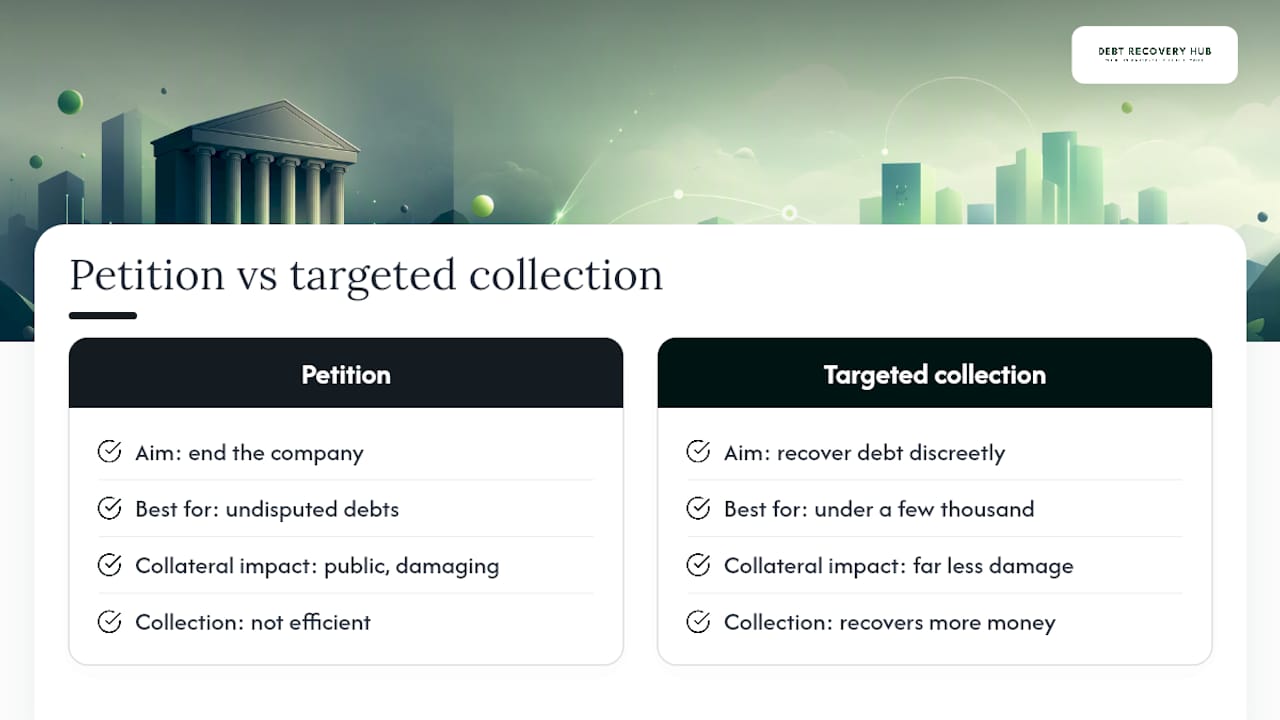
Petitions work best as a last resort, not a first move
Petitions are designed to end companies, not to collect debts efficiently. For most commercial disputes under a few thousand pounds, or where the debtor still trades and pays other suppliers, a targeted debt collection approach recovers more money with far less collateral damage. Reserve the petition route for cases where the debt is undisputed, the amount justifies the £2,600 deposit, and you’ve genuinely exhausted quieter options first. Preserving a trading relationship is often worth more than winning a public fight.
A less destructive way to recover what you’re owed
Not every unpaid invoice needs a courtroom. If the debt is disputed, modest in size relative to a £2,600 deposit, or you’d rather keep the debtor as a paying customer than force them into liquidation, Debt Recovery Hub matches you with a vetted collection agency chosen for your specific debt type, amount, age, and location.

- Works for business debts, property-related arrears, and international cases alike
- After a short intake, you’re introduced to agencies suited to your case rather than a generic list
- Every partner agency operates within recognised professional and compliance standards, so recovery stays ethical and proportionate
Before you spend £352 on a court fee and lock up £2,600 in a deposit, get matched with a debt collection agency that fits your case and see whether a quieter recovery route gets you paid faster.
Sources
This article is general information, not a substitute for advice from a qualified lawyer. Consult a qualified legal professional about your own circumstances before acting on anything here.
FAQ
What is the minimum debt for a winding up petition?
A creditor must be owed at least £750, and the debt must be undisputed, before presenting a winding up petition.
How much does a winding up petition cost?
Expect a £352 court fee plus a £2,600 petition deposit, both payable upfront and lost if the petition is dismissed or withdrawn.
How long does a winding up petition take?
From issuing the petition to the court hearing typically takes six to eight weeks, though Gazette advertisement can cause commercial damage well before that date.
Can a company stop a winding up petition?
Yes, common defences include showing a genuine pre-existing dispute, proving payment, proposing a CVA, or applying to set aside the petition for procedural errors.
Is a winding up petition the same as bankruptcy?
No, bankruptcy applies to individuals, while a winding up petition leads to compulsory liquidation of a company; both can result from unpaid debts but follow separate legal processes.
What happens to directors after a winding up order?
Directors lose control immediately, the Official Receiver investigates their conduct, and Debt Recovery Hub can help creditors pursue less destructive recovery routes before matters reach this stage.