


Yes, a US debt can usually be collected from the UK, but the route depends on where the debtor sits, how old the debt is, and whether you already hold a US judgment. Most creditors choose between two paths: recognising an existing US judgment through common law, or issuing fresh UK proceedings. Before anything else, check the six-year limitation clock under the Limitation Act 1980, gather your paperwork, and speak to a specialist who handles cross-border cases.
TL;DR:
- If the debtor is in the UK or the debt is uncontested, pursuing UK proceedings is often more straightforward than enforcing a US judgment.
- Recognizing an existing US judgment in the UK relies on proper jurisdiction and finality, but fresh UK court actions may be preferable if no judgment exists.
- Handling cross-border debts requires strict compliance with UK laws, including FCA authorization, GDPR, and adherence to the Limitation Act 1980, especially the six-year limit.
- Exchange rate fluctuations can significantly impact the sterling value of US dollar debts, making currency hedging advisable for large claims.
- Costs and timelines vary by case stage, with early amicable recovery generally being cheaper and faster than court enforcement, which can take several months or longer.
Table of Contents
- How USA debt collection UK enforcement actually works
- What steps should you take before instructing anyone?
- What will it cost, and how long does it take?
- How do you pick the right UK specialist for a US-origin debt?
- What US laws should you know if the debtor is American?
- When should you pursue recovery directly in the US?
- How should you handle the USD to GBP exchange risk?
- Do you need to report recovered US debts for tax?
- What should you do before starting formal collection?
- Author perspective: when to stop chasing and when to escalate
- Get matched to a specialist for your US debt recovery case
- Sources
- FAQ
How USA debt collection UK enforcement actually works
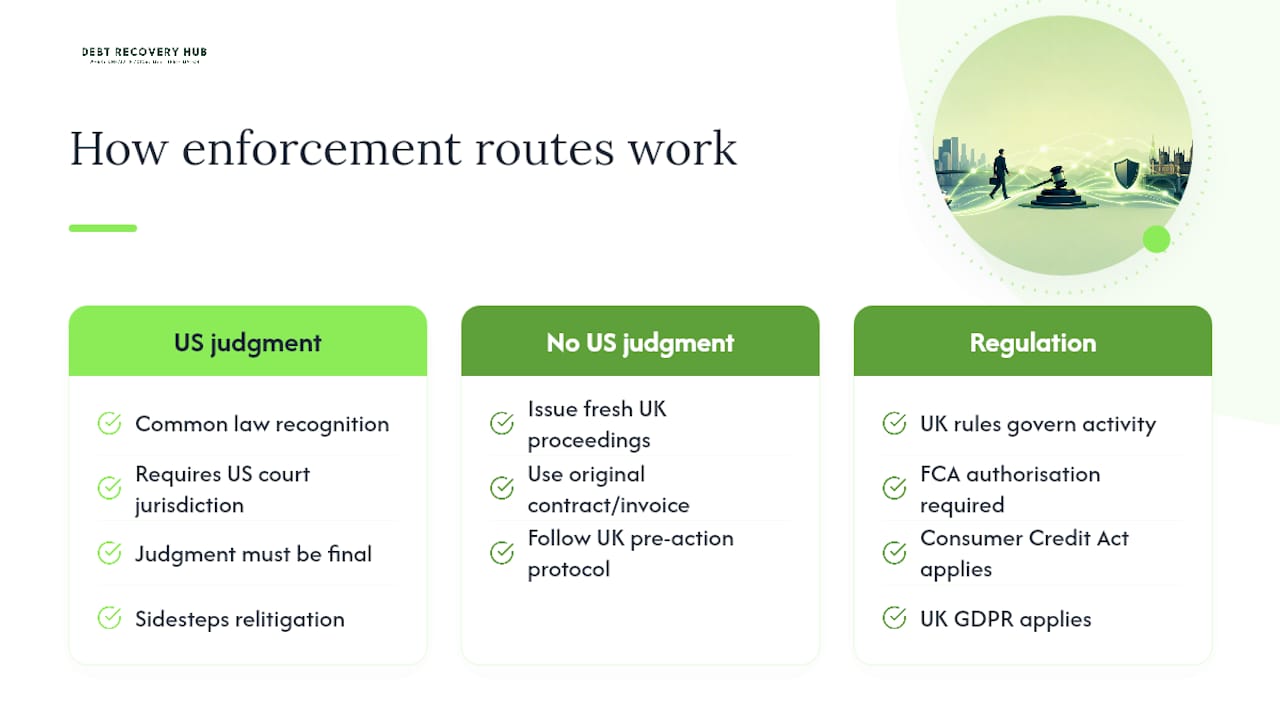
Two legal routes exist once you’re chasing USA debt collection UK creditors need, for money owed by an American debtor. If you already hold a US court judgment, English courts can sometimes recognise it under common law, provided the US court had proper jurisdiction and the judgment is final. That route sidesteps relitigating the facts. If you don’t have a judgment, or the common law recognition test isn’t met, you issue fresh proceedings in the UK courts instead, treating the original US contract or invoice as the basis of a new claim. A practical guide for UK creditors confirms both routes are viable, but success hinges on documentation, any jurisdiction clause in the original contract, and strict adherence to UK pre-action protocols.
Regulation matters just as much as the legal mechanics. Any UK-based agency contacting a debtor on your behalf needs FCA authorisation, and the Consumer Credit Act and UK GDPR both apply the moment personal data crosses into a UK collection process. This isn’t a formality. An unauthorised collector chasing a debtor in Manchester or Cardiff is breaking UK law, regardless of where the original debt was incurred.
Here’s the twist many creditors miss: the Fair Debt Collection Practices Act, the main US consumer protection statute, stops applying entirely once the person being contacted is in the UK. The FTC’s own guidance is clear that FDCPA protections and rules are US-specific. Once the collection activity is directed at someone in the UK, UK rules take over completely. That’s good news if you’re the creditor. It also means you cannot lean on US collection tactics and assume they’re compliant here.
What steps should you take before instructing anyone?
Work through this in order rather than jumping straight to a solicitor or agency.
- Confirm the debtor’s current location and the contract’s jurisdiction clause. Check whether the agreement specifies US or UK courts, and whether the Limitation Act 1980 has already barred the claim. Most simple contract debts become unenforceable after six years in England and Wales, so this step decides whether you have a case at all.
- Assemble every supporting document. Invoices, the signed contract, proof of delivery or acceptance, and the full email or letter trail. Gaps here are the single biggest reason cross-border claims stall.
- Choose your route using two triggers. If the debtor has moved to the UK or the debt is largely uncontested, fresh UK proceedings usually make sense. If the debtor remains in the US or you already hold a judgment, recognition or US counsel is the better starting point.
- Brief your chosen agency or solicitor properly, including a written data-sharing agreement that satisfies UK GDPR before you hand over any personal information.
Pro Tip: Don’t wait until the limitation period is nearly up before checking it. A claim that’s four years and eleven months old still has room to negotiate; one that’s six years and one-month-old is often dead on arrival.
What will it cost, and how long does it take?
Budget expectations shift depending on how far the case escalates. Providers working international claims typically structure fees in three stages: amicable collection, attorney-led escalation, and litigation, with a complete guide for UK businesses confirming that contingency fees usually cover the early amicable stage, while attorney involvement and any court action carry additional costs the creditor bears directly.
Timelines vary sharply by stage:
- Amicable recovery through calls and letters: typically a matter of weeks.
- Fresh UK court proceedings: usually several months from issue to judgment.
- Enforcement of a judgment, especially where US assets are involved: can run considerably longer, partly because US debt collection law varies by state, affecting everything from interest on judgments to court procedure.
Three risks catch out creditors most often: pursuing a claim that’s already statute-barred, assuming a US judgment is automatically enforceable in the UK without going through recognition, and mishandling personal data during cross-border transfer in a way that breaches UK GDPR. A failed litigation attempt also means the court costs you’ve paid are rarely recoverable, so weigh the strength of your evidence before committing to that stage.
How do you pick the right UK specialist for a US-origin debt?
Not every agency that claims to “do international recovery” actually has the experience to back it up. Before instructing anyone, ask these questions directly:
- Are you FCA authorised, and can you show it?
- Have you handled debts where the debtor is based in the US specifically, not just “abroad” generally?
- Do you understand how the debtor’s US state affects timelines and enforcement?
- At what point do you escalate to a solicitor, and what does that cost?
- Who pays court costs if litigation becomes necessary?
Watch for red flags too: vague or shifting fee structures, pressure tactics that sound more aggressive than professional, no written data-processing agreement, or reluctance to give you a straight answer on litigation costs. A guide on choosing a UK debt collector walks through more of these warning signs in detail.
Pro Tip: Ask any prospective agency for a real example of a US-origin case they’ve closed, not just a general pitch about “global reach”. Specifics separate genuine cross-border experience from marketing language.
This is exactly the gap a specialized debt recovery platform aims to close. Rather than cold-calling agencies and hoping one has the right experience, you submit the debt type, amount, age, and location once, and get matched to vetted specialists who handle USA debt collection UK cases.
What US laws should you know if the debtor is American?
US debt collection law isn’t one national system, it’s fifty separate ones stitched together. Statutes of limitations on debt vary by state, sometimes running three years, sometimes ten, depending on whether the claim is written or oral contract, and which state’s law governs. Interest that accrues on a judgment also differs by state, as does the court process for enforcing one.
This variance is precisely why generic advice about “US debt recovery laws” tends to fall flat. An agency or attorney with real experience in, say, Texas collection procedure won’t necessarily know how enforcement works in New York or California. If your case reaches the point of needing US-based legal action, the practical priority is finding representation licensed and experienced in the debtor’s specific state, not simply “a US debt collection lawyer”. Background research into how debtor entities are structured, including whether you’re dealing with an LLC, corporation, or holding company, also matters here, since business structure affects who is actually liable and how enforcement against assets works in practice.
The FDCPA, useful as it is for US consumers dealing with collectors, offers no comparable protection framework for creditors trying to collect. It exists to protect debtors, not to guide creditors through recovery. For a UK creditor, the more relevant question is always which US state governs the debt and what that state’s court system requires for judgment and enforcement.
When should you pursue recovery directly in the US?
If UK-based routes stall, usually because the debtor has no UK presence, no UK assets, and shows no willingness to engage, direct action in the US becomes the more realistic option. This typically means instructing a US attorney or collection agency licensed in the debtor’s state, since unauthorised or out-of-state collectors can face their own compliance problems.
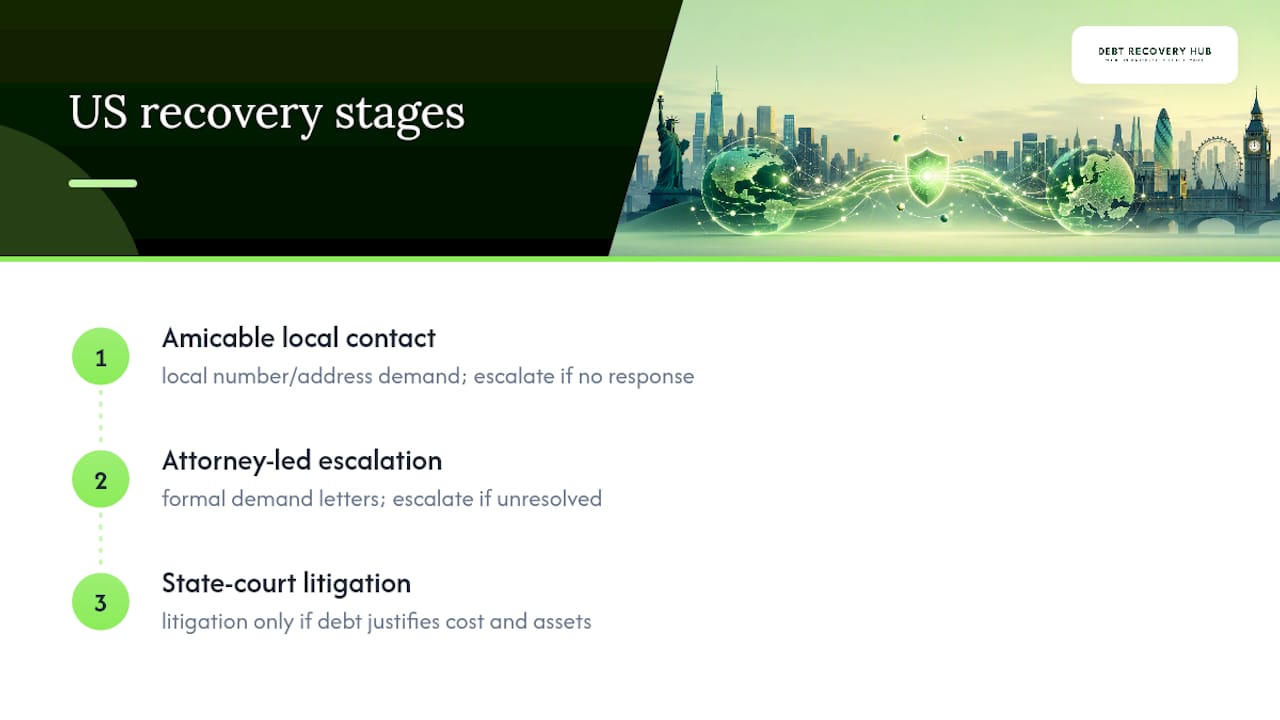
A staged approach tends to work best here too. Industry practice, as reflected in Safe Collections’ guide, moves through amicable local contact first, since a demand from a local number or address often gets a faster response than a letter with a UK postmark. Attorney-led escalation follows if that fails, using formal demand letters that carry more legal weight. Litigation in the relevant state court is the final step, reserved for cases where the debt is large enough to justify the cost and the debtor has identifiable assets worth pursuing.
Global platforms built for exactly this kind of routing, connecting a claim to a licensed local expert in the debtor’s own jurisdiction, illustrate how much simpler this becomes when you’re not trying to manage a US attorney relationship from scratch. Debitura’s model is one example of how case-routing to local specialists speeds up multi-jurisdiction recovery rather than leaving a UK creditor to find US counsel unassisted.
How should you handle the USD to GBP exchange risk?
A debt fixed in US dollars doesn’t stay a fixed number once you’re planning to bank it in pounds. Exchange rate movement between the point the debt was invoiced and the point it’s actually paid can shrink or inflate the sterling value you eventually receive, sometimes by a meaningful margin if the case drags on for months.
This matters more than most creditors realise at the outset. A $10,000 invoice raised when the pound was weak against the dollar is worth noticeably more in sterling than the same figure settled a year later if the pound strengthens. Litigation and enforcement delays, which can stretch a case out considerably, make this risk larger the longer a dispute runs.
Practical steps worth taking: agree, where possible, whether settlement will be made in USD or GBP before the case reaches judgment, since a US court judgment is typically denominated in dollars regardless of your reporting currency. If cashflow certainty matters more than chasing the best possible rate, consider a forward contract with your bank once a settlement date looks realistic, locking in a conversion rate rather than leaving it to chance. If the amount is small, this level of hedging usually isn’t worth the administrative effort, but for larger commercial claims it’s worth a conversation with your finance team before you agree final settlement terms.
Do you need to report recovered US debts for tax?
Any amount recovered from a US debtor is treated the same as domestic income or a written-off debt being reversed for UK tax purposes; it isn’t a separate category just because the debtor happens to be American. For businesses, a recovered debt that was previously written off as a bad debt typically needs to be brought back into taxable profit in the accounting period it’s recovered, since the original write-off would have reduced your taxable income at the time.
Individuals recovering a personal debt from a US party won’t usually face income tax on the recovery itself, since it’s the return of money already owed rather than new income, but any interest awarded as part of a judgment can be treated differently and may need declaring. Where the debtor is a US entity rather than an individual, and the payment involves any element of interest or royalty, there can be withholding tax considerations on the US side too, governed by the UK-US double taxation treaty rather than by UK domestic rules alone.
None of this is something to guess at. Given how easily a recovered debt, interest, and currency conversion can complicate a tax return, it’s worth flagging any significant US recovery to your accountant before you file, rather than after HMRC asks a question about it.
What should you do before starting formal collection?
Formal collection should be the second step, not the first. Before instructing anyone, run a basic credit or background check on the debtor if the amount justifies it, since discovering a business has already entered US bankruptcy proceedings changes your entire strategy, and pursuing a company with no assets left to recover from wastes time and money.
Direct communication is worth attempting first in most cases, but the tone and format that work with a UK debtor don’t always translate well to a US one. American businesses often respond better to a direct phone call than a formal letter, and a demand that references specific state law tends to land more seriously than a generic reminder. Keep every piece of correspondence in writing or follow up a call with an email confirming what was discussed, since this becomes the documentation trail your eventual agency or solicitor will need.
Set yourself a genuine deadline for self-managed contact, typically two to four weeks, after which escalation to a specialist makes more sense than continuing to chase alone. The longer an unpaid US invoice sits unaddressed, the more the Limitation Act 1980 clock and the practical difficulty of tracing a debtor both work against you.
Author perspective: when to stop chasing and when to escalate
Most creditors wait too long to escalate and then over-escalate once they finally decide to act. The sensible order is amicable, agency-led contact first, and litigation only once you’ve genuinely confirmed the debtor has recoverable assets in whatever jurisdiction you’d be enforcing against. A judgment against an empty shell company is a moral victory, not a financial one. Weigh the probable recovery against the incremental legal cost at every stage, not just at the start.
— Jack
Get matched to a specialist for your US debt recovery case
This platform offers an alternative to guessing which agency actually knows US-origin debt: instead of cold-calling firms and hoping one has cross-border experience, you provide the debt type, amount, age, and location once, and get matched to vetted UK specialists who handle such cases.

Submitting a case takes a few minutes. We capture the details that actually matter for a US-origin debt, the debtor’s state, the size and age of the claim, whether you hold a judgment already, then match you to an agency with relevant experience rather than a generic UK collector working outside their depth. Matches are made with agencies that operate within relevant regulatory rules and data protection safeguards, so users are not left checking compliance themselves. If your case is a commercial debt, start with Business Debt Recovery; for wider guidance on cross-border cases specifically, the International Debt Recovery UK action guide is worth reading before you submit. Either way, the next step is simple: tell us about your case and let us find the right specialist for it.
Sources
For readers who want to verify the legal detail directly: the FTC’s debt collection FAQs cover FDCPA scope and consumer protections, while the statutory text of the FDCPA sets out the underlying US law. For UK-specific procedure, The Source’s guide on collecting US debts in the UK and Safe Collections’ guide for UK businesses both offer practical detail worth reading in full.
This article is general information, not a substitute for advice from a qualified lawyer. Consult a qualified legal professional about your own circumstances before acting on anything here.
FAQ
Can a UK business really collect a debt owed by a US company?
Yes, through either recognition of an existing US judgment under common law or by issuing fresh proceedings in a UK court, depending on your case facts. Success depends heavily on documentation and whether the claim is still within the Limitation Act 1980 six-year window.
Does the FDCPA protect UK creditors chasing US debtors?
No. The FDCPA is a US consumer protection law that governs how collectors treat debtors within the US, and according to the FTC, it does not apply once collection activity is directed at someone based in the UK. UK regulation, including FCA rules, governs that activity instead.
How much does it cost to recover a US debt from the UK?
Costs typically follow a staged model: a contingency fee for amicable collection, additional fees if the case escalates to attorney involvement, and separate litigation costs if court action becomes necessary, as outlined in Safe Collections’ guide. No fixed price is published for these services, as costs depend on the matched agency and case complexity; current price details are typically available upon case submission.
What happens if the debt is close to the six-year limit?
Act immediately. Once a simple contract debt passes six years under the Limitation Act 1980, it typically becomes unenforceable, so any delay in checking this date can eliminate your recovery options entirely.
Should I go through Debtrecoveryhub or hire a US attorney directly?
It depends on where your debtor is and what evidence you hold. Debtrecoveryhub matches you to vetted UK specialists who can assess whether UK proceedings, judgment recognition, or referral to US counsel fits your case, rather than leaving you to find and vet an attorney in an unfamiliar state on your own.