


Pre-legal collections are the professional recovery actions a business takes before issuing court proceedings: formal notices, structured negotiation and targeted third-party contact aimed at getting an invoice paid without a judge involved. For most overdue B2B debts in the UK, this is the correct first escalation, not litigation. If you’d rather hand the case to a vetted specialist than run it yourself, a platform matches businesses with pre-legal collection agencies based on debt type, value and age.
TL;DR:
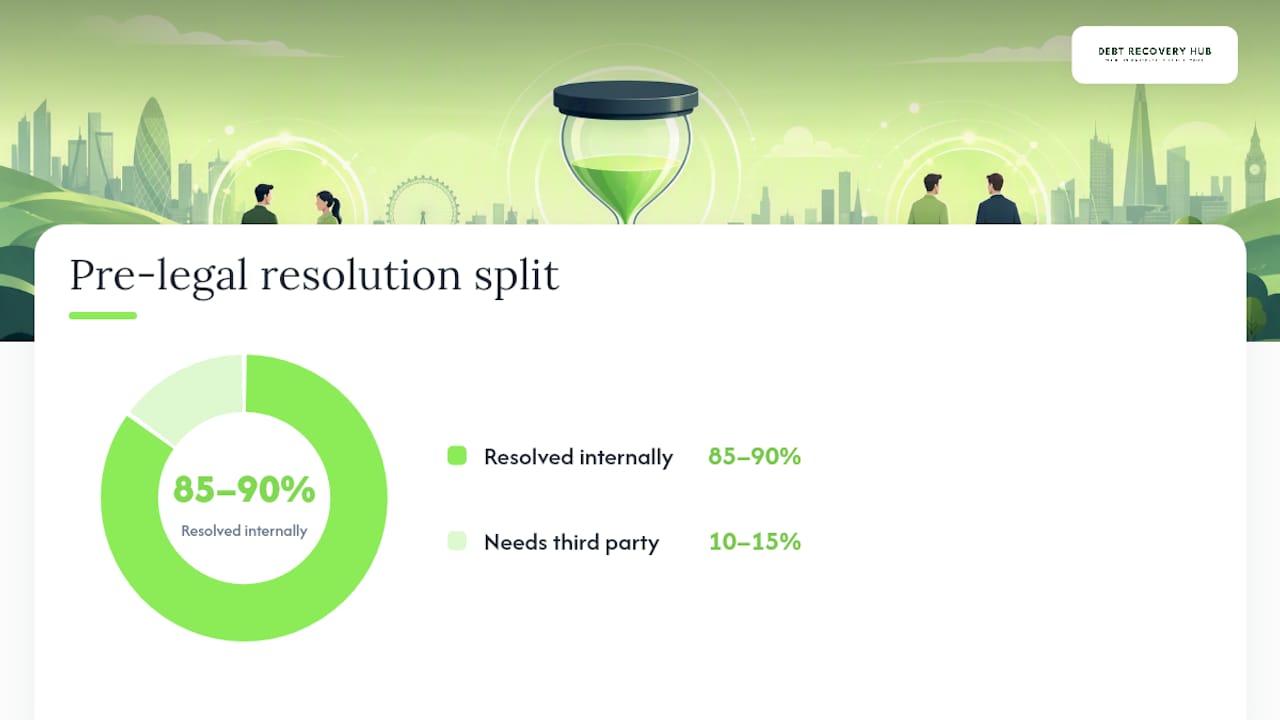
- Pre-legal collections are most effective before 90 days overdue, with internal efforts resolving up to 90% of invoices and third-party letters helping recover more.
- Escalation should be based on debt size, age, dispute status, and the debtor’s solvency, with red flags justifying immediate legal advice.
- Costs increase significantly at each escalation stage, with solicitor demand letters typically costing a few hundred pounds, avoiding the higher expenses of court litigation.
- Documentation of all communication, contracts, and reminders is crucial to support any eventual court case within the six-year recovery limit.
- Using a matching platform helps find specialized agencies suited to your debt profile, ensuring efficient recovery efforts without guessing which provider to choose.
Table of Contents
- How pre-legal collections work in practice
- When should you escalate to pre-legal collections?
- Costs, timelines and the UK’s six-year rule
- How to brief and hire a pre-legal collection agency
- What successful pre-legal collections actually look like
- What you’ll need to do during the process
- Applying pre-legal collections responsibly for UK businesses
- Get matched with a vetted pre-legal collection agency
- Sources
- FAQ
How pre-legal collections work in practice
Pre-legal collections follow a rough escalation ladder, and skipping steps rarely helps. It starts with a friendly reminder, usually by email, then moves to firmer written notices, phone contact, and finally a formal letter demanding payment within a set period.
Internal reminders handle most of the workload. Practitioner data suggests internal efforts resolve around 85 to 90% of recoverable invoices before any third party gets involved. The problem is what happens to the remainder: debts left to drift past 90 days without escalation tend to get harder, not easier, to collect.
That’s where third-party letters earn their keep. A letter arriving on an agency or solicitor’s letterhead signals that a debtor’s excuses have run out. The FSB notes that a professional third-party letter frequently succeeds where a business’s own repeated chasing has failed, simply because it changes how the debtor prioritises the bill internally.
Typical stage-by-stage actions look like this:
- Stage 1, days 0 to 30: Automated or personalised reminder by email and invoice statement.
- Stage 2, days 30 to 60: Phone call plus a firmer written notice referencing payment terms.
- Stage 3, days 60 to 90: Formal internal demand, often flagging the next step is external.
- Stage 4, days 90+: Agency or solicitor pre-collection letter, negotiation and payment plan offer.
- Stage 5: Letter before action (LBA), the final formal step before court papers are considered.
The numbers back the approach: pre-collection letters convert a meaningful share of previously unresponsive accounts, while a solicitor’s demand letter recovers a significant portion of accounts before anyone sets foot near a courtroom. Keep every email, call note, and delivery receipt as you go. If the debt does end up in litigation, that paper trail is what proves you tried the reasonable route first.
When should you escalate to pre-legal collections?
Not every overdue invoice needs the same treatment, and treating them all identically wastes time on debts that were never going to pay and under-resources the ones that would. Three questions should drive the decision:
- How much is owed, and for how long? A £150 invoice 20 days late doesn’t need the same urgency as a £15,000 invoice sitting at 75 days.
- Is the debt disputed? A genuine dispute over goods or service quality needs resolution, not escalation, or you risk a counterclaim.
- What’s the debtor’s track record and apparent solvency? A customer who has always paid late but eventually pays is a different case from one showing signs of insolvency.
Segmenting your ledger by days overdue, balance size and dispute frequency tells you where automation is enough and where a person needs to pick up the phone. Red flags that justify skipping straight to legal advice include a debtor who has gone silent for over 90 days despite contact, evidence of asset stripping, or multiple creditors chasing the same company.
Pro Tip: Run your aged debtor report monthly and colour-code by risk rather than just by age. A £500 invoice from a chronic late-payer often needs less urgency than a £5,000 invoice from a company that has never missed a payment before.
Costs, timelines and the UK’s six-year rule
Cost scales with how far you escalate, and the jump from step to step is bigger than most business owners expect. Internal chasing costs staff time only. Agency-led pre-legal collections typically charge on a contingency or percentage basis, so there’s no upfront fee if nothing is recovered. Solicitor demand letters sit in the middle: Farleys notes these commonly cost in the low hundreds of pounds, a modest outlay compared with full litigation, where court fees and legal costs climb substantially higher.
In England and Wales, the limitation period for recovering a simple contract debt is six years from the date payment was due. Miss that window and you lose the legal right to pursue it through court, no matter how clear the paperwork.
That six-year clock is why documentation matters from day one, not just once a case looks headed for court. A letter before action should give the debtor a clear, reasonable deadline, usually 14 to 30 days, state the exact amount owed, and warn plainly that court proceedings will follow if payment isn’t made. Keep:
- Signed contracts or terms of business referenced on the invoice.
- Delivery notes, timesheets, or proof of service completion.
- Every reminder, call log and response (or non-response) from the debtor.
- A copy of the LBA and proof of postage or delivery.
Rough timeline expectations: internal stages 1 to 3 run 0 to 90 days, agency or solicitor pre-legal work adds another 2 to 6 weeks, and an LBA typically allows a further 14 to 30 days before litigation becomes the live option.
How to brief and hire a pre-legal collection agency
Choosing the wrong agency wastes the weeks you don’t have before the limitation clock or a debtor’s solvency both work against you. Before signing anything, ask:
- What percentage or fee structure applies, and is it contingent on recovery?
- What’s your typical success rate for debts of this size and industry?
- How is evidence handled, and what happens to my documentation if the case escalates to legal action?
- What data security standards do you hold, such as Cyber Essentials certification?
- How do you handle vulnerable customers or disputed debts, and are you compliant with relevant codes of practice?
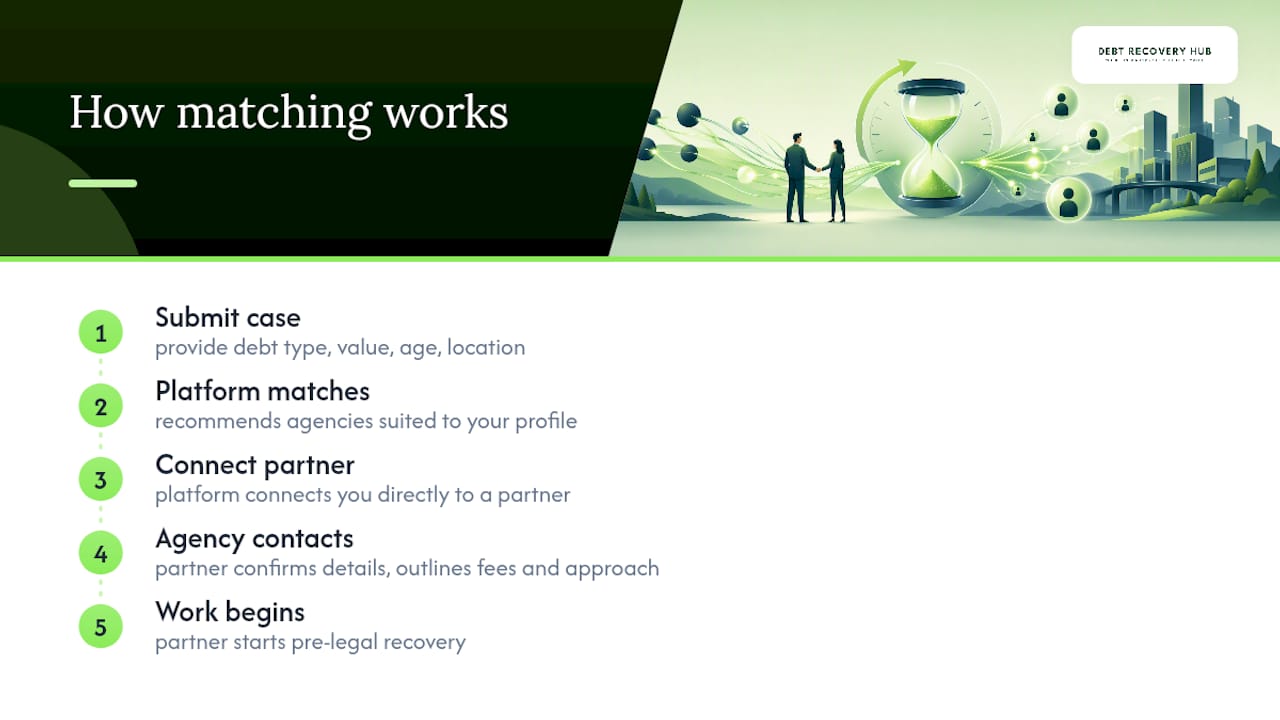
A good intake process asks for the invoice value, age, debtor details, and any dispute history upfront, because vague briefs lead to mismatched agencies and wasted weeks. This is precisely the gap a matching process closes: submit case details once, and the platform recommends agencies suited to your debt type, value, and location rather than leaving you to cold-call providers blind.
Pro Tip: Ask for a sample report format before you sign. If an agency can’t show you what weekly progress updates look like, you’ll be chasing them for information just as often as they’re meant to be chasing your debtor.
Expect one of three outcomes from a properly run pre-legal case: a formal LBA that prompts payment, a negotiated payment plan, or a recommendation to escalate to legal action because the debtor isn’t engaging in good faith.
What successful pre-legal collections actually look like
The pattern behind most successful cases isn’t aggression, it’s consistency. A construction subcontractor owed £8,000 for completed work, chased informally for 60 days with no response, typically sees movement within a fortnight of a solicitor’s demand letter landing, because the letter forces a decision that silence had been avoiding.
Retail and wholesale suppliers dealing with a slow-paying but otherwise solvent client tend to do better with a structured payment plan than an aggressive letter. Offering three or four instalments in writing, with a clear default clause if a payment is missed, often recovers more than an all-or-nothing demand and keeps a customer who might order again next quarter.
Professional services firms chasing unpaid retainers see a different rhythm: because the relationship is often personal (a named contact rather than an accounts department), a phone call from a third party at the pre-legal stage tends to work faster than another email ever would. The common thread across all three: documented escalation, a clear deadline, and a professional third party stepping in exactly when internal patience runs out, not months after.
What you’ll need to do during the process
Handing a case to an agency doesn’t mean stepping back entirely. You’ll still need to supply the original contract or terms of business, the invoice itself, and a full log of your own chase attempts before referral, since agencies can’t invent a paper trail you never kept.
Expect requests for confirmation on anything unusual: a partial payment received after referral, a dispute the debtor raises for the first time, or a change to the debtor’s contact details. Respond to these quickly, because a stalled response on your end slows the agency’s negotiating position just as much as a slow debtor does.
You’re also responsible for deciding, when the moment comes, whether to accept a negotiated settlement below the full amount or push on toward legal action. A good agency will present the options with a recommendation, but the call on your money is always yours to make.
Applying pre-legal collections responsibly for UK businesses
[Author note: Jack’s professional background in UK debt recovery to be added here.]
The temptation with overdue debt is to escalate hard and fast. Resist it. The businesses that recover most effectively keep meticulous records, treat every debtor as though the case might end up in court, and escalate in measured steps rather than jumping straight to threats. Fair treatment isn’t just good ethics, it’s what protects you if a dispute or a vulnerable-customer issue surfaces later. Build your collection checklist before you need it, not after the invoice is already 80 days overdue.
— Jack
Get matched with a vetted pre-legal collection agency
A specialized platform is an alternative to guessing which agency to call when an invoice goes cold: instead of researching providers one by one, you submit your case once and get matched against agencies for your specific debt type, value, age and location.

The detail you provide upfront is what makes the match useful. A £2,000 disputed invoice from a two-year-old debt needs a different specialist than a £50,000 undisputed construction debt at 45 days, and generic agency shortlists rarely draw that distinction. Submit your case details and the platform recommends agencies suited to the specific profile of your debt, then connects you directly with a partner rather than leaving you to sift through cold-call pitches.
Once matched, expect the partner agency to make contact quickly, confirm the case details you’ve already provided, and outline their fee structure and likely approach before starting work. If you’ve got an invoice sitting past 60 days with no resolution, start your case with Debt Recovery Hub and get matched with a suitable pre-legal specialist.
This article is general information, not a substitute for advice from a qualified financial advisor. Consult a qualified financial professional about your own circumstances before acting on anything here.
Sources
- FSB | What is the process for debt recovery?
- Debt recovery process: step-by-step (ClearReceivables)
- Farleys – debt recovery / legal fees overview
FAQ
How long before a debt becomes uncollectible in the UK?
In England and Wales, a simple contract debt becomes legally uncollectible through the courts after six years from the date payment was due, though you can still ask for voluntary payment after that point.
Can a debt from 10 years ago still be collected in the UK?
You can still contact the debtor and request payment, but if it’s a simple contract debt in England and Wales, you generally cannot enforce it through court action once six years have passed since the payment was due, unless the debtor has acknowledged the debt in writing or made a payment within that period, which can restart the clock.
What is the 11 word phrase to stop debt collectors?
There’s no legally recognised “magic phrase” that instantly stops collection activity; genuine ways to pause or dispute contact include writing to the collector to dispute the debt, request evidence, or ask them to only communicate in writing, which any properly regulated agency will respect.
When should I move from pre-legal collections to legal action?
Move to legal action when the debtor has stopped engaging after a letter before action, disputes have been resolved or ruled out, and the invoice value justifies court costs relative to the likely recovery.
Do pre-legal collection agencies charge upfront fees?
Many operate on a contingency or percentage basis with no upfront fee if nothing is recovered, though solicitor-drafted demand letters are typically charged as a fixed, modest fee regardless of outcome.