


The standard route to recovering money owed by an overseas debtor runs through three stages: a pre-legal push using demand letters and negotiation, a court or arbitration ruling if that fails, then enforcement wherever the debtor actually holds assets. Success hinges less on how good your legal argument is than on where those assets sit and what your contract says about jurisdiction. Start today by preserving every document and either sending a formal demand or requesting a vetted agency match.
TL;DR:
- Starting with a clear, translated demand letter and firm evidence increases the likelihood of settlement before incurring legal costs.
- Suing in the debtor’s country offers enforceability but may be slower and more expensive than using arbitration governed by the New York Convention.
- Enforcement times vary widely and depend on jurisdiction, with asset freezing and judgment registration requiring months due to procedural delays.
- In insolvency cases, early action is critical since claims often fall behind others, reducing recovery chances significantly once insolvency is filed.
- Using vetted local agencies through case-matching services improves chances of effective recovery and reduces delays caused by unfamiliarity with local laws.
Table of Contents
- How does the international debt recovery process work?
- What pre-legal steps should you take right now?
- Which forum should you choose: courts or arbitration?
- How do you enforce a foreign judgment or arbitral award?
- What usually derails a cross-border recovery?
- When should you bring in specialist help?
- Five questions to ask before you pursue an international claim
- How Debtrecoveryhub helps decide the right path
- What other options exist besides court and arbitration?
- Why do culture and language shape recovery outcomes?
- The gap between the textbook process and what actually happens
- Ready to pursue an overseas debt? Here’s your next step
- Sources
- FAQ
How does the international debt recovery process work?
Every cross-border claim moves through the same three phases, though how long each one takes depends entirely on the debtor’s jurisdiction and willingness to engage. Skipping a stage, or rushing the wrong one, is the most common reason recoveries stall.
The first phase is amicable and pre-legal. This means reminder letters, direct negotiation, and often a structured repayment plan that avoids the cost of litigation altogether. Most solvent debtors settle here once they see a credible paper trail and a clear signal that escalation is genuinely coming.
If that fails, you move to adjudication: getting a court or arbitral tribunal to formally decide the debt is owed. You generally have three choices:
- Sue in your own courts, which is cheapest but may produce a judgment the debtor’s home country won’t easily recognise.
- Sue where the debtor’s assets are located, which is often slower and more expensive but gives you a directly enforceable result.
- Use arbitration, if your contract allows it, which tends to travel across borders more easily than a court judgment.
The final phase, enforcement, is where a piece of paper becomes actual money. This means converting your judgment or arbitral award into an order a local court or bailiff can execute against a bank account, property, or other asset. As Intrum’s guidance on international debt recovery notes, creditors who manage this sequence deliberately, rather than jumping straight to litigation, tend to recover more with less spent along the way.
What pre-legal steps should you take right now?
Before you write a single legal letter, get your evidence in order. Courts and arbitrators overseas will scrutinise documentation far more closely than a domestic dispute ever would, and gaps here are expensive to fix later.
- Gather the paper trail: contracts, purchase orders, invoices, proof of delivery or acceptance, and every email or message discussing payment.
- Draft a formal demand letter that states the amount owed, the legal basis, a firm deadline, and the consequences of non-payment. Time it to arrive alongside, not instead of, a phone call or direct contact.
- Translate key documents into the debtor’s language, or at least have a certified translation ready. A demand letter that arrives in a language the recipient can genuinely read is taken more seriously.
- Check limitation periods for the debtor’s jurisdiction, not just your own. These vary enormously, and missing one can extinguish a perfectly good claim.
- Consider early preservation measures, including asset tracing and interim freezing orders, where your target jurisdiction permits them, before the debtor has time to move money.
A well-drafted demand letter backed by solid evidence and a visible escalation plan frequently persuades debtors to settle rather than risk a foreign court case, and this is exactly where solid pre-legal groundwork pays for itself.
Pro Tip: Keep a dated log of every contact attempt, including unanswered ones. Tribunals weigh a documented pattern of good-faith contact heavily when deciding costs and interest at the end of a case.
For a template and checklist of what a strong demand should contain, see Debtrecoveryhub’s guidance on drafting debt recovery letters.
Which forum should you choose: courts or arbitration?
Where you can sue, and where a ruling will actually be honoured, are two different questions. Getting this wrong is the single most expensive mistake in cross-border recovery.
Start with the contract. A forum-selection clause names the court that will hear disputes; a governing-law clause names which country’s law applies to interpreting the contract. Neither guarantees’ enforceability elsewhere, but both narrow your options considerably.
- If the contract names a specific court, you’re generally bound to sue there, even if it’s inconvenient.
- If it includes an arbitration clause, you typically must arbitrate rather than litigate, regardless of preference.
- With no clause at all, you’re left applying private international law rules to work out which court has jurisdiction, which adds cost and delay before the substantive case even begins.
Arbitration deserves particular attention because of how widely its outcomes travel. Awards are enforceable under the 1958 New York Convention, and more than 170 states are parties to it. That breadth is why many commercial creditors push for an arbitration clause at the contract stage rather than relying on litigation later.
Court judgments have historically travelled less easily, but that changed for the UK in 2025. The 2019 Judgments Convention (Hague 2019) entered into force for the United Kingdom on 1 July 2025, creating a new route for recognition and enforcement of foreign civil and commercial judgments between contracting states. It doesn’t cover every country, so check whether the debtor’s jurisdiction is actually a party before assuming your judgment will register there.
How do you enforce a foreign judgment or arbitral award?
Winning is not the same as getting paid. Enforcement is a distinct legal process, and the mechanics differ significantly depending on whether you’re holding a court judgment or an arbitral award.
An arbitral award generally goes straight to enforcement under the New York Convention in any signatory state, with limited grounds for a local court to refuse it. A court judgment, by contrast, needs either a bilateral treaty, an instrument like Hague 2019, or the debtor jurisdiction’s own domestic rules on recognising foreign judgments, and refusal grounds tend to be broader.
For UK-based creditors, one tool matters specifically because of what it doesn’t cover:
- The European Account Preservation Order (EAPO) lets creditors freeze a debtor’s bank account across participating EU member states, often without alerting the debtor first, to stop funds disappearing before judgment.
- EAPO applies across the EU (except Denmark), but not to the United Kingdom, so UK creditors chasing EU-based debtors cannot use it directly and need a different preservation route.
- Where Hague 2019 applies, UK statutory instruments set out how a foreign judgment gets registered in a UK court and the grounds on which a debtor can apply to set that registration aside.
- Beyond the legal instrument, actual recovery still comes down to conventional tools: local bailiffs, bank-account seizure, and asset freezing orders executed by counsel in the debtor’s own jurisdiction.
Timescales vary hugely by country and by whether the debtor contests enforcement, but expect months rather than weeks even in straightforward cases. For UK creditors weighing which route applies to their situation, Debtrecoveryhub’s guide on enforcing EU judgments sets out the practical alternatives available since EAPO isn’t on the table.
What usually derails a cross-border recovery?
Insolvency is the biggest single risk. Once a debtor enters formal insolvency or restructuring, an unsecured commercial claim usually drops to the back of a very long queue, and recovery rates fall sharply. Catching payment problems early, before insolvency proceedings formally start, is one of the few genuinely effective defences against this.
Currency controls and transfer restrictions in certain jurisdictions can block even a debtor who wants to pay. Local payment customs, from extended trade terms to informal grace periods, also distort what counts as “overdue” in practice. Limitation periods differ by country and sometimes by claim type, so a debt that’s still live at home may already be time-barred where the debtor is based.
Procedural friction adds further delay. Formal service of legal documents abroad, certified translation requirements, and evidential rules that don’t match your home jurisdiction’s standards can each add months to a case that looked simple on paper.
When should you bring in specialist help?
Local counsel and specialist agencies earn their fee mainly through two things: relationships and knowledge of procedure that a foreign creditor simply doesn’t have. A vetted in-country partner understands the local courts, speaks the language of both the debtor and the tribunal, and often has existing enforcement contacts that would take a foreign creditor months to build from scratch.
Fee structures vary. Some agencies work on contingency or success fees (a percentage of what’s actually recovered), others charge a flat retainer for legal work regardless of outcome. Contingency-based arrangements align incentives well for smaller commercial debts; retainer arrangements suit complex, high-value disputes where legal work is substantial regardless of recovery.
Before engaging anyone, check:
- Genuine expertise in the debtor’s specific jurisdiction, not just “international” experience generally.
- Verifiable references or a track record on comparable cases.
- Clear compliance and ethical standards, particularly around debtor communication.
- A defined reporting cadence, so you’re not chasing updates yourself.
Pro Tip: Ask any prospective agency for a specific example of a case they closed in the debtor’s exact country, not just their region. “Europe experience” means little if they’ve never actually worked a claim in that particular court system.
Five questions to ask before you pursue an international claim
Before committing time and money, run the case through a short filter. If the answers are weak across the board, settlement or write-off may be the more rational commercial choice.
- Where are the debtor’s assets, and how accessible are they? A judgment against an asset-less shell company is worthless on paper.
- Does the contract contain a jurisdiction or arbitration clause? This largely dictates your legal route before you’ve spent a penny.
- How old is the debt, and is insolvency or a limitation deadline looming? Both can extinguish a claim’s value fast.
- What do realistic recovery prospects look like against the likely legal costs? A £15,000 debt rarely justifies a £20,000 foreign lawsuit.
- Do you have the evidence and commercial justification to proceed? Weak paperwork undermines even a strong legal position.
How Debtrecoveryhub helps decide the right path
A matching service gathers case details upfront, including debt type, amount, age, and location, then matches creditors to vetted agencies suited to that exact profile rather than a generic shortlist. That intake detail is what improves match quality: an agency chosen for its experience in the debtor’s actual jurisdiction, not just its general reputation.
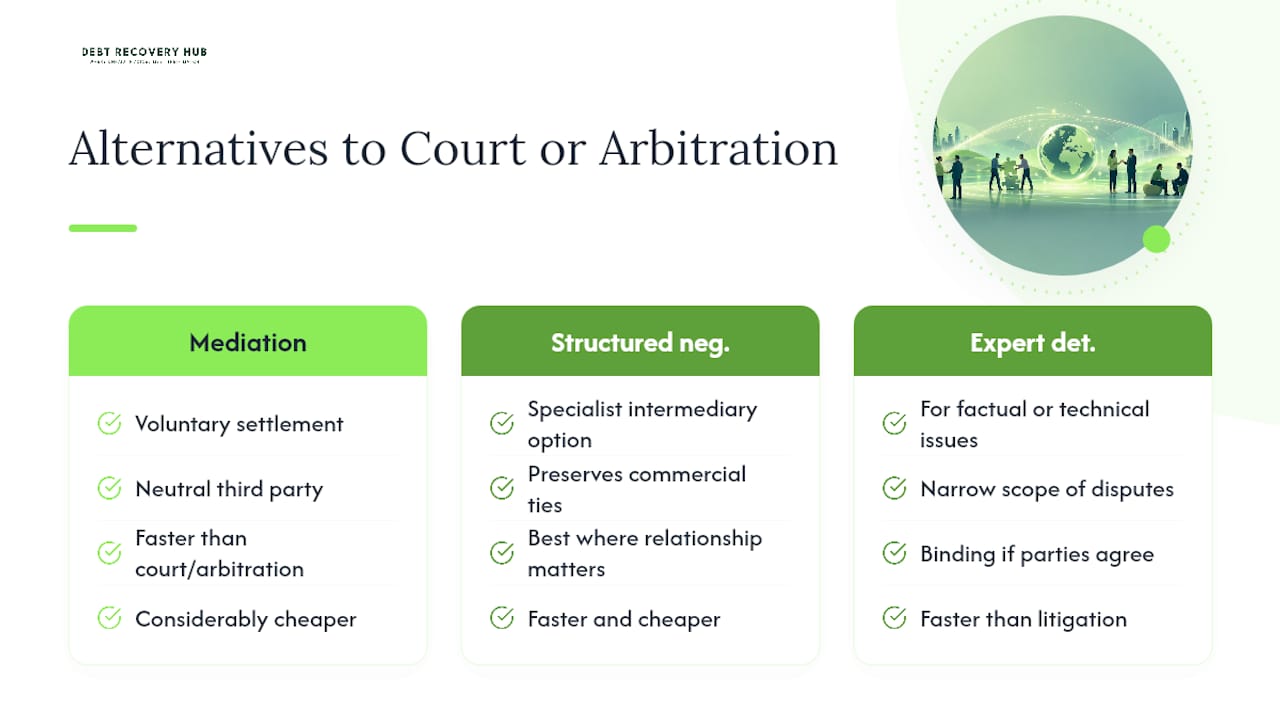
What other options exist besides court and arbitration?
Litigation and arbitration aren’t the only formal routes, and for many cross-border disputes, they’re not even the first ones worth trying beyond straightforward negotiation.
Mediation puts a neutral third party in the room to help both sides reach a voluntary settlement, without anyone issuing a binding ruling. It’s faster and considerably cheaper than either court or arbitration, and because nothing is imposed, debtors are often more willing to engage honestly about what they can actually pay. Many commercial contracts now build in a mediation step as a condition before either side can escalate further.
Structured negotiation, sometimes run through a specialist intermediary rather than the parties directly, works particularly well when the underlying relationship still has commercial value. A supplier who owes money but remains a useful long-term partner is a very different case from a one-off debtor who has disappeared.
Expert determination is a narrower option, mainly useful where the dispute turns on a specific factual or technical question, such as whether goods met a contractual specification, rather than a broader legal argument.
None of these routes carries the same enforceability guarantees as a court judgment or arbitral award. They work because they’re faster, cheaper, and preserve a relationship that formal proceedings would likely destroy. The trade-off is that a debtor who simply refuses to engage in good faith can render mediation or negotiation pointless, at which point adjudication becomes the only remaining lever.
Why do culture and language shape recovery outcomes?
A demand letter that reads as firm and professional in English can land as needlessly aggressive, or worse, confusing, when translated poorly into another language. Getting the tone and legal terminology right in the debtor’s own language isn’t a courtesy; it materially affects whether they engage at all.
Payment culture varies far more than most creditors expect. In some markets, a 60 or 90 day payment term is standard practice rather than a sign of financial distress, and treating it as default too early can damage a relationship that would otherwise resolve itself. In others, formal written demands carry far more weight than a phone call ever will, and the reverse is true elsewhere.
Working with local counsel or an agency based in the debtor’s own country solves most of this by default, since they understand which approach actually moves a debtor to pay rather than simply digging in. Service of legal documents abroad often has to run through formal channels such as the Hague Service Convention, and these processes routinely add months to a case once translation and certified delivery requirements are factored in.
Getting a native speaker to review any formal communication before it’s sent is one of the cheapest risk-reduction steps available, and one of the most frequently skipped.
The gap between the textbook process and what actually happens
Most guidance on cross-border recovery reads as though the three-stage model is a clean pipeline: negotiate, litigate, enforce. In practice, the biggest determinant of outcome isn’t legal strategy at all; it’s whether the debtor still has money by the time you get there. Insolvency doesn’t respect your procedural timeline, and creditors who treat litigation as their first move often discover the debtor filed for restructuring while the case was still being drafted.
The conventional advice underweights speed. A mediocre settlement negotiated in month one usually beats an excellent judgment obtained in month eighteen, because assets move, companies fold, and currency controls tighten while lawyers argue about jurisdiction. Hague 2019 is a genuinely useful development for UK creditors, but it’s not a substitute for acting early. It changes what happens after you win; it does nothing to speed up how fast you get there.
If there’s one priority worth committing to before anything else, it’s evidence discipline from day one. Every other decision, whether to litigate, arbitrate, mediate, or write the debt off, depends on documentation that’s usually assembled in a panic rather than built up from the first missed payment.
— Jack
Ready to pursue an overseas debt? Here’s your next step
Chasing an overseas debtor alone, without local contacts, language capability, or knowledge of that country’s enforcement system, is where most creditors lose time and money before a case even reaches a court. An international debt recovery service exists precisely for that gap: submit your case details once, including debt type, amount, age, and the debtor’s location, and get matched to a vetted agency with actual experience in that specific jurisdiction, rather than a generic international provider working from a template.

The matching process takes the guesswork out of choosing a partner blind. Instead of contacting agencies one by one and hoping one of them genuinely knows the debtor’s home market, you provide the details once and receive recommendations suited to the case at hand. If your claim involves an overseas debtor, start by visiting Debtrecoveryhub’s international debt recovery page and submitting your case for a vetted match.
Sources
- ANNEX I – Application for a European Account Preservation Order | eJustice Portal
- HCCH news: 2019 Judgments Convention enters into force for the United Kingdom
- International debt collection and global recovery in 2026: A full guide to the risks for UK companies | Allianz Trade UK
- International debt recovery: what businesses need to know | Intrum
- Explanatory memorandum to The Civil Jurisdiction and Judgments (Hague Convention) (Amendment) Regulations 2024
FAQ
Can overseas debt be enforced in the UK?
Yes, if the foreign judgment or arbitral award qualifies under an applicable treaty or convention. Arbitral awards enforce under the New York Convention in over 170 states, while foreign court judgments from a contracting state can now be registered in the UK under Hague 2019, which entered into force for the UK on 1 July 2025.
What happens if I don’t pay my debt and leave the country?
The creditor can still pursue the debt through the courts and, if they obtain a judgment, seek enforcement wherever your assets are located, including in your new country of residence if a relevant treaty applies. Leaving a jurisdiction doesn’t extinguish the debt or the creditor’s legal right to chase it.
Can I ignore a formal debt collection letter?
Ignoring a demand letter doesn’t make the debt disappear, and it typically strengthens the creditor’s position if the matter proceeds to court, since a documented pattern of non-response is used as evidence of bad faith. Engaging early, even to negotiate terms, is almost always the better commercial move.
Can I be chased for debt in another country?
Yes. Creditors regularly use local counsel or specialist agencies with in-country contacts to pursue debtors internationally, and enforcement mechanisms like the New York Convention or Hague 2019 make cross-border pursuit increasingly practical. Debtrecoveryhub’s Business Debt Recovery service matches creditors to agencies experienced in the debtor’s specific jurisdiction for exactly this scenario.