


Most UK debt collection cases resolve in a few weeks to a few months if a debtor does not contest the claim, but a defended case can take six months to well over a year. The critical legal boundary is limitation: under the Limitation Act 1980, simple contract debts become unenforceable through the courts after six years, while debts created by a deed have 12 years. Winning a judgment is not the finish line either, since enforcement runs on its own separate clock.
TL;DR:
- Debts created by a simple contract become unenforceable after six years unless there is a written acknowledgment or part-payment that restarts the limitation period.
- The typical court process from issue to judgment is around six to ten weeks for an undefended claim but can extend beyond six months for defended or contested cases.
- Enforcement methods like bailiffs, charging orders, or bank freezes take additional weeks or months to implement and vary based on debt size and asset availability.
- Proper documentation, including invoices and communication timestamps, is crucial to avoid delays caused by administrative failures rather than legal procedures.
- Creditor engagement is most effective when matched with the right collection agency early, especially for debts approaching the six-year limit or involving complex international or commercial cases.
Table of Contents
- How the debt collection process unfolds from missed payment to enforcement
- What ‘statute barred’ means and how to check your deadline
- Pre-action protocol and letter of claim timings you need to follow
- How long a court claim takes from issue to judgment
- What happens after judgment: enforcement options and delays
- Statutory interest and compensation for late business payments
- Worked examples for calculating your own limitation date
- When a vetted matching service adds real value
- Debt collection timelines in Scotland and Northern Ireland
- How insolvency proceedings change the debt collection timeline
- Settlement offers and how long they should stay open
- Mediation and arbitration timelines for debt disputes
- Appealing a court judgment in a debt case
- Why the paperwork matters more than the law
- Get matched with a vetted agency instead of guessing
- Where to check the rules yourself
- Sources
- FAQ
How the debt collection process unfolds from missed payment to enforcement
The journey from a missed payment to recovered money follows a fairly predictable sequence, even though the pace varies enormously depending on whether the debtor engages.
- Internal reminders: the creditor sends payment reminders and statements, typically over days or a few weeks.
- Formal demand or Letter of Claim: a written notice sets out the debt and gives the debtor a defined window to respond or pay.
- Pre-action period: both sides have a chance to negotiate, request documents or arrange a repayment plan before court action starts.
- Court claim issued: the creditor files a claim, commonly through Money Claim Online for straightforward money claims.
- Response window: the debtor has a set number of days to reply, admit, defend or ignore the claim.
- Judgment: the court enters judgment, either by default or after considering a defence.
- Enforcement: the creditor takes further, separate steps to actually collect the money owed.
An undefended claim, where the debtor never responds, can move from letter to judgment in a few weeks. A defended claim, where the debtor disputes the debt or the amount, often takes several months to over a year once you factor in court listing delays, disclosure of evidence and possible hearings. The most common source of delay is not the law itself but administrative friction: incorrect addresses that cause service problems, missing invoices or contracts, and creditors who wait too long to escalate. Good record keeping at the outset shortens almost every stage that follows.
What ‘statute barred’ means and how to check your deadline
A debt becomes “statute barred” when the legal time limit for suing over it has expired. The creditor can still ask for the money, but a court will no longer enforce payment if the debtor raises the time limit as a defence.
- Simple contract debts, including most personal loans, credit cards and unpaid invoices, carry a six-year limitation period under the Limitation Act 1980.
- Debts created by a deed, such as some mortgage shortfalls or formal deeds of covenant, carry a 12-year limitation period under the same Act.
- The clock starts on the date the cause of action accrued, usually the date the payment was due or the date of the last acknowledged payment.
- A written acknowledgement of the debt or a part-payment restarts the six-year clock, according to National Debtline’s guidance on statute barred debts.
A written acknowledgement or a single part-payment resets the six-year limitation period, so a debtor who is close to the deadline should be careful before replying to a creditor or making even a token payment, per National Debtline. If you are a creditor nearing the six-year mark, get advice before relying on informal contact to revive an old claim, since a poorly worded letter can backfire for either side.
Pre-action protocol and letter of claim timings you need to follow
Before most money claims reach court, the Pre-Action Protocol for Debt Claims sets out mandatory steps designed to encourage settlement and give debtors a fair chance to respond.
- The creditor must send a Letter of Claim setting out the amount owed, how it arose and how to pay or dispute it.
- The letter must be dated and posted promptly, since the reply window runs from that date.
- The debtor has a 30-day reply window to respond, request more information, or seek debt advice.
- A creditor should normally wait at least 30 days before issuing court proceedings, allowing genuine time for the debtor to seek help.
Pro Tip: Keep a dated copy of every letter you send and a record of postage, because courts can penalise a claimant on costs for skipping or rushing the Pre-Action Protocol even if they win the underlying claim.
Skipping these steps carries real risk. A court can reduce costs awarded to a creditor who failed to follow the protocol properly, and if a repayment agreement lapses, the creditor typically has to send an updated Letter of Claim before restarting the clock. Readers who want the fuller stage-by-stage breakdown can see our UK debt collection stages guide.
How long a court claim takes from issue to judgment
Once the pre-action stage ends without payment, the next phase is the formal court claim, and its timings are far more fixed than the negotiation stage that preceded it.
- Issuing the claim: through Money Claim Online, a claim is typically issued within two working days of submission, per the MCOL user guide.
- Date of service: the claim is treated as served five days after issue in the standard MCOL process, which is what starts the defendant’s response clock, according to the same MCOL guidance.
- Response window: the defendant has 14 calendar days to respond once served.
- Extended window: filing an Acknowledgment of Service extends that to 28 days, giving the defendant more time to prepare a defence.
- Default judgment: if the defendant does not respond at all, the claimant can apply for default judgment, this is confirmed in the Gov.
| Claim type | Typical duration | What drives the timing |
|---|---|---|
| Undefended claim | 6 to 10 weeks from letter to judgment | No response filed, default judgment granted |
| Defended claim | 6 months or more | Hearings, disclosure, case management directions |
An undefended claim can be a fast, almost administrative process. A defended claim, by contrast, moves at the pace of the court’s own list, and delays multiply once a hearing date is needed.
What happens after judgment: enforcement options and delays
A judgment is a legal finding that the money is owed, not a guarantee of payment. Enforcement is a separate legal process, and the creditor must actively choose and pursue a route, as set out in Gov.
- Warrant of control: county court bailiffs attempt to seize goods, usually taking a few weeks to arrange and execute.
- High Court Enforcement: used for larger judgments, often faster and more assertive than county court bailiffs, but with its own upfront fees.
- Charging order: secures the debt against the debtor’s property, which can take months to register and may only pay out when the property is sold.
- Third-party debt order: freezes and redirects money held in the debtor’s bank account, often one of the quicker routes when funds are known to exist.
- Attachment of earnings: deducts money directly from wages through the debtor’s employer, useful for employed debtors but dependent on continued employment.
Each route carries its own fees and lead times, and none of them is instant. Where the debtor has no realisable assets or income, further enforcement may simply not be worth pursuing, and creditors sometimes need to consider whether insolvency proceedings against the debtor are a more realistic path to any recovery at all. Our guide to CCJ enforcement options goes into each route in more depth.
Statutory interest and compensation for late business payments
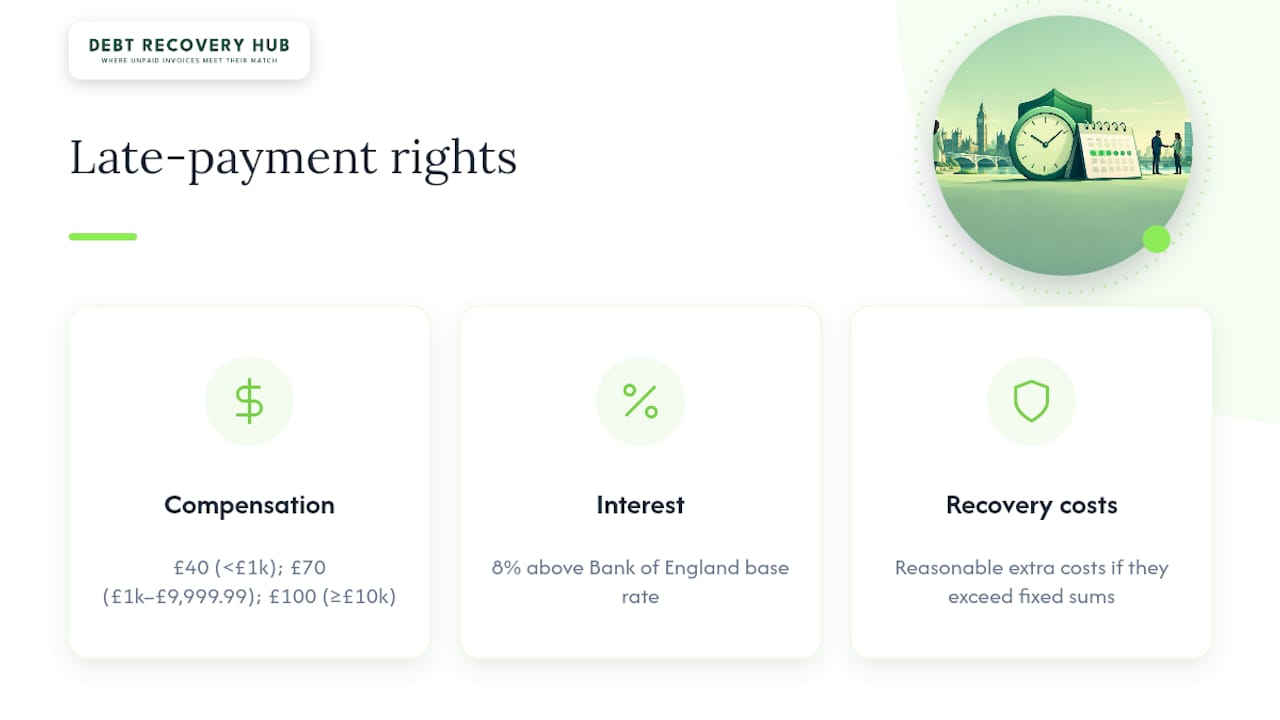
Business creditors chasing unpaid invoices from other businesses have additional rights under the Late Payment of Commercial Debts (Interest) Act 1998.
Qualifying B2B creditors can claim statutory interest of 8% above the Bank of England base rate, together with fixed compensation, under the Late Payment of Commercial Debts Act. The compensation is tiered by debt size: £40 for debts under £1,000, £70 for debts between £1,000 and £9,999.99, and £100 for debts of £10,000 or more. Creditors may also claim reasonable additional recovery costs beyond these fixed sums where those costs genuinely exceed the fixed compensation. Our page on late payment compensation sets out how to calculate and claim it.
Worked examples for calculating your own limitation date
Take an unpaid invoice dated 1 March 2020 with payment due within 30 days, so the debt became due on 31 March 2020. Under the Limitation Act 1980, the six-year period runs from that date, making the debt statute barred from 31 March 2026 unless something restarts the clock.
Now suppose the debtor made a part-payment on 1 June 2023. That payment restarts the six-year clock from that date, pushing the new limitation deadline to 1 June 2029, per National Debtline.
- Locate the original invoice or credit agreement and its exact due date.
- Gather any payment records, including partial payments and their dates.
- Check correspondence for any written acknowledgement of the debt.
- Search the CCJ register for any existing judgment on the debt.
- Use the most recent qualifying date, whether original due date, part-payment or acknowledgement, as your starting point.
Our debt collection checklist walks through gathering this evidence in more detail.
When a vetted matching service adds real value
A detailed intake process, covering debt type, age and amount, allows faster escalation to an agency actually suited to the case rather than a generic one. This matters most for debts approaching the six-year limit, where speed and correct handling both count, and for complex or international debts where the wrong agency wastes weeks. High-value commercial debts also benefit from a bespoke match rather than a one-size-fits-all approach. Readers in these situations gain the most from providing full case details upfront rather than contacting agencies at random.
Debt collection timelines in Scotland and Northern Ireland
Scotland and Northern Ireland run separate court and enforcement systems from England and Wales, which changes some of the practical timings involved. In Scotland, debt recovery generally proceeds through the Sheriff Court rather than the county court system, and enforcement (known as “diligence”) includes distinct mechanisms such as earnings arrestment and attachment, which follow their own procedural steps and are not identical to English warrants of control or charging orders. Scotland has also seen recent reform activity around debt discoverability rules affecting older debts, covered in our piece on debt discoverability reform.
Northern Ireland similarly operates its own court structure, with money claims processed through its own small claims and county court systems rather than Money Claim Online, which is an England and Wales service. The underlying principle that limitation periods restrict how long a debt remains legally enforceable applies across the UK, but the exact statutory periods and procedural rules are set separately in Scotland and Northern Ireland rather than by the Limitation Act 1980, which applies to England and Wales. Creditors operating across more than one UK jurisdiction should treat each nation’s timeline and enforcement route as a distinct process rather than assuming the England and Wales rules apply uniformly.
How insolvency proceedings change the debt collection timeline
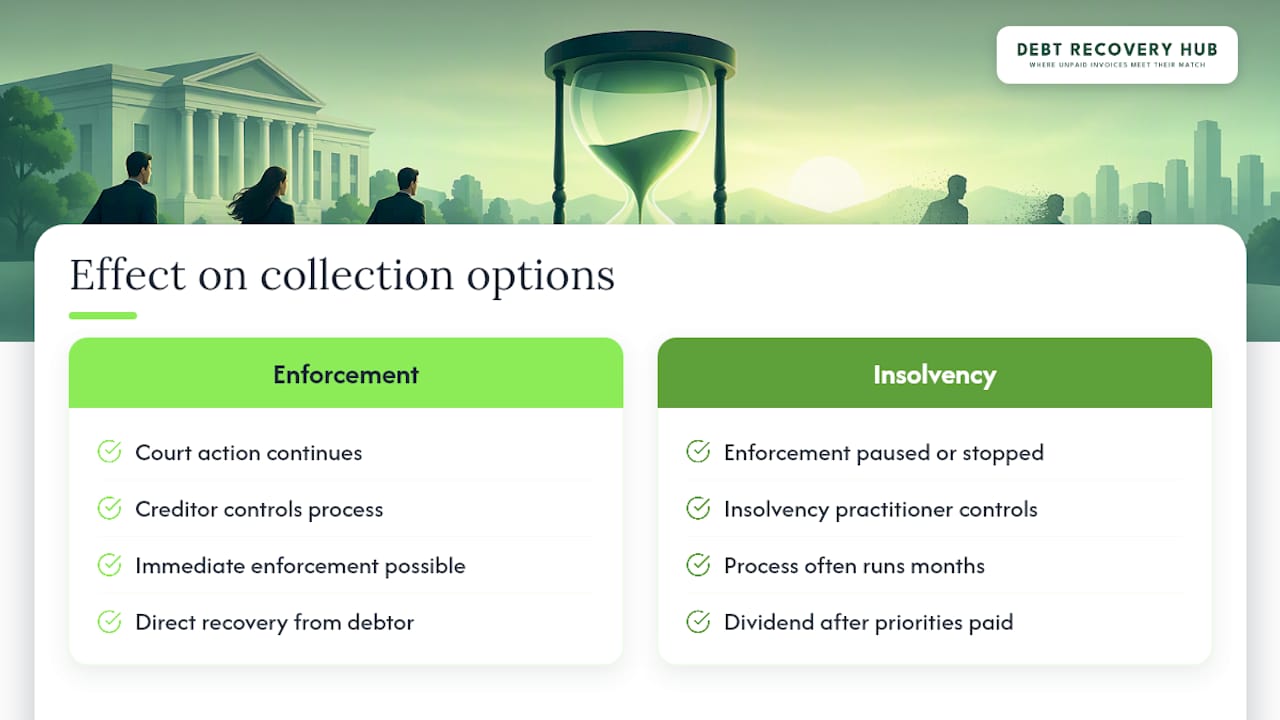
When a debtor enters insolvency, whether through bankruptcy, a company voluntary arrangement or liquidation, individual debt collection action generally has to stop. Creditors are usually required to submit a claim through the formal insolvency process instead of continuing to pursue court action or enforcement directly against the debtor. This can substantially extend the practical timeline for recovery, since insolvency proceedings themselves often run for many months and any dividend to unsecured creditors is typically paid only once the insolvency practitioner has realised the debtor’s assets and settled priority claims.
For a creditor who has already obtained a county court judgment, insolvency proceedings against the debtor generally halt further enforcement action, meaning warrants, charging orders or third-party debt orders in progress may need to be paused or abandoned. This is one of the clearest cases where continuing to chase enforcement independently stops making sense, and where recovery prospects depend far more on the insolvency process than on anything the original creditor can control. Businesses facing this scenario often benefit from a route built for the situation, such as our bad debt recovery service.
Settlement offers and how long they should stay open
Settlement negotiations can happen at almost any stage, from the initial reminder through to after a court judgment has been obtained, and there is no single fixed statutory window for how long an offer must remain open. In practice, creditors following the Pre-Action Protocol for Debt Claims are expected to give a debtor a reasonable period, generally in line with the 30-day reply window, to consider a repayment proposal before proceedings continue.
A settlement offer made during the pre-action period should be given enough time for the debtor to seek debt advice if needed, since courts can take a poor attempt at settlement into account when awarding costs later. Once a repayment agreement is reached, it typically remains open only as long as the debtor keeps to its terms, and a single missed instalment is often enough for a creditor to treat the arrangement as lapsed and resume formal action, provided an updated Letter of Claim is sent first. Businesses juggling multiple outstanding invoices sometimes prefer to hand this negotiation to a specialist rather than manage it invoice by invoice, which is where our unpaid invoice recovery service fits.
Mediation and arbitration timelines for debt disputes
Alternative dispute resolution, including mediation and arbitration, is generally faster than a fully defended court claim, though it depends entirely on both parties agreeing to take part. A single mediation session for a straightforward debt dispute often takes place within a matter of weeks of both sides agreeing to it, rather than the months a contested court hearing can require, since it avoids the court’s own listing queue entirely.
Arbitration tends to sit somewhere between mediation and full litigation in terms of speed, since it still involves formal evidence and a binding decision from an arbitrator, but without some of the procedural steps a court claim requires. For business creditors with a contract that specifies an arbitration clause, this route can be faster than court, though it usually costs more upfront in arbitrator fees. Neither route removes the underlying limitation deadline, so a debt nearing its six-year cut-off under the Limitation Act 1980 still needs court proceedings issued in time if mediation or arbitration does not resolve matters.
Appealing a court judgment in a debt case
A defendant, or occasionally a claimant, who believes a debt judgment was wrongly decided has a limited window to appeal, and that window is generally short and strictly enforced by the courts. Appeals against decisions made by a judge at a hearing typically need to be filed within 21 days of the decision unless the court sets a different period at the time of judgment, and missing this window usually means permission to appeal out of time must be sought, which is granted only in limited circumstances.
An appeal does not automatically pause enforcement of the original judgment unless the court specifically orders a stay, so a creditor may in principle continue enforcement while an appeal is pending unless a stay is granted. This makes the appeal stage one of the less predictable parts of the timeline, since a genuinely contested appeal can add several more months to a case that had already gone through a full defended hearing. For most straightforward debt claims this stage never arises, but it is worth knowing about before assuming a judgment is the definite end of the process.
Why the paperwork matters more than the law
The single biggest lesson from working through these timescales is that the law itself is rarely what slows a case down. The six-year rule is clear, the court deadlines are fixed in days, and the enforcement routes are well documented. What actually determines whether a case takes six weeks or eighteen months is the quality of the creditor’s own records: a dated invoice, a clear paper trail of reminders, and evidence of when a debtor last acknowledged or paid something.
Conventional advice tends to focus heavily on the legal mechanics, the protocol, the court forms, the enforcement options, while underplaying the fact that most delay is self-inflicted through poor documentation. If you take one thing from this article, it should be to calculate your limitation date now, using the worked examples above, and to gather your paperwork before you send another letter. That single step does more to speed up a case than knowing every procedural rule in this guide.
— Jack
Get matched with a vetted agency instead of guessing
Chasing an old invoice or a defended dispute takes real time, and picking the wrong collection agency can waste even more of it. A matching service can link your case, whether a straightforward unpaid invoice, an ageing debt approaching its limitation date, or a more complex commercial claim, to a vetted agency suited to that specific debt type, amount and age.

If you run a business chasing unpaid invoices, start with our Business Debt Recovery service and gather your invoice dates, payment records and any correspondence before submitting your details.
Where to check the rules yourself
- Limitation Act 1980: the statute text setting six and twelve-year limits.
- Pre-Action Protocol for Debt Claims: mandatory pre-court steps and timings.
- Money Claim Online user guide: filing and service timescales.
- National Debtline: plain-English statute barred guidance.
- Bfil: a further perspective on how acknowledgement affects limitation.
Sources
FAQ
How long before a debt becomes uncollectible in the UK?
A simple contract debt in England and Wales generally becomes unenforceable in court after six years from the date it fell due, under the Limitation Act 1980. Debts created by a deed have a longer 12-year limit instead. The debt still exists, but a court will not enforce payment if the debtor raises the time limit as a defence.
Can a debt from 20 years ago be collected?
A simple contract debt that is 20 years old is almost certainly statute barred under the Limitation Act 1980, since the standard limit is six years from when it became due. The exception is a debt created by a deed, which carries a 12-year limit and could still be within time if a later acknowledgement or payment restarted the clock.
What is the 6-year debt rule in the UK?
The six-year rule refers to the general limitation period under the Limitation Act 1980, which prevents most simple contract debts, including credit cards, loans and unpaid invoices, from being enforced through the courts once six years have passed since the debt fell due. A written acknowledgement or a part-payment restarts that six-year clock, per National Debtline.
How long before a debt is legally written off?
A debt is not automatically written off; it becomes statute barred, meaning the creditor can no longer use the courts to force payment once the six-year period (or 12 years for a deed) has passed. The debtor can still choose to pay voluntarily, and the debt may remain on record even after it becomes unenforceable.