
Follow this checklist to recover overdue invoices efficiently: verify the invoice, send the first reminder on day 1, escalate on a 15/30/45/60-day cadence, preserve evidence throughout, and prepare a compliant letter before action before anyone mentions court.
That’s the whole system in one sentence. Everything else in this article is detail on how to run it without losing money to disputes, missed deadlines, or a debtor who simply stops answering the phone.
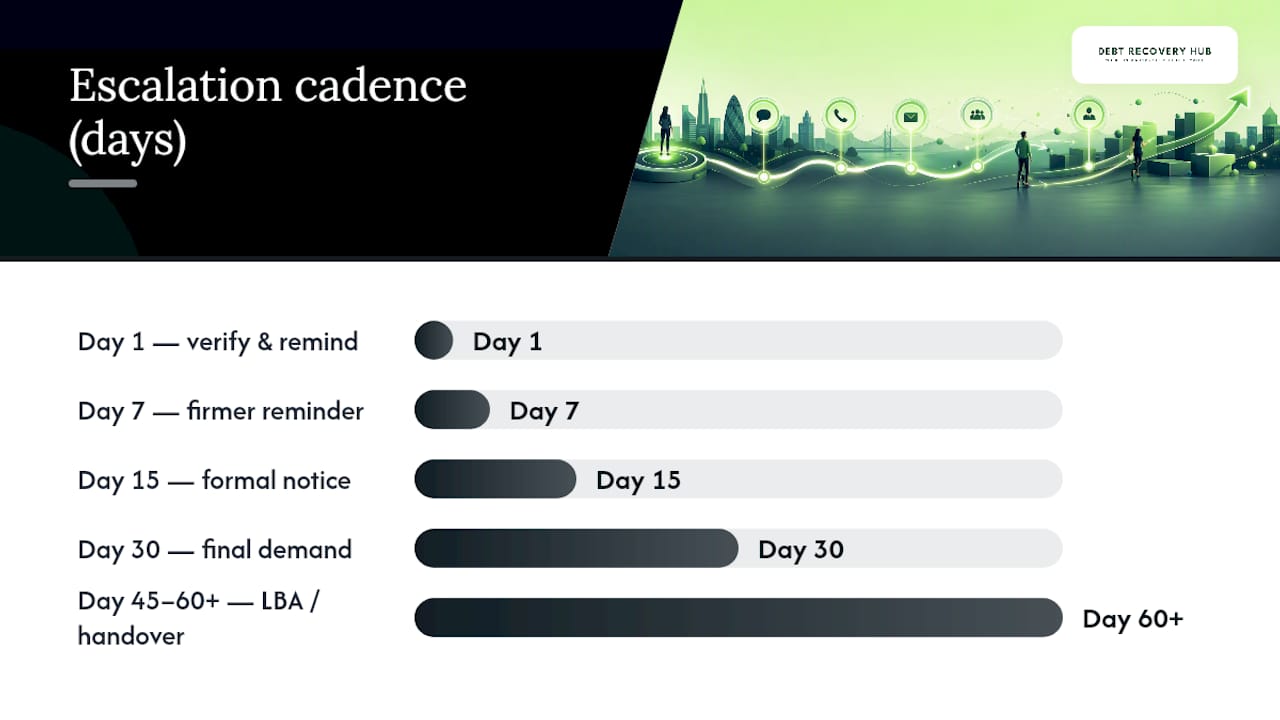
Here’s the immediate action list, with suggested days attached so your credit control record shows exactly when each contact happened:
- Day 1: Confirm the invoice is accurate. Wrong PO numbers or disputed pricing kill more recoveries than any debtor’s excuse.
- Day 1: Send a friendly, factual reminder by email and, if the relationship warrants it, a phone call.
- Day 7: Second reminder, slightly firmer tone, restating the amount and due date.
- Day 15: Formal written notice with a fixed deadline for payment.
- Day 30: Final demand, referencing prior contacts and stating the next step is a formal letter.
- Day 45: Issue a letter before action if the debt remains unresolved. This is the one non-negotiable legal step before litigation, and courts expect to see it.
- Day 60+: Hand the file to a collection agency or solicitor, or refer it through a matching service such as Debtrecoveryhub.
A staged internal recovery process resolves the majority of recoverable invoices within the first 60 days when the cadence above is followed consistently, and the friendly reminder in week one recovers the most low-friction debts. Miss that window and recovery odds drop sharply, which is exactly why the schedule matters more than the wording of any individual letter.
Key Takeaways
Consistent staged escalation, from a day-1 reminder through a compliant letter before action, recovers more debt than aggressive or delayed contact ever does.
| Point | Details |
|---|---|
| Start immediately | Verify the invoice and send the first reminder on day 1, not day 30. |
| Follow a fixed cadence | Escalate at days 7, 15, 30, 45, and 60 rather than reacting ad hoc. |
| Send a letter before action | Issue it around day 45, with a clear deadline, before considering court. |
| Keep a complete evidence file | Contracts, invoices, delivery proof, and a full communication log speed up any escalation. |
| Match debt to the right route | Use balance size, age, and evidence strength to choose between an agency and legal action. |
Table of Contents
- Debt collection checklist: the day-by-day escalation timeline
- What must a letter before action include?
- What documents do you need for escalation or court?
- When should you escalate to an agency or go legal?
- How Debtrecoveryhub fits into this checklist
- What actually matters in this process
- Sources
- FAQ
Debt collection checklist: the day-by-day escalation timeline
The schedule above tells you when to act. This section tells you what to actually do at each point, who inside your business should own it, and how to avoid the two mistakes that derail most in-house recovery efforts: acting too slowly, and escalating without a paper trail.
Pre-issue checks (before you send anything)
Before you chase a single invoice, confirm the basics. A shocking number of “unpaid” invoices are actually disputed invoices in disguise.
- Match the invoice to the contract or purchase order. Check the agreed price, quantity, and payment terms word for word.
- Confirm delivery or completion. If goods were delivered or work finished, you need proof, not just an assumption.
- Check deposit and staged-payment terms. If the contract allowed partial payment, make sure you’re chasing the correct outstanding balance, not the full invoice value.
- Verify the debtor’s legal identity. Is it a limited company, a sole trader, or an individual? This determines who you can legally pursue and what address to use for formal notices.
Skipping this stage is the single biggest cause of wasted collection effort. Chase the wrong entity, or chase an amount the debtor genuinely disputes, and you’ve handed them a legitimate reason to stall for weeks.
Days 0 to 14: automated reminder and first human contact
Your credit control system should fire an automated reminder the moment an invoice goes overdue, ideally by day 1. Keep the tone neutral and administrative. Something like: “Our records show invoice #1234 for £X is now overdue. Please arrange payment or contact us if there’s a query.” No threats, no urgency theatre.

By day 7, a human should follow up, by phone if the account is large enough to justify it, or by a more personalised email otherwise. This is where early automation captures the highest-leverage recoveries of the entire process. Most debtors who intend to pay do so somewhere in this window, once someone has clearly flagged the invoice as a priority.
Own this stage internally with whoever manages accounts receivable day-to-day, not a director. It should be routine, not escalated.
Days 15 to 45: formal notice and demand for payment
If day 14 passes with no payment and no response, the tone shifts. Send a formal written notice restating the debt, referencing all prior contact attempts, and setting a firm deadline, typically 7 to 14 days.
Check your contract for a late payment interest clause before adding charges. If the contract is silent, statutory interest under the Late Payment of Commercial Debts (Interest) Act may apply for business-to-business debts, but confirm this before quoting a figure to the debtor.
By day 30, if there’s still silence, issue a final demand. State plainly that the next step is a formal pre-action letter, and that legal costs may follow if the matter proceeds further. This is also the point to flag the account to whoever owns escalation decisions, usually a finance manager or the business owner directly.
Days 45 to 60: pre-collection warning and file preparation
Around day 45, issue what’s sometimes called a final warning or pre-collection notice, distinct from the formal letter before action covered in the next section. This gives the debtor one last clear opportunity before you hand the case to a third party.

Use this window to prepare the file rather than wait passively. Pull together the contract, invoices, delivery evidence, and a full log of every contact attempt. Debtors who were going to pay quietly during a warning period usually do so here.
Day 60+: handover to an agency or solicitor
Once you pass day 60 with no resolution, further in-house chasing rarely changes the outcome. A structured collection process built around intake, balance verification, and monitored escalation is what agencies run once a file lands with them, and they expect that file to be complete on arrival.
Your handover pack should include:
- The signed contract or terms of business
- All invoices and purchase orders
- Proof of delivery or completion
- A full communication log with dates and channels
- Copies of every reminder, notice, and the letter before action
Pro Tip: Track two numbers as you run this process: days sales outstanding (DSO) and recovery rate by stage. If most of your recoveries happen at day 7 rather than day 30, you’re escalating too slowly elsewhere in the business, and it’s worth tightening the early cadence rather than the late one.
What must a letter before action include?
A letter before action isn’t a formality you rush through to tick a box. Courts in England and Wales expect to see one before commercial debt claims proceed, and a poorly drafted letter can undermine your position later, even if the underlying debt is completely legitimate.
The letter should state, in plain terms:
- The exact amount owed, broken down by invoice
- Invoice references, dates, and the original due dates
- A summary of the goods or services provided
- The proposed remedy, almost always full payment by a specific date
- A clear deadline, typically 14 to 30 days depending on the debt type
- The consequences of non-payment, including potential court proceedings and cost liability
Confirming the debtor’s identity matters more than most creditors realise. If you’re pursuing a limited company, check its registered name and address at Companies House rather than the trading name on old correspondence. Get this wrong and you risk sending a legally significant document to the wrong entity entirely, which can delay or derail a later claim.
A short compliance checklist keeps the letter usable as evidence if the matter escalates:
- Send it by a trackable method, recorded delivery or a service that confirms receipt
- Keep a dated copy of the letter itself, not just the template
- Attach or reference copies of every prior reminder and notice
- Sign it personally rather than sending an unsigned system-generated copy
- Store proof of postage or delivery alongside the file
Debtrecoveryhub’s pre-action protocol guide for UK creditors walks through the procedural detail in full, and it’s worth reading before you send your first letter rather than after a debtor challenges it. Government consultation documents on debt repayment procedures also set out the kind of notice periods and creditor notification expectations that shape what “fair” pre-action conduct looks like in practice.
For larger or contested debts, a solicitor-drafted letter carries genuine weight. Attorney demand letters often recover accounts that would otherwise drift into full litigation, at a fraction of the cost, simply because a legal letterhead changes how seriously a debtor treats the claim. If the debtor has gone quiet entirely or disputes liability outright, that’s the point to get legal review rather than sending another internal template.
What documents do you need for escalation or court?
Meticulous record-keeping is what separates recoveries that succeed from ones that stall in dispute. Practitioners consistently point to documentation, not aggression or persistence, as the real driver of successful outcomes, and an escalation without a solid paper trail rarely goes anywhere useful.
Your file should include:
- The signed contract, terms of business, or purchase order
- Every invoice, with dates and reference numbers
- Delivery confirmations or signed acceptance of work
- Proof of performance where the debt relates to services
- A full communication log
- Proof of delivery for every formal notice and the letter before action
| Document type | What it proves |
|---|---|
| Contract or PO | The agreed terms and payment obligation |
| Invoices | The specific amount owed and when it fell due |
| Delivery or acceptance record | Goods or services were actually provided |
| Communication log | A consistent, good-faith attempt to resolve the debt |
| Proof of delivery for notices | The debtor received formal warnings before escalation |
Format your communication log consistently: date, sender and recipient, channel used, a one-line summary of content, and any attachment reference. This single habit prevents the “we never received that” argument that derails so many escalations.
For proof of delivery, recorded post, courier tracking, or an email delivery and read receipt all work, though recorded post carries the most weight if a dispute reaches court. Keep digital files indexed by date and stage, not scattered across email threads, so a handover to an agency or solicitor takes minutes rather than days.
When should you escalate to an agency or go legal?
The decision usually comes down to four factors: the size of the balance, how old the debt is, how complete your evidence file is, and whether the debtor is still responsive at all.
Smaller balances with a complete file tend to suit a collection agency working on contingency. Larger balances, or ones where the debtor has assets worth pursuing, may justify fixed-fee legal action instead, since contingency fees on a large sum can outweigh a solicitor’s flat cost.
Consider these triggers together, not in isolation:
- Debt age: the older it gets, the harder it is to recover, so don’t wait past 60 to 90 days to decide.
- Evidence completeness: a full file speeds up agency intake and reduces the fees lost to unnecessary discovery work.
- Debtor responsiveness: silence after multiple contacts is a stronger signal to escalate than a debtor who’s negotiating, even slowly.
- Solvency indicators: a debtor facing genuine financial difficulty may already be in, or heading towards, a debt management plan, which changes the calculus around legal action.
Before handing a file over, prepare a short briefing: the debt amount, key dates, a summary of contact attempts, and the complete document pack described above. Agencies and solicitors move faster, and often charge less, when they don’t have to chase you for basic facts first.
Some cases simply aren’t worth pursuing further. If the debtor is untraceable, if your evidence file has genuine gaps you can’t fill retrospectively, or if the debt is small relative to likely legal costs, cutting losses is the financially sound call, not a failure of process.
Pro Tip: If a debtor mentions they’re on a debt management plan, don’t assume you’re out of options. Creditors aren’t obliged to freeze interest or charges, and you can still negotiate directly, though aggressive escalation against someone already in a formal plan rarely improves your recovery odds.
How Debtrecoveryhub fits into this checklist
Once a file passes day 60 and you’ve decided escalation is the right call, the next challenge is picking the right agency, and getting that wrong wastes the weeks you’ve just spent building a clean file. Debtrecoveryhub gathers the debt type, amount, age, and location details you’ve already collected in this checklist and uses them to match your case to a vetted agency suited to it, rather than leaving you to choose blind.
That intake process does the work of narrowing dozens of possible agencies down to ones with a genuine track record on cases like yours, including specialist and cross-border situations covered in Debtrecoveryhub’s international debt recovery guide. The emphasis throughout is on ethical, compliant collection, in line with Debtrecoveryhub’s ethical debt collection guide.
To prepare a lead for submission, use exactly the file you built in the documentation section above: contract, invoices, delivery proof, communication log, and copies of every notice sent.
| Step | What to prepare |
|---|---|
| Debt details | Amount, age, and type of debt |
| Debtor information | Legal identity and last known contact details |
| Evidence file | Contract, invoices, delivery proof, communication log |
| Prior action taken | Copies of reminders, notices, and the letter before action |
What actually matters in this process
Most debt collection advice obsesses over tone: be firm, be polite, sound professional. That’s not wrong, but it’s not where the real leverage is either. The businesses that recover money consistently are the ones with boring, reliable systems, not the ones with the cleverest phone script.
The conventional advice undersells documentation until it’s too late. Everyone talks about it once a case reaches a solicitor, but by then the gaps are already baked in. Build the file from day 1, not day 45.
If you take one thing from this, take the cadence, not the wording. A predictable schedule does more work than any individual letter, because it removes the guesswork about when to escalate. And when it’s time to hand a case off, don’t default to the first agency you find. A matching process that accounts for debt type and debtor location, which is exactly what Debtrecoveryhub does, beats a generic search every time.
This article is general information, not a substitute for advice from a qualified financial advisor. Consult a qualified financial professional about your own circumstances before acting on anything here.
Sources
- Gov
- Debt recovery process: step-by-step guide – Clear Receivables
- SDRP consultation document (final version)
- Debt management plan (DMP) – StepChange
- How the collection process works in debt recovery operations – Tratta
FAQ
What should you never say to a debt collector?
Never admit the debt is definitely yours without checking the details first, and never agree to a payment plan verbally without getting it confirmed in writing.
What are the “11 words” people mention for dealing with debt collectors?
This refers to a phrase some consumer advice sites suggest using to request written validation of a debt, such as asking the collector to “please stop calling me” or “put everything in writing.” Definitions of this phrase vary between sources, so treat it as a starting point for a written request, not a legal script.
What are the rules for debt collection in the UK?
UK creditors must follow fair pre-action conduct, including reasonable notice and a letter before action ahead of court proceedings, and cannot use misleading or harassing tactics. Consumer debtors also have protections around debt management plans and repayment arrangements, as set out by StepChange.
Do I still have to pay if my debt was sold to a collection agency?
Yes. Selling a debt to a collection agency doesn’t cancel the obligation, it simply transfers who you owe the money to, and the agency has the same right to pursue payment as the original creditor did.