
Instructing a vetted UK debt collection agency is often the quickest, compliant way to recover unpaid invoices from a distressed company, provided you act before the position worsens. The first move is not to chase harder but to gather and preserve evidence: invoices, signed contracts, delivery notes, all correspondence, and a company registration check. Once that file exists, statutory interest and fixed compensation become additional sums worth claiming on top of the principal debt.
TL;DR:
- Agencies verify the debtor’s trading status and follow a sequence of contact, negotiation, and asset tracing before involving solicitors.
- Signs of distress, such as late payments, asset stripping, or phoenix activity, should prompt immediate action within weeks to prevent asset loss.
- Statutory interest of 8% plus the Bank of England base rate and fixed compensation of up to £100 can significantly boost recovery amounts.
- Choosing an agency with experience in distressed debt cases and clear data handling practices increases chances of successful recovery.
- Clear, complete documentation and prompt instruction are key to faster settlement and may reduce the need for lengthy court proceedings.
Table of Contents
- What UK debt collection agencies do for creditors facing distressed firms
- When should you instruct an agency for a distressed or potentially insolvent debtor?
- What you can claim: statutory interest, fixed compensation and court fees
- How to choose and brief a reputable UK debt collection agency
- What to expect after instruction: timelines and warning signs
- How Debtrecoveryhub matches creditors to vetted UK agencies
- How a matching service can help and next steps
- Sources
- FAQ
What UK debt collection agencies do for creditors facing distressed firms
A UK debt collection agency’s job starts with checking your paperwork: invoices, contract terms, proof of delivery, and any prior demands. From there, most agencies follow a similar sequence.
- Verify the debt and confirm the debtor’s current trading and registration status.
- Make direct commercial contact by letter, phone and email to open negotiation.
- Attempt settlement, including payment plans where the debtor shows genuine but temporary distress.
- Trace the debtor or its assets if contact details are out of date or the company has moved.
- Refer the file to solicitors for litigation if negotiation fails and the debt is worth pursuing further.
What agencies do not do is run formal insolvency procedures. Administration, liquidation and creditor voting on proposals are handled by licensed insolvency practitioners, not collection agencies, and that boundary matters because the two roles use different powers and different rules. An agency’s strength is fast, direct commercial pressure; documented evidence from this stage, timestamps of contact, written responses, part-payments, also supports court action later if the debtor cannot be brought to settle. Our B2B debt collection guide covers this recovery process in more depth.
When should you instruct an agency for a distressed or potentially insolvent debtor?
Distress signs rarely announce themselves cleanly. Late payments that were once occasional turning into a pattern, bounced cheques, a sudden change of directors, or a company quietly stripping assets into a similarly named new entity are all reasons to move quickly rather than wait for a clearer signal.
- Check the debt’s size and age: older, larger debts lose recovery value the longer they sit unpaid.
- Weigh the commercial relationship: a valued ongoing customer may warrant a softer, negotiated approach first.
- Confirm your documentation is complete before instructing anyone, since gaps slow every later step.
- Watch for phoenix activity, where a company closes and a near-identical business reopens under a new name.
- Escalate faster to litigation or specialist advice if you see multiple distress signals at once.
Pro Tip: If you suspect phoenix activity, act within weeks rather than months. Evidence of asset transfers becomes harder to trace the longer you leave it.
What you can claim: statutory interest, fixed compensation and court fees
Recovering the principal is only part of the picture. UK law gives business creditors extra tools that many never use.
- Business-to-business debts carry statutory interest of 8% plus the Bank of England base rate unless the contract sets a different, substantial remedy, and the calculation should use the full invoice value including VAT.
- Fixed compensation is also claimable under the Late Payment of Commercial Debts (Interest) Act 1998: £40 for debts under £1,000, £70 for debts between £1,000 and £9,999.99, and £100 for debts of £10,000 or more.
- Reasonable additional recovery costs beyond the fixed sum may also be claimed where they are genuinely incurred.
- If escalation to court becomes necessary, civil court fees and enforcement application fees are tiered by claim value, with separate charges for steps such as third-party debt orders or charging orders.
A defensible interest and compensation figure is easier to produce than most creditors assume. The Small Business Commissioner’s interest calculator guidance sets out how to work out statutory interest and compensation, and notes a six-year time limit for claiming interest on an unpaid invoice. Many creditors never claim the fixed compensation tiers at all, simply because they draft a chasing email instead of a proper new invoice showing interest and compensation added. That single change often speeds up payment. Our guide to late payment act interest walks through the calculation in full.
How to choose and brief a reputable UK debt collection agency
Not every agency handles distressed-company cases well, so selection matters as much as timing.
- Confirm the agency’s data-handling practices meet ICO expectations, since responsibility for compliant data use sits with whoever processes it.
- Ask about experience specifically with distressed or insolvent debtors, not just routine late payers.
- Get fee structures and VAT treatment in writing before instructing, since debt collection services are generally standard-rated for VAT.
- Ask what happens if negotiation fails: does the agency have a clear route to solicitors, or does the file simply stall?
- Check how often you will get updates, and in what format.
Before instructing, prepare a briefing pack: original invoices, the signed contract or terms of business, a timeline of contact attempts with dates, agreed payment terms, a company registration check, your bank details for receiving funds, and any note of a dispute the debtor has raised. A thin file slows an agency down before it has even started.
Pro Tip: Ask a prospective agency how they source and verify debtor contact details. A vague answer here is often the clearest red flag you will get.
Red flags include reluctance to explain fees, no clear complaints process, and pressure to hand over data before explaining how it will be stored or used. Our GDPR and debt collection guide sets out what compliant data handling should look like in practice, and our debt recovery letters checklist covers what a strong demand letter needs to include.
What to expect after instruction: timelines and warning signs
Most agencies move through recognisable phases: an initial contact and verification stage, a negotiation window where settlement or a payment plan is proposed, and, if that fails, referral to solicitors or court. How long each phase takes depends heavily on the debtor’s responsiveness and the completeness of your file.
Outcomes vary widely, and three factors tend to decide them.
- How complete and well-timestamped your original documentation is.
- Whether the debtor has recoverable assets or income at all.
- Whether early signs of insolvency were already present when you instructed the agency.
Watch for behaviour that suggests an agency is cutting corners: no clear explanation of where debtor contact data came from, communications that tip into harassment rather than firm professionalism, or fee arrangements that only become clear after work has started. Proportionate, well-documented pre-action conduct, the kind courts expect to see if a case eventually reaches litigation, tends to produce faster settlements without ever needing to go that far. Our pre-action debt recovery guide explains what that looks like in practice.
How Debtrecoveryhub matches creditors to vetted UK agencies
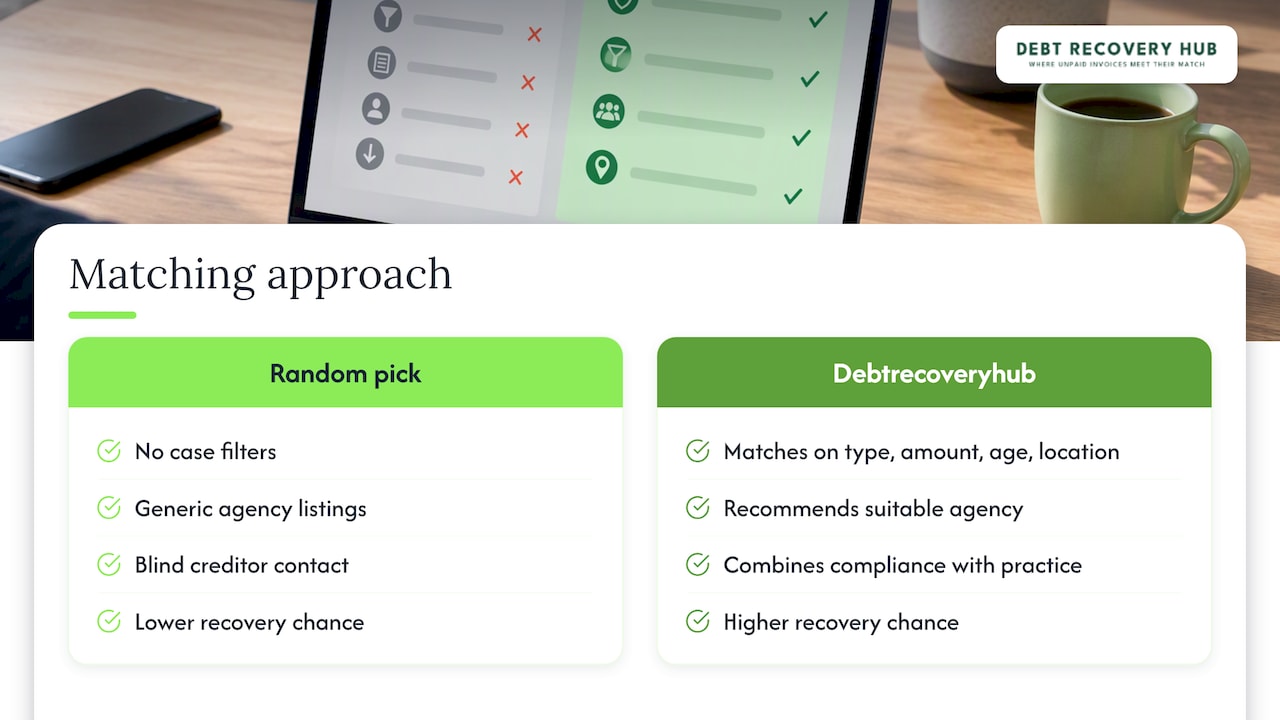
Debtrecoveryhub works from the same principle this guide follows: recovery outcomes improve when the right agency is matched to the right case, rather than a creditor picking a name at random. We gather the details that actually affect recovery, debt type, amount, age and location, before recommending an agency, so the match reflects the realities of your case rather than a generic listing.
That upfront intake is the point. A creditor chasing a £2,000 unpaid invoice from a local supplier needs a different agency than one dealing with a six-figure trade debt from a company showing signs of financial distress. Matching on those specifics, rather than leaving creditors to contact agencies blind, is how Debtrecoveryhub aims to combine compliant practice with a genuine chance of recovery.
— Jack
How a matching service can help and next steps
If you are already gathering invoices and chasing a distressed debtor, the next decision is which agency to trust with the file. A matching service can take the case details you would give any agency anyway—debt type, amount, age and location—and use them to recommend agencies suited to that case rather than providing a generic list.

- Coverage may include business debt, property-related debts, international cases and more complex or phoenix-style scenarios.
- The intake process may be detailed but free to use, with no obligation to proceed once you see the matches.
- You can get a shortlist of vetted agencies rather than a single blind pick.
If your debt sits with a UK business, start with our business debt recovery page. For debts crossing multiple categories, or if you are unsure where yours fits, the main platform page will guide you to the right match.
Sources
The figures and rules in this guide come directly from primary UK sources, worth bookmarking if you handle recovery cases regularly.
- Late Payment of Commercial Debts (Interest) Act 1998 — section 5A
- Gov
- Interest calculator guidance — Small Business Commissioner
FAQ
Can I still recover a debt if the company looks insolvent?
Often yes, particularly if you act early and the company still has trading income or assets. A debt collection agency can attempt negotiated recovery well before any formal insolvency process begins, which is why documenting the debt and moving quickly matters.
What interest and compensation can I add to an unpaid invoice?
Business debts carry statutory interest of 8% plus the Bank of England base rate, plus fixed compensation of £40, £70 or £100 depending on the debt’s size. Reasonable additional recovery costs beyond that fixed sum may also be claimable.
How is a debt collection agency different from an insolvency practitioner?
An agency negotiates directly with the debtor to recover money owed to you, using contact, pressure and settlement talks. An insolvency practitioner instead runs formal legal processes such as administration or liquidation once a company has entered those procedures.
How does Debtrecoveryhub choose which agency to recommend?
Debtrecoveryhub gathers details on the debt’s type, amount, age and location, then matches your case to agencies suited to that profile rather than offering one generic option. The intake is free and comes with no obligation to proceed with any match offered.
How long does debt recovery from a struggling company usually take?
Timelines vary with the debtor’s responsiveness and how complete your documentation is, ranging from a quick negotiated settlement to a longer process ending in court referral. Cases with strong paperwork and early action tend to move faster than those started once a debtor is already in serious difficulty.