
There’s no legal minimum debt for collection in the UK. You can send a debt of £5 or £50,000 to an agency and neither is against the law. What actually decides whether it gets picked up is economics: agencies weigh their own commercial thresholds against your evidence, the debt’s age, and whether it makes sense to chase at all.
TL;DR:
- Most collection agencies consider debts as low as £50 to £200 viable, but small balances below this often become unprofitable due to admin and recovery costs.
- Contingency fees for small debts typically range from 15% to over 40%, increasing as the debt ages or becomes harder to trace.
- Bundling multiple small debts or acting within 90 days of unpaid invoices increases the chances of successful recovery and reduces costs.
- Court action is usually only economical once debts reach a few hundred pounds or more, as legal fees often outweigh the debt for smaller amounts.
- Proper documentation and early action significantly improve recovery prospects, especially when using a platform that matches debts with suitable vetted agencies.
Table of Contents
- What the law and credit reporting rules say about minimum debts
- Industry norms: typical thresholds and contingency fees for small debts
- How to decide whether to pursue a small debt
- Practical steps to make a small debt collectable
- How a specialist matching platform helps place small or bundled debts
- Common mistakes businesses make with small debts
- Get vetted agencies matched to your small or bundled debts
- Sources
- FAQ
What the law and credit reporting rules say about minimum debts
No statute stops a business from placing any unpaid balance into collections, however small. SW Recovery’s summary of collections practice confirms there’s no legal floor. The law doesn’t care whether the debt is £8 or £8,000; it cares about how the debt was created and how it’s pursued.
Where things diverge sharply is economics, not legality. A court claim carries filing fees, admin time, and (for higher-value claims) legal costs that quickly outstrip a small balance. That’s why litigation and collections operate on completely different thresholds, even though both are legally available at any amount.
A few other factors shape whether a small debt is worth reporting or chasing at all:
- Credit reference agencies and lenders use their own internal thresholds for what gets flagged on a credit file, separate from collections practice.
- Consumer debts and business debts sit under different regulatory regimes, which affects how communication and enforcement must be handled.
- Statute-barred rules mean debts unpursued for a set number of years (typically six in England and Wales for most unsecured debts) become far harder to recover, regardless of size.
None of this creates a minimum. It just means the further you get from “clean, recent, well-documented invoice,” the more the economics work against you.
Industry norms: typical thresholds and contingency fees for small debts
Agencies aren’t obliged to take every account, and most won’t bother with certain ones. Small-BizSense’s cost-benefit analysis points to informal thresholds commonly sitting around £50 to £200 per individual account. Below that, the agency’s own admin cost, letters, calls, tracing, can eat the entire recovery, so it stops making sense to run the case.
Contingency fees typically range from around 15% up to 40% or higher, depending on debt age and complexity, with the percentage climbing as debts age or become harder to trace, according to SW Recovery. A fresh £500 invoice might cost 15% to collect. A three-year-old £500 invoice with a disconnected phone number could cost 40% or more, if an agency accepts it at all.
Three things push an agency to say yes to a small debt anyway:
- Portfolio placement. Bundling dozens or hundreds of small accounts together spreads fixed costs across the batch, which is exactly what Small-BizSense identifies as the mechanism that makes low-value debts viable.
- Freshness. Invoices under 90 days old recover far more reliably than aged ones, so agencies price and accept them differently.
- Documentation quality. A complete paper trail lowers the agency’s setup cost, which matters more on small accounts than large ones.
How to decide whether to pursue a small debt
Before you place anything, work out whether collection actually pays. The formula is simple:
- Estimate the debt value. Use the exact outstanding amount, not the original invoice if partial payments have been made.
- Estimate recovery probability. Be honest, and conservative for anything over 90 days old. A six-month-old unpaid invoice with no response might realistically sit at 30 to 40% probability, not 80%.
- Apply the contingency rate. Multiply the debt by the probability, then by (1 minus the contingency percentage).
- Subtract your internal admin cost. Time spent chasing, invoicing, and liaising with the agency has a real cost even if no cheque changes hands.
- Compare the net figure against your threshold for bothering. If it’s negative or trivial, you have your answer.
A worked example: a debt example with a certain amount, recovery probability, contingency fee, and internal admin time nets out at a viable sum, calculated by debt × probability × (1 – contingency fee) minus admin cost. That’s a viable placement, particularly if it’s bundled with other accounts.
Litigation sits on a different scale entirely. HP Sears notes that court action typically only becomes economical once a debt reaches a balance in the range of low hundreds to low thousands, depending on court fees and whether legal representation is needed. Below that, a small claims track filing might cost more in fees and time than the debt itself.
Pro Tip: Don’t judge a small debt purely on the net-recovery number. A repeat late payer worth thousands a year in future business might justify chasing a £60 balance on principle alone, because letting it slide signals you won’t enforce your own terms.
Non-financial factors matter here too: the reputational and deterrent value of pursuing debt is often as important as the cash itself, particularly for repeat customers.
Practical steps to make a small debt collectable
The single biggest lever you control is documentation. Latimer Legal Solicitors’ evidence checklist shows that agencies accept and recover low-value debts far more readily when the paperwork is already in order.
Before placing any account, pull together:
- The signed agreement or terms of business the debt is based on.
- The original invoice and any proof of delivery or completed work.
- A full communications log, every email, call, and letter chasing payment.
- Current contact details, including any updated address or phone number.
- A pre-action letter already sent, showing you gave the debtor a fair chance to respond.
Two tactical moves improve your odds further. First, bundle small accounts rather than placing them one at a time, since batch submissions are cheaper for an agency to process and more attractive to accept. Second, act early. Debts under three months old are considerably easier to recover than ones left to age, so don’t wait until a small balance becomes an old, cold one before you escalate it.
How a specialist matching platform helps place small or bundled debts
Agencies reject far more small accounts than large ones, mostly because they can’t judge risk quickly with thin information. A detailed intake, debt type, age, amount, documentation on hand, gives an agency everything it needs to price and accept a case fast, rather than passing on it out of uncertainty.
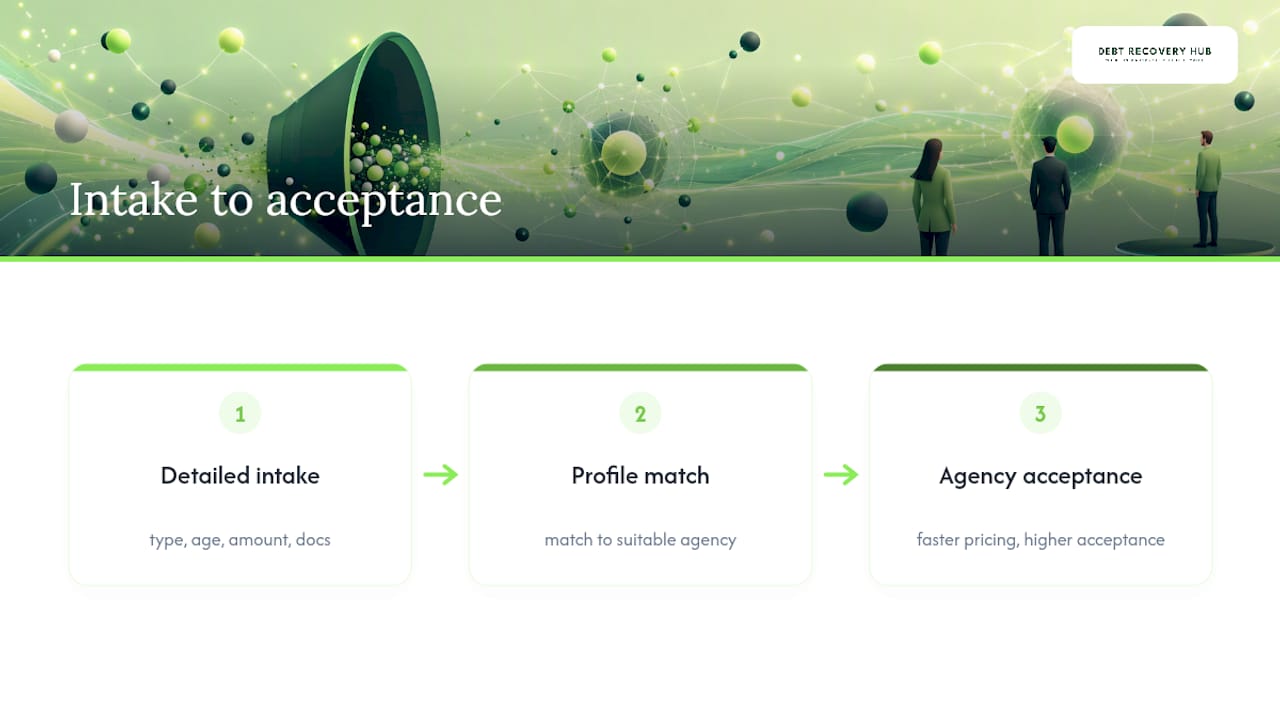
That’s the practical case for using a platform like Debtrecoveryhub rather than cold-approaching agencies one by one. It’s particularly useful if you’re holding a portfolio of small overdue invoices, have limited internal admin capacity to chase each one individually, or simply want vetted partners rather than a guessing game. Matching the right debt profile to the right agency, rather than sending every account to whichever firm you found first, tends to raise acceptance rates on exactly the low-value cases that get turned away most often.
Common mistakes businesses make with small debts
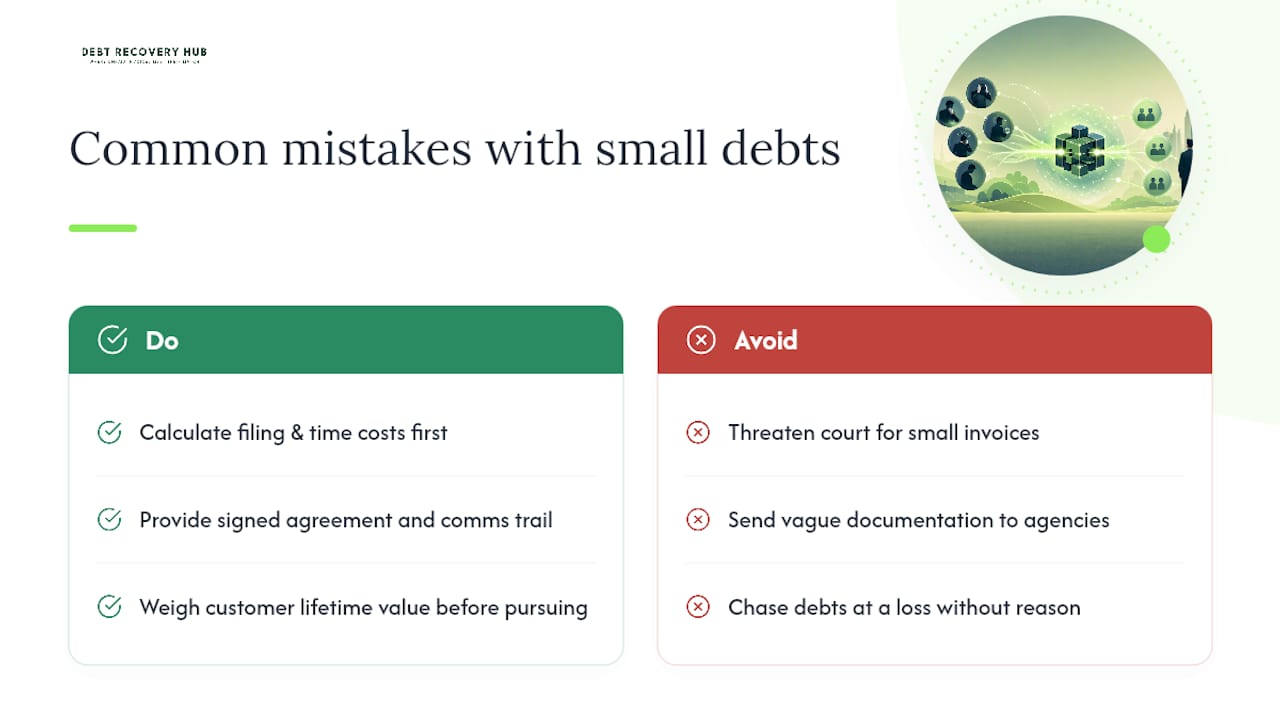
The biggest mistake I see is businesses jumping straight to threats of court action on a £150 invoice, when the filing fee and time cost more than the debt. Litigation has its place, but only once the maths clearly supports it.
The second mistake is weak documentation, sending an agency a vague description instead of a signed agreement and a communications trail. And sometimes chasing a small debt at a loss is still the right call: protecting your terms with a repeat customer is worth more than the number on the invoice.
— Jack
Get vetted agencies matched to your small or bundled debts
A specialist platform can serve as an alternative to cold-calling agencies one by one: submit your case details once, including debt type, amount, age, and documentation, and receive matches with vetted partners who are able to handle accounts of various sizes.

That matters most if you’re sitting on a stack of low-value invoices rather than one big one. Instead of guessing which agency will bother with a £120 account, the intake process surfaces partners suited to exactly that profile, individually or as a bundled portfolio. If your case looks like it’s heading towards court rather than a standard placement, the same intake also flags legal debt recovery routes worth considering.
Start by submitting your case details on the debt collection page and see which vetted agencies are matched to your debt’s profile.
Sources
- Is there a minimum amount to send to collections? | SW Recovery
- Minimum debt amount to send to collections: SMB cost‑benefit equation explained | Small‑BizSense
- Debt recovery documents and evidence checklist | Latimer Legal Solicitors
FAQ
What is the lowest amount debt collectors will accept?
There’s no fixed floor, but most agencies apply informal thresholds around an informal threshold commonly around £50 to £200 per individual account, below which admin costs outweigh likely recovery. Bundled or portfolio placements can make smaller balances viable.
Is there a minimum amount to go to collections?
No, there’s no legal minimum debt for collection agencies to accept. Any unpaid balance can legally be placed, though whether an agency chooses to take it on depends on their own commercial thresholds.
How long before a debt is uncollectible in the UK?
Most unsecured debts in England and Wales become statute-barred after six years without acknowledgement or payment, after which recovery becomes far harder. Rules differ slightly in Scotland and for certain debt types, so check the specific limitation period that applies to your case.
What are the rules for debt collection in the UK?
Collection activity must follow fair treatment rules on contact frequency, tone, and accuracy of information, alongside data protection requirements. There’s no rule setting a minimum debt size, so the same standards apply whether the balance is £50 or £50,000.