

Mutual debts can reduce or completely cancel a money claim where a genuine cross-claim exists, but which rule applies depends on whether the debts arise from the same contract, from separate dealings, or from a formal insolvency. The main routes are contractual set-off, equitable set-off, independent legal set-off, and insolvency set-off. Defendants plead it under CPR 16.6, while insolvency cases fall under section 323 of the Insolvency Act 1986.
TL;DR:
- Legal offset requires two fixed, calculable debts between the same parties acting in the same capacity; equitable offset instead requires closely connected claims.
- Check the contract for a clause barring offset, and confirm neither debt was assigned nor held on trust, since either can defeat mutuality.
- Under CPR 16.6, plead the offset in your defense with its amount, supporting facts, and documents; use a Part 20 claim to recover any excess.
- Section 323 requires insolvency debts to be netted at the insolvency date, including qualifying future or contingent claims; creditors can prove only the balance.
- A Part 36 offer must state whether it accounts for an offset or counterclaim, since ambiguity can fuel later disputes over costs.
Table of Contents
- What set-off is and the main types
- When the right of set-off arises: mutuality and the legal tests
- How to plead set-off in your defence
- Insolvency set-off and automatic netting
- Practical steps if you want to rely on set-off
- Preparing your set-off defence: documents and next steps
- Where defendants usually go wrong
- An alternative route for creditors chasing unpaid debts
- FAQ
- Sources
- Key legislation, rules and guidance
What set-off is and the main types
Set-off works by replacing two separate debts with a single net figure, so instead of each party paying the other in full, only the balance changes hands. This matters because it can shrink a claim, wipe it out entirely, or even leave the original claimant owing money once the cross-claim is accounted for. Legal commentary on set-off) describes it as replacing gross debts between parties with a single net position, which is exactly the outcome a defendant is aiming for when raising it as a defence.
Several recognised types exist, and knowing which one fits your facts changes how you plead it:
- Contractual set-off: an express clause in the agreement allows one debt to be set against another.
- Legal (independent) set-off: two liquidated debts between the same parties, even if they arise from unrelated transactions.
- Equitable (transactional) set-off: claims that are closely connected, such as a contractor’s unpaid invoice against the client’s claim for defective work on the same job.
- Banker’s set-off: a bank’s right to combine a customer’s accounts, applying credit balances against overdrawn ones.
A supplier owed £10,000 for goods, who also caused £4,000 of damage during delivery, illustrates equitable set-off well: the claims arise from the same transaction, so a court is likely to let the £4,000 reduce the £10,000 owed.
When the right of set-off arises: mutuality and the legal tests
Courts look for mutuality first: the debts must be between the same parties, in the same capacity. A claim held personally cannot usually be set off against a debt owed to a company you control, because the legal persons are different even if you feel like the same party.
Liquidated claims (a fixed, calculable sum) are far easier to rely on than unliquidated ones (damages still to be assessed), particularly for legal set-off, which demands both debts be liquidated. Equitable set-off is more forgiving on this point, since it only requires a close connection between the transactions, but the connection still has to be real rather than convenient.
A few practical checks matter before relying on any of this:
- Confirm both debts belong to the same parties acting in the same capacity.
- Check whether the contract contains a clause excluding or restricting set-off.
- Consider whether either debt has been assigned to a third party or is held on trust, since this can break mutuality.
Practitioner guidance warns that a “no set-off” clause in a commercial contract can shut this defence down entirely, so reading the contract before building an argument saves wasted effort.
How to plead set-off in your defence
Under CPR 16.6, a defendant who believes they are owed money by the claimant can include this as a defence of set-off against the whole or part of the claim. This applies whether or not the same facts are also raised as a Part 20 counterclaim, which is a separate additional claim seeking its own judgment rather than simply reducing the claimant’s.
The two routes work differently in practice:
- Set-off alone: pleaded in the defence, it reduces or extinguishes the claim without the defendant seeking a separate judgment.
- Part 20 additional claim: filed alongside the defence, it asks the court for a judgment in the defendant’s favour, useful when the cross-claim exceeds what is owed.
- Both together: common where the defendant wants the set-off recognised and also wants to recover any excess beyond the original claim.
Drafting matters as much as strategy. Particulars of the set-off need a clear figure, the facts giving rise to it, and reference to supporting documents, with the court often asking for directions on disclosure once both sides’ positions are on the table.
Pro Tip: Plead the set-off in the defence even if you also intend to bring a Part 20 claim, since omitting it risks losing the ability to rely on it later.
Insolvency set-off and automatic netting
Where one party is insolvent, the rules change from optional to mandatory. Section 323 of the Insolvency Act 1986 requires an account to be taken of mutual dealings between the insolvent party and its counterparty, with only the net balance being provable or payable. Neither side can opt out once the conditions are met.
This account is taken as at the date insolvency begins, which makes record-keeping up to that point important for anyone with a live claim against a company heading into liquidation or an individual entering bankruptcy.
- The account captures debts that are due, payable in future, and in many cases contingent, provided they are provable.
- Only the net figure after set-off is claimed in the insolvency, not the gross amount.
- Creditors who fail to account for mutual dealings risk having their proof of debt rejected or adjusted.
Preserving invoices, statements and correspondence that show the mutual dealings up to the relevant date helps ensure the right figure gets proved.
Practical steps if you want to rely on set-off
Building a set-off defence that survives scrutiny means assembling evidence early, not scrambling for it once a defence is due. Courts expect a quantified figure tied to source documents, not a round number asserted without support.
- Gather invoices, the underlying contract, payment records, and any written admissions of the debt.
- Prepare a reconciliation showing how the net figure was calculated, listing every invoice, payment and credit.
- Check whether a Part 36 offer has been made or should be made, and whether it states clearly how it treats any set-off or counterclaim.
- Decide whether the amounts and complexity justify instructing a solicitor or whether direct negotiation is more proportionate.
A Part 36 offer must state whether it accounts for a counterclaim or set-off, because that clarity affects the cost consequences if the matter proceeds to judgment. An ambiguous offer can leave both sides arguing about costs long after the substantive dispute is settled.
For businesses still tidying up the paper trail, a bookkeeping clean-up and reconciliation checklist is a useful starting point before trying to quantify a cross-claim for pleadings.
Preparing your set-off defence: documents and next steps
A strong defence rests on the paperwork, not the argument alone. Before filing anything, pull together the invoices, contract terms, correspondence and payment history that show the mutual debts and when they arose.
- Check contract terms for a clause excluding set-off, since this can end the argument before it starts.
- Keep a dated record of correspondence that shows admissions, disputes or partial payments.
- Use a pre-action checklist to confirm you have followed the right steps before court involvement.
- Review the evidence creditors are expected to hold, since the same standard applies when you are the one raising a cross-claim.
Where the dispute sits on the other side, meaning you are the one owed money rather than defending a claim, a debt recovery route rather than a set-off argument may be the better fit, and we cover that option further down.
Where defendants usually go wrong
The most common mistake is assuming mutuality exists without checking whether the debts involve the same parties in the same capacity, which can unravel an otherwise strong defence. A close second is overlooking a contract clause that excludes set-off entirely, and a third is pleading a figure that isn’t tied to clear documents.
My own rule of thumb: weigh what you can actually prove against what the fight will cost, both in legal fees and in the business relationship, before deciding to press the point in court rather than settle it.
— Jack
An alternative route for creditors chasing unpaid debts
Set-off is a defendant’s tool. When we’re the one owed money and a cross-claim isn’t the problem, slow payment or avoidance is, pursuing recovery directly tends to make more sense than waiting for a courtroom argument over mutual debts.

Several services are available that are built for exactly that situation:
- Unpaid Invoice Recovery for businesses chasing overdue invoices where no credible cross-claim exists.
- Business Debt Recovery for broader commercial debts beyond a single invoice.
- Legal Debt Recovery for escalated matters where solicitor-led action is the right next step.
Before reaching out, having the invoice details, correspondence dates and a copy of the underlying contract ready speeds up the process considerably. We match each case to a vetted collection agency based on debt type, amount, age and location rather than leaving you to search blindly, so starting your business debt recovery with those details in hand is the fastest way to see what options are available.
This article is general information, not a substitute for advice from a qualified lawyer. Consult a qualified legal professional about your own circumstances before acting on anything here.
FAQ
What are the rules for set-off in administration?
Set-off in administration follows a similar principle to liquidation: mutual debts between the insolvent company and a creditor are netted so only the balance is provable, under the framework set out in section 323 of the Insolvency Act 1986. The account is taken as at the relevant insolvency date, and creditors should keep records showing mutual dealings up to that point.
What is the common law right of set-off?
The common law (legal, or independent) right of set-off allows two liquidated debts between the same parties to be set against each other, even where they arise from entirely unconnected transactions. It differs from equitable set-off, which requires the cross-claims to be closely connected rather than simply owed between the same two parties.
What is the difference between a set-off and a counterclaim?
Set-off is a defensive argument that reduces or extinguishes what the claimant is owed, while a counterclaim is an additional claim seeking a separate judgment in the defendant’s favour. Practitioner guidance describes this as the shield versus sword distinction, and a defendant can often plead both together.
What does set-off mean in law?
Set-off is the legal mechanism that allows a sum one party owes another to be reduced or cancelled by a genuine debt owed in the other direction, so the parties settle only the net balance. It can arise from a contract term, from equitable principles where claims are closely connected, from independent liquidated debts, or automatically under insolvency rules.
Sources
- The Civil Procedure Rules 1998 — Part 16 (Contents of statement of case)
- Insolvency Act 1986 — section 323
- What is set off and when does the right arise? — Gowling WLG
Key legislation, rules and guidance
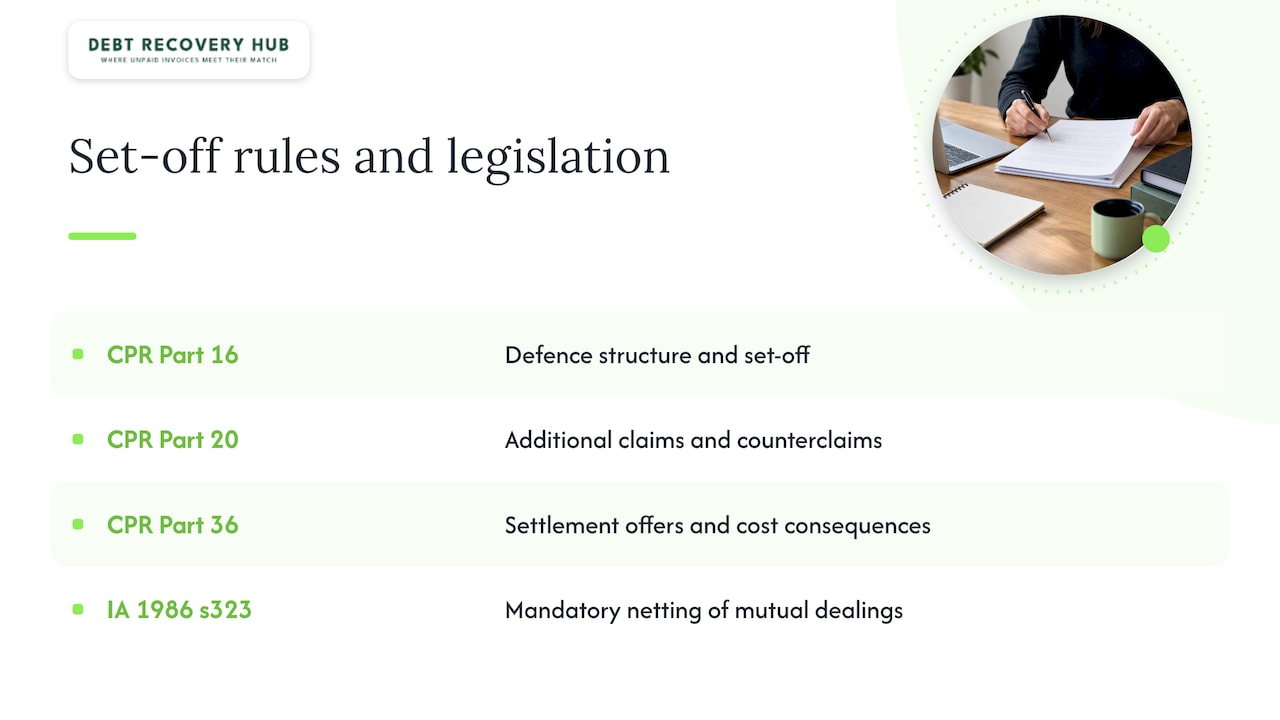
Anyone building or defending a set-off argument benefits from going straight to the primary rules rather than relying on summaries. The Civil Procedure Rules Part 16 set out how a defence is structured and how set-off fits within it, while Part 20 governs additional claims and counterclaims that sit alongside or instead of a set-off defence.
Part 36 of the Civil Procedure Rules governs offers to settle and the cost consequences that follow, which becomes relevant the moment a set-off or counterclaim is on the table. For insolvency cases, section 323 of the Insolvency Act 1986 is the governing provision for mandatory netting of mutual dealings.
For a broader explanation of set-off types and the policy reasoning behind mandatory insolvency netting, legal commentary on set-off gives useful context alongside the primary legislation. Practitioner analysis from Gowling WLG is a solid next step for understanding how contract clauses and evidence requirements shape a real set-off argument.