
Contact your creditor today, explain what changed, and send a written affordability statement showing what you can realistically pay. Early contact keeps your options open, while silence makes enforcement and credit-file damage more likely. For free, independent help with the conversation, use MoneyHelper and the Gov.
TL;DR:
- Prioritize rent, mortgages, Council Tax, utilities, court fines, and benefit overpayments; arrears can threaten housing, energy access, or trigger faster enforcement.
- A reduced instalment can keep an arrangement active but extend repayment; longer terms may increase total interest unless the creditor freezes charges.
- Breathing Space can pause enforcement, creditor contact, most interest, and fees for up to 60 days in England and Wales, but repayment obligations remain.
- Repeated broken plans can lead to default notices, a county court judgment, wage deductions, bailiffs, or a charging order, while worsening future borrowing options.
- Avoid refinancing unless the new payment fits your actual budget; borrowing against a home converts unsecured debt into a risk to the property.
Table of Contents
- What should you do in the first 48 to 72 hours after a missed payment?
- Which renegotiation options can you ask for?
- Which debts are priority debts, and what happens if you ignore them?
- Which statutory protections and formal routes are available?
- How can you stop missing payments in future?
- Worked example: how does prompt contact change the outcome?
- When should you get free debt advice, and what should you bring?
- What legal consequences follow repeatedly broken payment plans?
- What steps do creditors typically take when a payment plan breaks?
- How do you keep good relations with creditors after breaking a plan?
- Could debt consolidation or refinancing replace a broken plan?
- How does a broken payment plan affect secured and unsecured debt differently?
- Why is prompt, documented contact the single best move?
- When can a professional recovery route help?
- FAQ
- Sources
What should you do in the first 48 to 72 hours after a missed payment?
The first days decide whether a missed instalment stays a hiccup or becomes a default. Your aim is to reach the creditor before they reach a conclusion about you, and to leave a paper trail that proves you acted.
- Call, use webchat or write to the creditor, and note the date, time and name of whoever you speak to. If one channel gets no answer, try another.
- Prepare a simple budget showing income, essential spending (housing, food, utilities, transport) and the amount you can pay each month.
- If the debt is a court fine, contact the fines office straight away. MoneyHelper explains that fines officers can adjust payment dates or amounts, but ignoring a fine risks more serious enforcement.
- Ask for any agreement or concession in writing, and ask how it will be recorded on your account and on your credit file.
- Check your bank balance for bounced direct debit fees, which can pile on top of the original problem.
MoneyHelper notes that telling a creditor early and showing what you can afford makes it more likely they will set up a plan and helps you avoid added charges or loss of service.
Pro Tip: Send your affordability statement by email or post as well as discussing it by phone, so the creditor has your figures in writing and you have proof of when you sent them.
Which renegotiation options can you ask for?
Creditors respond best to a specific, evidenced proposal rather than a plea for leniency. State the problem briefly, attach your budget, say what you can pay and for how long, and say when you expect your circumstances to change, if they will.
- Reduced instalments: a lower monthly amount keeps the plan alive but usually lengthens the term, so you pay for longer. Citizens Advice says reducing payments on a debt management plan can lengthen the repayment period.
- Payment holiday: a short pause, useful if you expect a clear recovery such as returning to work. Be ready to say exactly when payments restart.
- Extended term: spreads the same balance over more months. Your payments fall, though total interest may rise unless it is frozen.
- Interest or fee freeze: ask for charges to stop while you stabilise. Creditors usually want evidence of hardship before agreeing.
- Token payments: small symbolic amounts are temporary by design. Creditors tolerate them for a short review period, not indefinitely.
- Write-off: possible mainly where you can evidence that you cannot pay now or in future. Citizens Advice offers a template letter for asking non-priority creditors to write off a debt, and advises including a budget and supporting evidence.
Our guide to debt recovery letters shows how written requests are usually structured, which helps when you draft your own.
Which debts are priority debts, and what happens if you ignore them?
Not every debt carries the same risk. Priority debts can lead to losing your home, your energy supply or your liberty, so they come before credit cards, overdrafts and catalogue accounts.
- Rent and mortgage: missed payments can lead to possession proceedings.
- Council Tax: councils can escalate quickly, though many offer flexible payment plans if you contact them early.
- Utilities: arrears can lead to disconnection or forced prepayment meters.
- Court fines and benefit overpayments: both are treated as priority liabilities, and repayments to the DWP can sometimes be reduced or deferred depending on circumstances.
MoneyHelper confirms that priority debts carry more severe consequences than unsecured debts. Enforcement routes can include bailiffs, attachment of earnings and charging orders on property, and a county court judgment (CCJ) narrows your room to negotiate. If you already have a court order or instalment order, you can apply to vary it by sending evidence of your current income and spending.
Which statutory protections and formal routes are available?
When informal talks stall, formal routes can pause pressure or restructure what you owe.
- Breathing Space: gives up to 60 days’ protection in England and Wales, or, for a mental health crisis, the length of treatment plus 30 days. It pauses enforcement and contact and stops most interest and fees, but you still owe the debt and must work with a debt adviser.
- Debt management plan (DMP): an informal arrangement where you make one affordable payment shared among creditors.
- Individual voluntary arrangement (IVA): a formal, legally binding agreement with creditors, arranged through an insolvency practitioner.
- Debt relief order (DRO): a formal option for people with low income, few assets and modest debts.
Up to 60 days of legal protection is available under the Debt Respite Scheme, with a mental health crisis version lasting the duration of treatment plus 30 days. It does not apply if you already hold a DRO or IVA.
Access usually runs through an adviser, and each route affects creditor behaviour and your credit record differently. Citizens Advice explains that each option has its own conditions and effects, so free advice helps you pick one.
How can you stop missing payments in future?
Prevention is mostly about timing, buffers and honest numbers.
- Build an affordability statement and update it whenever income or bills change, so any plan is based on real figures.
- Move payment dates to just after payday, so money leaves your account when it is most likely to be there.
- Review direct debit and standing order mandates for amounts, dates and the account used, to avoid bounce fees.
- Build a small emergency buffer, even a few pounds a week, to absorb a surprise bill.
- Agree short contingency terms with creditors in advance, such as a temporary pause if your income dips.
Pro Tip: Set a bank alert for a balance threshold a few days before each payment date, giving you time to act or call the creditor before the instalment fails.
Worked example: how does prompt contact change the outcome?
Take two illustrative customers, both owing the same amount on an instalment plan and both missing one payment after an unexpected expense.
- Customer A phones the day after, apologises, explains the cause and emails a one-page budget. The creditor agrees a lower payment for a period, confirmed in writing. The plan stays live and the account is not escalated.
- Customer B ignores the reminders. A default notice arrives, fees are added, the debt may be passed on, and a CCJ or enforcement agents become possible. Costs rise and resolution takes longer.
Customer A’s first message could read: “I missed my payment on [date] because of [reason]. My budget is attached. I can pay [amount] monthly from [date]. Please confirm in writing.” Attach recent payslips or benefit letters, plus bank statements.
When should you get free debt advice, and what should you bring?
Seek advice as soon as you cannot see a clear way through, or if you have several debts and are unsure which to pay first. MoneyHelper and Citizens Advice both offer free, confidential help. Bring:
- Your current budget with income and essential spending
- Recent bank statements
- Letters, emails and default notices from creditors
- Proof of changed circumstances, such as redundancy or sickness letters
An adviser can apply for Breathing Space on your behalf and speak to creditors for you.
What legal consequences follow repeatedly broken payment plans?
One missed payment, handled promptly, rarely leads to court. Repeated breaks are different, because they signal to the creditor that the arrangement is failing. Citizens Advice notes that once an arrangement is broken, creditors often view the original agreement as failed and may be less willing to offer informal concessions.
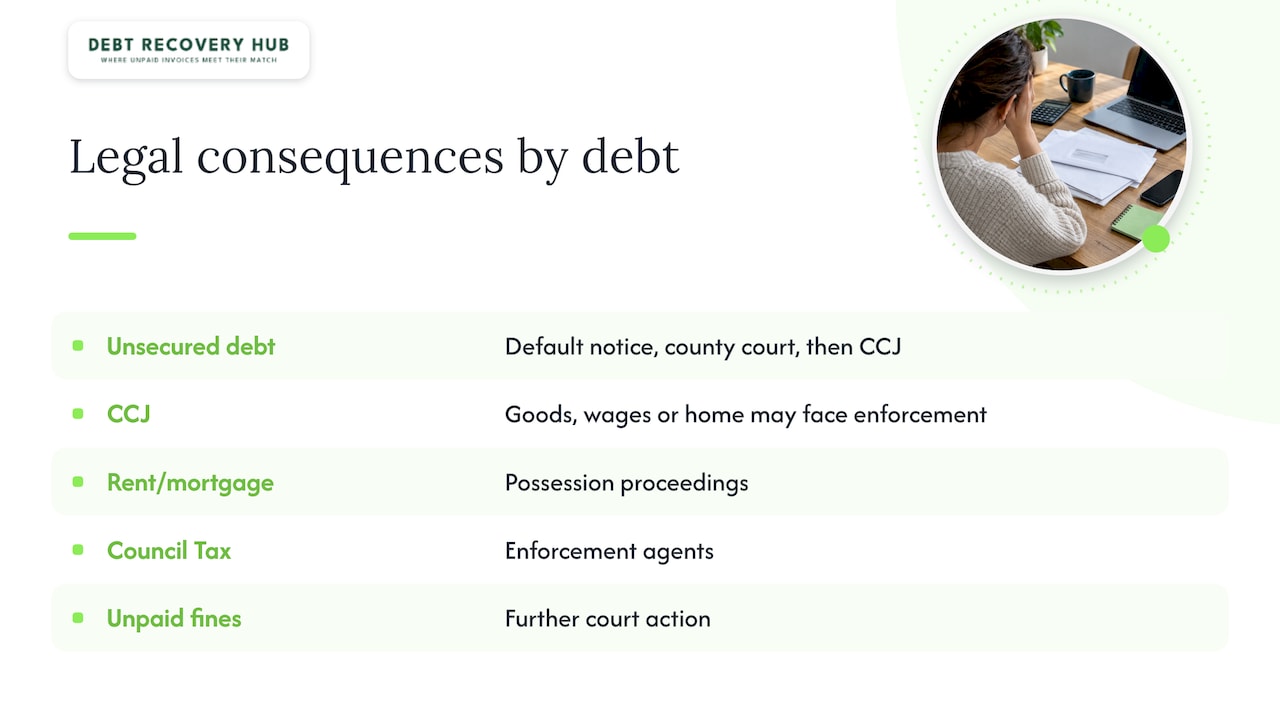
For unsecured debts such as credit cards, loans and catalogue accounts, the creditor can issue a default notice, then pursue the debt through the county court. A CCJ can follow, and a judgment can open the door to enforcement: bailiffs taking control of goods, deductions straight from your wages, or a charging order against your home.
For priority debts the consequences are quicker and more serious. Rent and mortgage arrears can lead to possession proceedings, Council Tax arrears to enforcement agents, and unpaid fines to further action by the court.
Repeated breaks also damage your credit file and can make future borrowing harder or more expensive. The practical lesson is simple: if you cannot keep a plan, say so before the next due date, with a revised budget in hand, rather than letting the payment fail again.
What steps do creditors typically take when a payment plan breaks?
Most creditors follow a predictable ladder, though timings vary by lender and debt type.
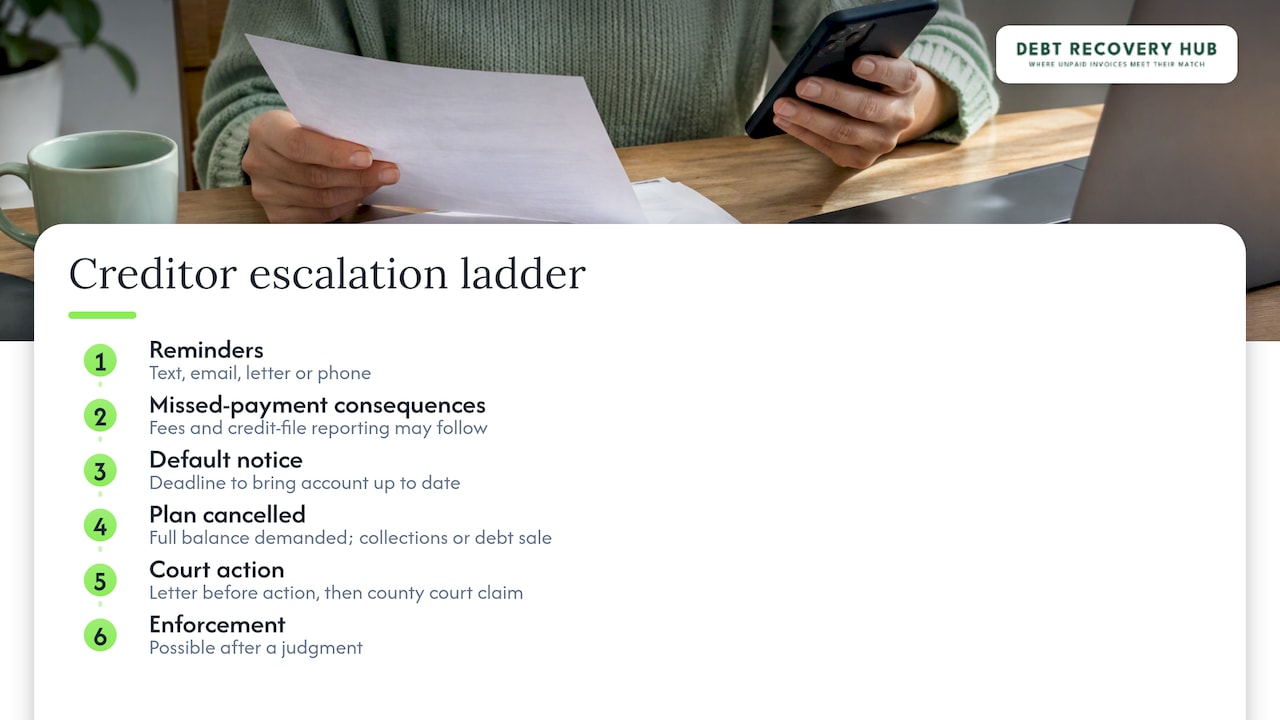
First come reminders by text, email, letter or phone. If those go unanswered, the creditor may add late fees where the agreement allows, and record the missed payment on your credit file.
Next, a formal default notice usually sets a deadline to bring the account up to date. If that deadline passes, the creditor may cancel the plan, demand the full balance, and either hand the account to an in-house collections team or place it with a debt collection agency. Some sell the debt outright to a debt purchaser.
Final steps can include a letter before action and a county court claim. Where a judgment is granted, the creditor may ask for enforcement.
Businesses chasing customers see this same ladder from the other side. A partner article sets out a five-stage invoice collection process with KPIs that show how structured follow-up works. Our own guide to UK debt collection timelines explains when escalation usually happens. As a debtor, your best leverage is contact early in that ladder, because every step further along adds cost and reduces the creditor’s willingness to bargain.
How do you keep good relations with creditors after breaking a plan?
Creditors deal with missed payments every day. What they value is honesty, clarity and follow-through, so treat each exchange as a chance to rebuild trust.
Start with a brief, factual explanation. You do not need a long story: say what happened, what has changed and what you propose. Keep a calm, courteous tone, even if the other person is not.
Send updated figures. Because a broken arrangement makes creditors sceptical, a fresh, realistic statement matters more than promises. Rocket Lawyer’s guide adds that proactive communication before a missed payment is the biggest factor in stopping a setback becoming a formal breach.
Then do exactly what you said. If you offer a specific amount on an agreed date, pay it on that date. If something changes again, tell the creditor before the date, not after it.
Finally, keep records: dated notes of calls, copies of emails and letters, and written confirmation of every agreement. If you feel overwhelmed, a free adviser can speak to creditors for you, which often lowers the temperature on both sides.
Could debt consolidation or refinancing replace a broken plan?
Consolidation means combining several debts into one, ideally with a lower payment or rate. It can help in the right circumstances, but it is not a fix for unaffordable debt.
Options include a consolidation loan, a balance transfer to a card with an introductory rate, or, for homeowners, borrowing against property. The last carries the highest risk, because it turns unsecured debt into debt secured on your home. A missed payment then puts the property itself in play.
Approval depends on your credit file, and missed payments reduce your chances or push up the rate. Any new borrowing should be checked against your real budget first. If the new monthly payment is not clearly affordable, you are rebuilding the same problem with a new label.
A debt management plan offers a similar single-payment structure without new borrowing. Citizens Advice points to its debt remedy tool and charity services for assessing which solutions fit your income and debts.
If the problem is one lender who will not renegotiate, refinancing that single debt elsewhere may be worth asking an adviser about. Ask before you sign anything, and read the total cost, not just the monthly figure.
How does a broken payment plan affect secured and unsecured debt differently?
The type of debt changes both the stakes and the speed.
Secured debts are tied to an asset, usually your home or a vehicle. A broken mortgage plan can lead to arrears action and, ultimately, possession proceedings. A broken plan on a car finance agreement can lead to repossession, depending on the terms. Lenders in these cases have a direct route to the asset, which is why MoneyHelper treats such debts as priority.
Unsecured debts such as credit cards, overdrafts and personal loans have no asset attached. The creditor must go through default notices, collections and, if needed, the courts before enforcement. That gives you more time, but not unlimited time.
Public and statutory debts sit in a category of their own. Council Tax, court fines and benefit overpayments follow different enforcement rules and tend to move faster. Newham Council’s advice page lists priority debts on a budget plan to be addressed first, with creditors contacted to explain difficulties.
In practice, protect the debts that threaten your home, energy and liberty first, then negotiate with the rest from a stable position.
Why is prompt, documented contact the single best move?
In my view, the most useful thing you can do after a missed payment is to speak up quickly and keep everything in writing. A creditor who hears from you early has options. One who hears nothing has only escalation. Deal with urgent liabilities first, and if you are unsure where to start, ask a free adviser.
— Jack
When can a professional recovery route help?
If you are the one owed money, or a creditor will not entertain reasonable renegotiation, a specialist route can help. We match individuals and businesses with vetted debt collection agencies by debt type, amount, age and location.

- Tailored matches: we gather the case details first, so you are not choosing an agency blindly.
- When to consider us: if talks have failed, or for specialist and international cases.
- Sensible order: take free advice first, then speak to us about formal recovery through our consumer debt recovery service.
FAQ
What if I can’t afford a payment plan?
Tell the creditor straight away and send a budget showing what you can pay. If even a reduced plan is out of reach, free advisers can help you explore Breathing Space or a formal solution. Citizens Advice says Breathing Space can give 60 days’ protection and guidance while you explore options.
Can I get debt written off due to mental health?
A write-off is possible where you can show you cannot pay now or in future, with a budget and supporting evidence. Mental health crisis Breathing Space also exists, lasting the length of treatment plus 30 days, and gives protection while an adviser reviews your options.
Why might a creditor refuse my payment plan?
They may think your offer is unaffordable, unevidenced or too low for the balance. Resubmit with a clear budget and a specific timeframe, and ask a free adviser to contact them on your behalf.
What happens if I miss a payment on a debt management plan?
Contact your provider immediately. They may renegotiate payments or keep the plan running, though reducing payments can lengthen the term.