



If you’re holding a foreign court judgment and the debtor’s assets are in England or Wales, the route you take depends on where the judgment came from and when proceedings started. Here’s the short version:
- Hague Choice of Court Convention 2005/2019 applies if the original court sat in a state party to the Convention and the case fell under a qualifying choice-of-court agreement. This route has applied in England and Wales since 1 July 2025.
- Civil Jurisdiction and Judgments Act 1982 governs judgments from other UK jurisdictions (Scotland, Northern Ireland) and, in narrower circumstances, other reciprocal arrangements.
- Administration of Justice Act 1920 or the Foreign Judgments (Reciprocal Enforcement) Act 1933 apply to judgments from designated Commonwealth and reciprocal states.
- Everything else, including most US judgments, falls to the common law route: issuing a fresh claim in England and Wales relying on the foreign judgment as your cause of action.
Your immediate action, before anything else: if the debtor holds assets in England, consider a freezing injunction under section 25 of the Civil Jurisdiction and Judgments Act 1982 before you serve any registration application under CPR Part 74. Recognition of a judgment and recovery of money are two different battles. Debtrecoveryhub exists precisely because the gap between “judgment recognised” and “money in your account” is where most creditors lose ground.
Key Takeaways
Enforcing a foreign judgment in England and Wales succeeds when the creditor identifies the correct legal regime early and secures interim relief before the debtor is put on notice.
| Point | Details |
|---|---|
| Identify the regime first | Check Hague 2019, the 1982 Act, or the 1920/1933 Acts before defaulting to a common law claim. |
| Secure interim relief early | Apply for a freezing injunction before serving registration to prevent asset dissipation. |
| Follow CPR Part 74 precisely | File authenticated judgments, translations, and a witness statement under CPR 74.4 at the High Court. |
| Expect a set-aside challenge | Build your rebuttal evidence, service proof, and jurisdictional facts, alongside your registration filing. |
| Match with a vetted partner | Debtrecoveryhub connects creditors with enforcement agencies experienced in cross-border recovery. |
Table of Contents
- How to enforce a foreign judgment in the UK: a decision tree
- Registering a foreign judgment: the CPR Part 74 procedure
- What can you actually do once the judgment is recognised?
- Grounds a debtor can use to resist enforcement
- Sequencing and cost: what actually determines your timeline
- Checklist for counsel: what to prepare before you file
- A publisher’s note on the recognition trap
- Getting enforcement help from Debtrecoveryhub
- Sources
- FAQ
How to enforce a foreign judgment in the UK: a decision tree
Working out which regime governs your case is mostly a matter of asking three questions in order.
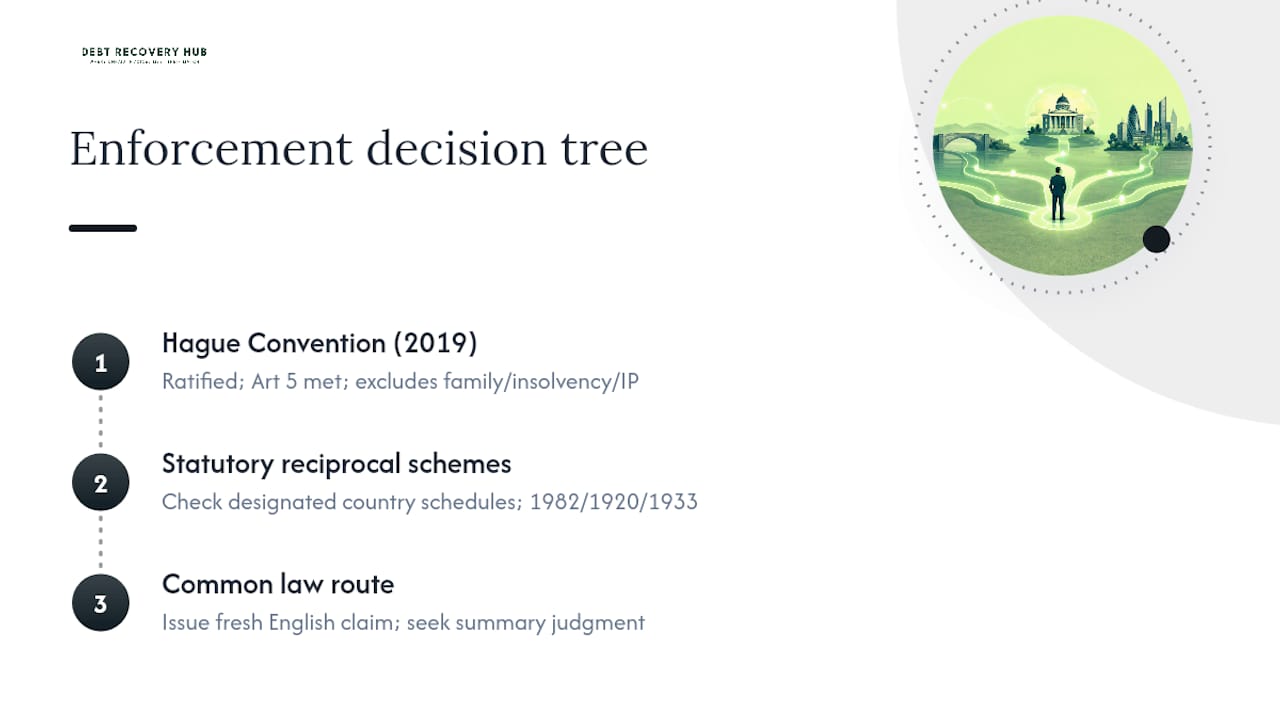
First: does Hague 2019 apply? Check whether the judgment came from a court in a state that has ratified the Hague Convention on the Recognition and Enforcement of Foreign Judgments, and whether the claim arose from a qualifying jurisdictional basis, most commonly a choice-of-court agreement, habitual residence, or consent to jurisdiction. The Convention entered into force for England and Wales on 1 July 2025, so it only helps where the originating country has also signed up and the procedural conditions in Article 5 are actually met. It doesn’t cover every civil judgment either; family law, insolvency and certain intellectual property matters sit outside its scope.

Second, if Hague doesn’t apply: does a statutory reciprocal scheme cover the country? The 1982 Act handles judgments from Scotland and Northern Ireland, plus a handful of reciprocal states. The 1920 Act and the 1933 Act cover designated Commonwealth countries and a short list of other states with formal reciprocity, including Australia, Canada, India, and Israel among others. These lists are fixed by statutory instrument, not by guesswork, so check the designated country schedule before assuming coverage.
Third: if none of the above applies, you’re in common law territory. This is where most judgments from the United States, and many from countries with no reciprocal arrangement, end up. You issue a fresh claim in England, plead the foreign judgment as your cause of action, and typically apply for summary judgment on the strength of it rather than relitigating the underlying dispute.
The practical difference matters: EU and EFTA judgments generally lost their fast-track post-Brexit recognition route and now often fall to common law unless Hague 2019 rescues them. Commonwealth judgments usually move faster through the 1920/1933 Acts. Non-reciprocal states, the US chief among them, mean a longer, costlier common law claim from the outset.
Registering a foreign judgment: the CPR Part 74 procedure
Once you know your regime, registration under CPR Part 74 follows a fairly consistent shape, whether you’re proceeding under Hague 2019, the 1982 Act, or the 1920/1933 Acts.
- Confirm the judgment is final and enforceable in its country of origin. A judgment still open to appeal, or one where the appeal period hasn’t expired, is vulnerable to a stay application.
- Gather an authenticated copy of the judgment, certified by the originating court, plus a certified translation if it isn’t in English.
- Obtain a certificate of enforcement where the applicable regime requires one (Hague 2019 and the 1982 Act both do in specific circumstances).
- Prepare a witness statement in support, as required by CPR 74.4, setting out the jurisdictional basis, the sum outstanding, interest, and why the judgment qualifies under your chosen regime.
- File the application at the High Court, usually the King’s Bench Division for commercial judgments, though Chancery Division handles matters involving trusts, property, or insolvency-adjacent claims.
- Serve the registration order on the debtor once granted, triggering the set-aside window.
Timing varies by regime. The 1920 Act carries a one-year limit from judgment date to registration application; the 1933 Act allows six years. Hague 2019 doesn’t impose a fixed registration deadline but does require the underlying judgment to still be enforceable in its home jurisdiction. An appeal pending abroad can pause or unwind your English registration, so check the appellate status before filing.
Here’s the document checklist worth building before you go anywhere near the court:
- Authenticated/certified copy of the foreign judgment
- Certified English translation, where needed
- Certificate of enforcement (Hague 2019/1982 Act cases)
- Witness statement addressing jurisdiction, sums due, and regime eligibility
- Proof of service on the original defendant in the foreign proceedings
- Apostille or notarisation of documents, where the originating country requires it
Once registered, the order must be served, and under CPR 74.9(1), enforcement cannot begin until the set-aside window has run its course or any application to set aside has been decided.
Pro Tip: If you suspect the debtor will move assets on notice, apply for a freezing injunction before you serve the registration order, not after. Once the debtor is served, the clock starts on their right to challenge, and that delay is exactly when assets disappear.
What can you actually do once the judgment is recognised?
Recognition and registration confer the same enforceability as an English judgment, which opens the full toolkit available to any domestic creditor.
- Writ or warrant of control, executed by High Court Enforcement Officers, seizes and sells goods to satisfy the debt. Fast where the debtor has visible, sellable assets in England.
- Charging orders secure the debt against property, useful for long-term security rather than quick cash, particularly where the debtor owns UK real estate.
- Third-party debt orders (the modern equivalent of garnishee proceedings) freeze and redirect funds held by a bank or other third party, effective when you already know the debtor’s account details.
- Freezing injunctions stop assets moving before you’ve finished enforcement, rather than recovering money directly.
- Attachment of earnings orders apply against individual debtors in employment, less relevant for corporate debtors.
- Receivership appoints a receiver to manage income-generating assets, typically reserved for complex or high-value cases.
Costs and timescales diverge sharply. A third-party debt order against a known bank account can move in weeks. A charging order followed by an order for sale can run months, particularly if the debtor contests it. If the debtor is showing signs of insolvency, enforcement steps may need to pause or compete with formal insolvency proceedings, which change the priority of your claim entirely.
Grounds a debtor can use to resist enforcement
Debtors rarely accept registration quietly. The most common grounds for resisting recognition, or applying to set aside a registration order under CPR rule 74.7, fall into a fairly predictable pattern.
- Lack of jurisdiction in the original court: the debtor argues the foreign court had no proper basis to hear the case in the first place.
- Inadequate notice: the debtor claims they weren’t properly served or given a fair opportunity to defend the original claim.
- Fraud: an allegation that the judgment was obtained by fraudulent evidence or misrepresentation.
- Public policy: the judgment offends a fundamental principle of English law, punitive damages disproportionate to the loss being a recurring example.
- Conflict with an earlier English judgment: the same dispute has already been decided in England.
- Pending appeal: the appeal period in the originating jurisdiction hasn’t yet expired, or an appeal is live.
Each defence has a corresponding evidential answer. Jurisdiction challenges get rebutted with the contract’s jurisdiction clause and evidence of the debtor’s presence or activity in the foreign forum. Notice disputes need affidavits of service from the original proceedings, ideally from the process server who executed it. Fraud allegations require you to show the judgment survived scrutiny in its home court, or that the fraud claim was already litigated and rejected there.
The practical point solicitors miss: build your set-aside rebuttal file at the same time as your registration application, not after the debtor raises an objection. You’ll have the documents in hand already; you just need to know which ones matter.
Sequencing and cost: what actually determines your timeline
The gap between recognition and recovery is where cases stall, and where debtors reorganise assets if you let them.
Registration itself, once filed correctly, typically clears relatively quickly unless the debtor lodges a set-aside application, which restarts the clock. Court fees for registration are modest compared with what follows: enforcement agent fees, local process server costs, and asset tracing investigations for offshore or corporate structures are where the real spend sits. High Court Enforcement Officer fees scale with the sum recovered; charging order and third-party debt order applications carry fixed court fees plus solicitor time.
- Secure interim relief, ideally a freezing injunction, before serving the registration order, not after.
- Instruct asset tracing early and discreetly. Public registration alerts the debtor; covert tracing beforehand often reveals more.
- Obtain the debtor’s bank details wherever possible, since a third-party debt order is often the fastest route to cash.
- Preserve every piece of service evidence from the original foreign proceedings; you’ll need it if jurisdiction or notice is challenged.
- Where the debt is straightforward and undisputed, ask whether summary judgment under the common law route might be faster than waiting on a statutory registration process.
Pro Tip: Ask your client for the debtor’s banking relationship, property holdings, and any UK subsidiary structure before you file anything. That information is far harder to get once the debtor knows enforcement is coming.
Checklist for counsel: what to prepare before you file
- Assess whether interim relief is warranted, and apply for it first if asset flight is a real risk.
- Assemble the authenticated judgment, certified translation, and certificate of enforcement.
- Draft the CPR 74.4 witness statement covering jurisdiction, sums due, and regime eligibility.
- Confirm the appellate status of the judgment in its home jurisdiction.
- Instruct enforcement agents to be ready the moment the set-aside window closes.
Prepare a proof-of-service file and an asset disclosure checklist alongside the witness statement, since both get requested if the debtor contests registration. On the client side, set expectations early: registration is a procedural win, not a payment. Costs and timescales differ wildly by enforcement route, and the biggest single delay factor is almost always a set-aside application, not the court itself.
A publisher’s note on the recognition trap
The mistake we see most often isn’t procedural, it’s psychological. Creditors treat registration as the finish line and relax exactly when they should be moving fastest. Recognition tells you the debt is legally due; it says nothing about whether the money is still there to collect. Get interim relief locked down early, and bring in local enforcement specialists the moment sums justify it.
Getting enforcement help from Debtrecoveryhub
Debtrecoveryhub is the practical alternative to hunting for enforcement counsel and asset tracers separately, one intake, matched to vetted UK partners who already handle cross-border recovery. Rather than researching enforcement agents from scratch while a set-aside window ticks down, you submit the case once and get matched to agencies with the specific experience your judgment needs, whether that’s High Court enforcement, freezing order execution, or international asset tracing.

The intake process asks for exactly what a registration application needs anyway: debt type, amount, age, and the debtor’s known location and assets. That overlap means the paperwork you gather for enforcement doubles as the paperwork Debtrecoveryhub uses to match you with the right partner, whether the case needs a domestic debt collection specialist or an agency with genuine international enforcement capability. Costs vary by case complexity and the enforcement route required, and Debtrecoveryhub’s matching service doesn’t charge you to find out which partner fits. If you’re holding a foreign judgment and need to move on it, submit your case details and get matched to an agency that can actually execute.
Sources
For the procedural mechanics of registration, service, and enforcement pauses, CPR Part 74 is the primary text every practitioner should have open. The 1933 Act sets out the reciprocal registration scheme and its time limits, while the Civil Jurisdiction and Judgments Act 1982 governs intra-UK and select reciprocal judgments. For Hague Convention scope and its 1 July 2025 entry into force, the Ashurst quick guide is a reliable summary. Common law enforcement principles, including the summary judgment route, are covered in LexisNexis practice guidance, and jurisdiction-by-jurisdiction procedural detail sits in the ICLG enforcement report.
This article is general information, not a substitute for advice from a qualified lawyer. Consult a qualified legal professional about your own circumstances before acting on anything here.
- PART 74 – ENFORCEMENT OF JUDGMENTS IN DIFFERENT JURISDICTIONS – Civil Procedure Rules – Justice UK
- Foreign Judgments (Reciprocal Enforcement) Act 1933
- Enforcement of Foreign Judgments Laws and Regulations 2026 England & Wales (ICLG)
- Enforcement of an overseas judgment in England (Ashurst/Perkins Coie quick guide)
- Enforcing foreign judgments at common law in England and Wales – LexisNexis UK
FAQ
How can I enforce a foreign judgment in England?
Identify which regime applies, Hague 2019, the 1982 Act, the 1920/1933 Acts, or common law, then register under CPR Part 74 with an authenticated judgment, translation, and supporting witness statement before pursuing enforcement remedies like charging orders or third-party debt orders.
How do you enforce a UK county court judgment?
A County Court Judgment (CCJ) is enforced through the same domestic remedies available after any registered foreign judgment: writs of control, charging orders, third-party debt orders, or attachment of earnings, depending on the debtor’s known assets.
Can a French court order be enforced in the UK?
Since Brexit ended the UK’s participation in the Brussels regime, French judgments generally require either Hague 2019 (if the case falls within its scope) or a fresh common law claim, rather than the fast-track recognition that applied previously.
How long does it take to register a foreign judgment in England?
Registration itself often clears within weeks once filed correctly, but a debtor’s set-aside application under CPR rule 74.7 can add months, which is why securing interim relief before serving the registration order matters.
What happens if the debtor applies to set aside registration?
Under CPR 74.9(1), enforcement must pause until the set-aside application is decided, so creditors who anticipate a challenge should have freezing relief and rebuttal evidence in place beforehand.