


If you suspect a backdoor hire, do three things before anything else: preserve every submission record you hold, send a brief factual notification to the client contact, and open a dedicated recovery file. Do not confront, do not threaten, and do not delete anything. The window to protect your contractual position closes fast once a candidate’s employment is established and the client realises you know.
Immediate actions in the first 24–72 hours:
- Save every email, CV submission, LinkedIn message, and calendar invite that documents your introduction of the candidate.
- Screenshot the candidate’s LinkedIn profile showing their new employer and start date.
- Note the exact date you first introduced the candidate and cross-reference it against your CRM submission log.
- Notify the relevant client contact in writing, keeping the tone factual and non-accusatory.
- Open a named recovery file and log every action with timestamps from this point forward.
- Pause any new candidate submissions to that client until the matter is resolved or formally closed.
When to hold and when to escalate: if the client acknowledges the hire and disputes only the fee amount, hold escalation and negotiate. If the client denies the introduction entirely or goes silent after your written notification, move to a formal demand within five working days and consider instructing a specialist. Industry guidance confirms that early escalation to a recovery specialist, once a credible evidence pack exists, materially improves both the speed and likelihood of payment.
Key takeaways
Backdoor hire recovery in the UK depends on three things: a documented introduction, enforceable contract terms, and early escalation to a specialist once informal contact fails.
| Point | Details |
|---|---|
| Preserve evidence immediately | Save submission emails, CRM logs, and LinkedIn screenshots within 24 hours of suspecting a backdoor hire. |
| Contract wording is decisive | Include possession periods of 12–24 months, effective-cause wording, and group company clauses in your terms of business. |
| Escalate early with a strong evidence pack | Early specialist referral materially improves payment likelihood and speed of resolution. |
| Follow the pre-action protocol | Issue a formal letter before action and allow a response period before starting court proceedings. |
| Use Debtrecoveryhub for specialist matching | Submit your case details to Debtrecoveryhub to be matched with a vetted recovery agency experienced in commercial fee disputes. |
Table of Contents
- What counts as a backdoor hire in UK recruitment?
- How to detect a backdoor hire and collect the evidence you need
- Step-by-step: what to do after you suspect a backdoor hire
- Contractual changes that prevent backdoor hires from happening
- How backdoor hire investigations work in practice
- UK recovery routes: from demand letter to court claim
- A recovered placement fee: how one agency did it
- Why backdoor hire prevention is core business protection
- Debtrecoveryhub: find a vetted recovery specialist for your case
- Sources
- FAQ
What counts as a backdoor hire in UK recruitment?
A backdoor hire occurs when a recruiter introduces a candidate to a client, the client subsequently employs that candidate directly, and no placement fee is paid. The recruiter’s terms of business were in force at the time of introduction, but the client bypasses the fee obligation, either deliberately or through internal process failures.
The most common patterns in UK recruitment include:
- Immediate direct hire: the client interviews the candidate through the agency, makes no offer, then contacts the candidate privately and hires them within weeks.
- Delayed hire: the client declines the candidate initially, then re-engages them months later through a direct application or internal referral, hoping the agency’s possession period has expired.
- Internal referral route: the candidate’s CV is forwarded internally by the hiring manager to another department or subsidiary, which then hires without notifying the agency.
- Group company hire: a parent company, sister company, or affiliate entity employs the candidate, with the client arguing the terms of business do not extend to related entities.
A typical pattern: a recruiter submits a candidate for a marketing director role. The client interviews but passes. Eight months later, the candidate appears on LinkedIn as “Head of Marketing” at the same company. The client’s terms of business included a twelve-month possession period, but the client never flagged the re-engagement. That is a textbook backdoor hire, and documented case analysis from UK law firms shows that a clear submission timeline is often decisive in resolving exactly this kind of dispute.
How to detect a backdoor hire and collect the evidence you need
Backdoor hires rarely announce themselves. Industry reporting confirms they are often invisible to standard CRM or invoicing records, and many agencies only discover them by chance: a candidate mentions it in passing, a LinkedIn update surfaces in a feed, or a contact at the client company lets something slip.
Where to look first:
- LinkedIn profile changes (new employer, new job title, start date)
- Candidate communications that go quiet after a second interview
- HR announcements or company news mentioning new hires in roles you were briefed on
- Payroll or invoicing contacts at the client who were not involved in the original brief
Building your evidence timeline
The evidence that wins backdoor hire disputes is almost always chronological. A clear, dated sequence showing your introduction preceded the hire is the foundation of any recovery claim.

| Evidence item | What it proves | Where to find it |
|---|---|---|
| CV submission email | Date and fact of introduction | Email sent folder, CRM |
| Client acknowledgement | Receipt of candidate details | Reply email, CRM log |
| Interview schedule | Client engaged with candidate | Calendar invites, email |
| Candidate consent record | Candidate authorised submission | Signed consent form, email |
| LinkedIn start date | Candidate is now employed | Public profile screenshot |
| Offer letter or contract | Employment terms and start date | Candidate disclosure (if willing) |
The phrase “first introduction” matters legally. UK courts and arbitrators typically treat the date the client first received the candidate’s CV or profile as the introduction date, not the date of interview. Make sure your submission email is timestamped and sent to a named individual, not a generic inbox.
Pro Tip: Set up a Google Alert or LinkedIn Sales Navigator alert for every candidate you submit to high-value clients. You will catch employment changes within days rather than months.
Under UK data protection rules, you may monitor publicly available information (LinkedIn, company websites, Companies House) without issue. Accessing private employment records or pressuring candidates to disclose confidential terms is not permissible. Keep your investigation to public signals and voluntary candidate disclosures.
Step-by-step: what to do after you suspect a backdoor hire
Follow this sequence. Skipping steps or going straight to legal threats typically damages your position and the client relationship simultaneously.
- Confirm the facts internally. Cross-reference your CRM, email records, and the candidate’s LinkedIn profile. Establish the introduction date, the role briefed, and the apparent start date at the client.
- Assemble your evidence pack. Gather every item from the evidence table above before making contact. You need dates, names, and document references ready.
- Send a factual written notification. Contact the client’s senior decision-maker (not the original hiring manager) by email. State the facts, reference your terms of business, and ask for a response within five working days.
- Issue a formal demand if there is no satisfactory response. This is a letter before action, not a threat. It states the fee owed, the contractual basis, and a deadline for payment, typically fourteen days.
- Suspend new submissions to that client until the matter is resolved. Continuing to supply candidates while a fee dispute is live weakens your negotiating position.
- Instruct a specialist or solicitor if the client denies liability or ignores the formal demand. At this point, the evidence pack you built in step two becomes the foundation for a recovery agent or court claim.
Your initial written notification should be firm, factual, and free of accusation. Something close to this structure works well:
Practitioner guidance from recruitment solicitors confirms this escalation path: formal written demand first, then pre-action steps if the client refuses to engage.
Contractual changes that prevent backdoor hires from happening
The most cost-effective investment in backdoor hire recovery is prevention. Industry commentary recommends a combination of staff training, regular contract reviews, and clear escalation rules as the primary defence against revenue leakage.
Clauses every agency’s terms of business should include:
- Candidate ownership window (possession period): a defined period, typically twelve to twenty-four months, during which a fee is payable if the client hires the introduced candidate by any route. State explicitly that the period runs from the date of introduction, not the date of the last interview.
- Effective cause / referral wording: a clause confirming that the agency’s introduction is the effective cause of the hire, regardless of whether the candidate later applied directly or was referred internally.
- Non-circumvention and group company wording: extend fee obligations to parent companies, subsidiaries, affiliates, and any entity under common ownership with the client. Without this, a group company hire is a clean escape route.
- Fee triggers and exceptions: define precisely what constitutes a “hire” (including fixed-term contracts, consultancy arrangements, and zero-hours engagements) and list any genuine exceptions.
- Confirmed receipt rule: require the client to acknowledge receipt of each candidate submission in writing. An unacknowledged submission is much harder to enforce.
Process controls to run alongside your contract:
- Log every submission in your CRM with a timestamp and the recipient’s name and email address.
- Send a submission confirmation email to the client for every candidate, even when the client has not requested one.
- Obtain signed candidate consent forms that record the date, the client name, and the role.
- Brief your consultants on what a backdoor hire looks like and how to flag it internally.
Pro Tip: Have a recruitment solicitor review your terms of business at least once every two years. Standard template terms frequently lack group company wording and effective-cause language, which are the two clauses most commonly exploited in backdoor hire disputes.
When a client relationship is high-value or complex, bespoke legal drafting is worth the cost. A solicitor experienced in recruitment law can tailor possession periods, fee scales, and circumvention clauses to your specific market.
How backdoor hire investigations work in practice
Manual audits are the starting point for most agencies. You review your CRM submissions against LinkedIn profiles and public company announcements, looking for candidates who were introduced but never placed and who now appear employed at the client. This works, but it is slow and misses hires where the candidate has a private LinkedIn profile or the client operates under a different trading name.
Investigative methods and what each reveals:
- CRM audit: matches your submission records against known hires. Reliable for recent cases; misses hires outside your monitoring window.
- LinkedIn and public profile monitoring: catches employment changes on public profiles. Free, but dependent on the candidate updating their profile promptly.
- Candidate timeline matching tools: specialist tools cross-reference your submission data against external employment outcome databases, raising detection rates for hires that would otherwise remain invisible. Treat vendor claims about detection rates as indicative rather than guaranteed.
- Third-party tracing services: used when a candidate’s employment is disputed and public records are insufficient. These services can identify employment through Companies House filings, professional registrations, and other public records.
What these tools can and cannot prove matters. A LinkedIn update showing a new employer is a strong signal, not proof of a backdoor hire. Proof requires the combination of a documented introduction, a confirmed employment start date, and evidence that no fee was paid. False positives occur when a candidate was introduced by a second agency, when the client hired through a direct application made before your introduction, or when the possession period had genuinely expired.
GDPR applies throughout. You may process publicly available data and data the candidate provided to you during the recruitment process. You may not run background checks, access private records, or contact the candidate’s new employer to demand employment confirmation without a lawful basis. If your investigation requires anything beyond public sources and voluntary disclosures, take legal advice before proceeding.
Convert an internal enquiry into a formal investigation when: the client denies the introduction, the hire date is disputed, or the fee involved justifies the cost of a specialist.
UK recovery routes: from demand letter to court claim
The route you choose depends on the fee amount, the strength of your evidence, and how the client responds to initial contact.
| Route | When to use | Typical timeline | Cost indication |
|---|---|---|---|
| Informal demand | Client relationship intact; fee undisputed | 1–2 weeks | Minimal (internal time) |
| Formal letter before action | Client disputes or delays after informal contact | 2–4 weeks | Solicitor letter: — |
| Pre-action protocol for debt | Client ignores formal demand; fee amount disputed | 4 weeks | Solicitor time; court fees from £35 |
| Small claims | Fee within small claims limit; evidence strong | 3–6 months | Court fee: £35 |
| County Court claim | Fee amount disputed; complex dispute | 6 months | Court fees plus solicitor costs |
| Debt recovery agency | Client solvent; fee established; you want to outsource | 4 weeks | Commission-based; no upfront fee typical |
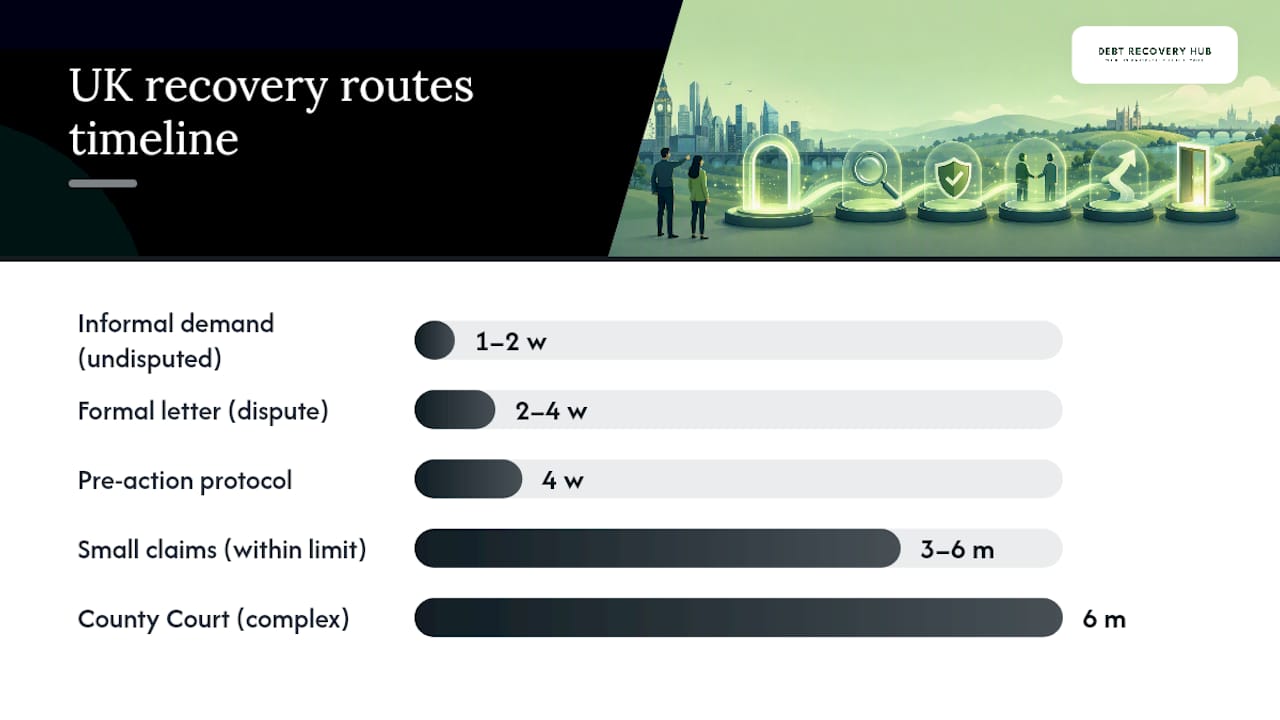
The pre-action protocol for debt requires a formal letter before action giving the debtor a reasonable time to respond, typically thirty days, before court proceedings begin. Skipping this step can result in cost penalties even if you win.
Legal remedies available in UK backdoor hire cases include breach of contract (the most common claim), tortious interference where a third party actively induced the breach, and enforcement of non-circumvention clauses. NPAworldwide’s legal guidance notes that the specific remedy available depends on the circumstances and the strength of the contractual wording.
Documentary evidence your solicitor or recovery agent will expect:
- Signed terms of business with the client, including the relevant fee and possession period clauses
- Timestamped submission email and any client acknowledgement
- Evidence of the candidate’s employment (LinkedIn, company announcement, or candidate disclosure)
- Record of your formal demand and the client’s response (or non-response)
- Any prior correspondence that establishes the client’s awareness of your terms
A debt recovery agency is often the most practical route for fees under £25,000 where the client is solvent and the evidence is clear. Agencies typically work on a commission basis, meaning no upfront cost to you. Matching your case to the right specialist matters: a generalist debt collector is less effective in a recruitment fee dispute than one with sector experience.
A recovered placement fee: how one agency did it
An independent recruitment agency specialising in financial services submitted a candidate for a senior compliance role at a mid-size asset manager. The client interviewed the candidate twice, then declined. Seven months later, the recruiter noticed the candidate’s LinkedIn profile showed the same asset manager as their employer, in a role almost identical to the one briefed.
The agency’s terms of business included an eighteen-month possession period and effective-cause wording. The recruiter pulled the original submission email (timestamped), the client’s acknowledgement reply, and both interview calendar invites. The candidate confirmed, voluntarily, that the client had contacted them directly three months after the second interview.
The agency sent a formal demand citing the specific clause and the documented introduction date. The client initially disputed the fee, claiming the candidate had applied directly. The agency’s solicitor sent a letter before action referencing the submission email and the candidate’s voluntary statement.
The lesson is straightforward: the evidence pack built before any contact was made is what created the settlement. Case analysis from Menzies Law shows this pattern repeatedly: a factual timeline and documented submissions are decisive. Without the timestamped submission email and the client’s acknowledgement reply, this case would likely have settled for a fraction of the fee or not at all.
Why backdoor hire prevention is core business protection
The conventional wisdom in recruitment is that backdoor hires are an occupational hazard, an annoying but manageable leak. That framing is wrong, and it costs agencies real money.
A single unrecovered placement fee at the senior end of the market can represent weeks of margin. Multiply that across a year of undetected hires and the revenue leakage is significant. More damaging still is what inaction signals to clients: that your terms of business are optional, that the possession period is a suggestion, and that the fee is negotiable after the fact.
Prevention is not just about protecting individual placements. A well-drafted contract with a confirmed receipt process and a twelve-to-twenty-four-month possession period changes the commercial dynamic entirely. Clients who know you track submissions and enforce your terms are far less likely to test the boundary. That clarity also tends to improve the client relationship rather than damage it: the expectations are explicit from the start.
There is a pragmatic counterpoint worth stating. Not every backdoor hire warrants full legal escalation. If the fee is small, the client relationship is genuinely valuable, and the evidence is ambiguous, a negotiated resolution at a reduced fee may be the better commercial decision. The goal is not to win every dispute; it is to recover what you are owed where the evidence supports it and to prevent the pattern from repeating.
Debtrecoveryhub: find a vetted recovery specialist for your case
When a formal demand has not produced payment and you need a specialist to take the case forward, Debtrecoveryhub matches your case to vetted debt collection agencies with experience in commercial fee disputes, including recruitment placement fees.

The matching process works on the specifics of your case: the fee amount, the age of the debt, the evidence you hold, and your location in the UK. That means you are connected to an agency that handles cases like yours, not a generalist collector unfamiliar with recruitment terms of business. Agencies on the platform work on a commission basis in most cases, so there is no upfront cost to refer a case.
Before you submit, prepare: your signed terms of business, the timestamped submission email, any client acknowledgement, and a brief chronology of events. The more complete your evidence pack, the faster the matching process and the higher the likelihood of referral acceptance.
Submit your case details for an initial review, or browse the debt collection services available through the platform to understand which specialists handle recruitment fee disputes.
Sources
The sources below cover legal procedure, investigative technique, and industry practice for backdoor hire disputes in the UK.
- Back-door hire: a case study | Menzies Law
- Understanding “Backdooring” in Recruitment | Excellolaw
- Act As If…You Might Just Get Paid! | recLAW
- Why you need to have a process for dealing with backdoor hires | UK Recruiter
- How Backdoor Hiring Costs Agencies Thousands | The Global Recruiter
This article is general information, not a substitute for advice from a qualified financial advisor. Consult a qualified financial professional about your own circumstances before acting on anything here.
FAQ
What is a backdoor hire in UK recruitment?
A backdoor hire occurs when a client employs a candidate introduced by a recruiter without paying the agreed placement fee, typically by hiring the candidate directly after the agency’s introduction.
How long do I have to claim a backdoor hire fee in the UK?
The limitation period for a contract claim in England and Wales is six years from the date the breach occurred, which is generally the date the client hired the candidate without paying the fee.
What evidence do I need to recover a backdoor hire fee?
You need a timestamped submission email, your signed terms of business with the relevant possession period and fee clause, evidence of the candidate’s employment at the client (such as a LinkedIn profile), and a record of your formal demand and the client’s response.
When should I instruct a debt recovery specialist?
Instruct a specialist once a formal written demand has produced no satisfactory response, typically after five to fourteen working days. Early escalation with a complete evidence pack materially improves recovery outcomes.
Can Debtrecoveryhub help with recruitment fee disputes?
Debtrecoveryhub matches recruitment agencies with vetted debt collection specialists experienced in commercial fee disputes; submit your case details with a brief evidence pack for an initial review and specialist referral.