
A business debt becomes statute barred once the legal deadline for suing over it has passed under the Limitation Act 1980 in England, Wales and Northern Ireland, or under the Scottish prescription rules north of the border. The debt itself may still exist, but the courts will no longer enforce it. If a debtor or their staff have made no payment and signed nothing acknowledging the sum owed, avoid doing either until you have taken advice, and get help immediately if court papers turn up.
TL;DR:
- A debt is not erased after becoming statute barred; in England, it only loses enforceability through courts, while in Scotland, the debt can be extinguished entirely.
- The six-year limitation period in England, Wales, and Northern Ireland starts from the contractual payment due date, not the invoice date, with some debts having different period lengths.
- Any written acknowledgement or partial payment by the debtor restarts the limitation clock from that date, but subsequent payments cannot revive a truly barred claim.
- Creditors must avoid misleading debtors about the availability of court action once the debt is time barred and should not pursue enforcement or harassment calls.
- Verifying whether a debt is statute barred requires checking internal records, court judgments, and consulting legal advice before taking further action.
Table of Contents
- What statute barred actually means for a business debt
- How long before a business debt becomes statute barred in each UK jurisdiction
- When the clock resets: acknowledgements and part-payments
- What limitation means for enforcement and creditor conduct
- How to check whether a business debt is statute barred
- Tax and accounting implications when a business debt is time barred
- Tactical priorities for creditors approaching a limitation deadline
- How Debtrecoveryhub can help with older business debts
- Key primary sources and guidance
- Sources
- FAQ
What statute barred actually means for a business debt
Statute barred does not mean the debt disappears. In England, Wales and Northern Ireland, the underlying obligation remains, but the creditor loses the right to enforce it through the courts once the limitation period runs out. The debtor still technically owes the money; a judge simply will not order them to pay it if they raise limitation as a defence.
Scotland works differently. Under Scottish prescription law, the debt itself can be extinguished once the prescriptive period expires, not merely the right to sue over it. That distinction matters for how a business records the debt in its accounts and for whether it makes sense to keep chasing payment informally.
Creditors are not banned from asking for the money after limitation has passed. They can write, call or negotiate, but they must not pretend court action remains on the table, and they must not harass a debtor who has said they will not pay because the debt is time barred. Consumer protection principles and, for regulated firms, the FCA’s rules on fair treatment set the boundary between reasonable contact and misconduct.
- The debt survives in England, Wales and Northern Ireland; only court enforcement is lost.
- In Scotland, prescription can extinguish the debt outright.
- Creditors may still ask for payment but cannot claim court action is available once it is not.
- Full legal text and regulator guidance sit in the primary sources you should check before acting.
How long before a business debt becomes statute barred in each UK jurisdiction
Most unpaid commercial invoices and simple contract debts fall under a straightforward rule. In England, Wales and Northern Ireland, the Limitation Act 1980 sets a six-year limitation period for these debts. In Scotland, the prescriptive period for the same type of obligation is five years.
The clock usually starts from the date the cause of action arose, which for an unpaid invoice is typically the contractual payment due date rather than the invoice date itself. If your terms say “payment due 30 days from invoice”, the limitation period begins running from that 30-day deadline, not from the date you raised the invoice. For regulated consumer credit, a default notice can shift the trigger point, so check the paperwork rather than assuming.
- Six years applies to most simple contract and commercial debts in England, Wales and Northern Ireland.
- Five years is the equivalent prescriptive period in Scotland.
- The countdown generally starts from the payment due date set out in the contract or invoice terms.
- Some specialised debts, including certain tax liabilities and secured debts, follow different rules entirely, so treat the six or five year figure as the default, not a universal one.
Businesses trading across the border should be careful not to assume the English six-year period applies to a Scottish counterparty. If your recovery strategy touches Scottish debtors, the Debt Discoverability Reform: Recover Older Scottish Debts guide covers the procedural detail that the shorter prescriptive period creates.
When the clock resets: acknowledgements and part-payments
The limitation clock is not fixed once it starts. Under section 29 of the Limitation Act 1980, a written and signed acknowledgement of the debt, or any part-payment made towards it, restarts the limitation period from the date of that act, resetting the default time limit. This is one of the most consequential rules in the whole area because it can extend a creditor’s rights well beyond the original six or five years, often without either party realising it has happened.
- A signed letter or email from the debtor admitting the debt is owed resets the clock to that date.
- A part-payment, even a small one, has the same effect and creates a fresh six-year (or five-year in Scotland) period.
- Where a debt is jointly owed, a payment by one debtor can restart the clock against all of them, which catches partnerships and co-signed guarantees off guard.
Pro Tip: Treat any email that even loosely admits liability as a signed acknowledgement risk, and flag it in your credit control notes before it gets forgotten.
There is a firm limit on how far this can go, though. The Limitation Act 1980, section 29 (enacted) makes clear that a right of action once statute barred cannot be revived by a later payment or acknowledgement. Once the deadline has genuinely passed, nothing the debtor does afterwards brings the creditor’s court rights back to life.
A part-payment or a signed acknowledgement resets the six-year clock from the date it happens, which is why token payments on old debts deserve far more scrutiny from credit control teams than they typically get.
What limitation means for enforcement and creditor conduct
Once a debt is genuinely statute barred, a creditor cannot obtain a county court judgment against it: if the debtor raises limitation as a defence, the claim fails. This only applies going forward, though. If court proceedings were already issued before the limitation period expired, the case proceeds under ordinary rules, and a judgment obtained then remains fully enforceable.
The FCA’s CONC 7.15 rules require regulated firms not to pursue a statute-barred debt in England, Wales or Northern Ireland where there has been no contact with the debtor during the limitation period, and firms must not mislead anyone into thinking court action remains possible once it does not. If a customer has told a firm they will not pay because the debt is time barred, continued demands can amount to unfair treatment.
- Do not pay anything or sign anything admitting the debt while you are checking its status.
- Reply to written contact in writing, keeping a copy, rather than agreeing anything by phone.
- If court papers arrive, respond within the deadline stated on the form and raise limitation explicitly as a defence.
- Get advice quickly if you are unsure whether the debt is genuinely time barred, since misjudging this can be costly either way.
Pro Tip: Never ignore a claim form because you believe the debt is statute barred: failing to respond can still result in a default judgment against you.
How to check whether a business debt is statute barred
Before deciding to write a debt off, or to chase one that looks old, verify its actual status rather than guessing from the invoice date alone.
- Search your own company records first for any payment, credit note or signed correspondence that might have reset the limitation clock without anyone noticing.
- Check court records and the Registrar of Judgments, Orders and Fines to see whether a claim was ever issued or a judgment already obtained, since either changes the analysis completely.
- Gather documentary evidence, bank statements showing payments, signed emails, settlement notes, and line them up against the contractual due date to calculate the real limitation deadline.
- Take legal advice before making any further contact if the figures involved are significant or the paperwork is ambiguous.
Avoid the obvious trap here: contacting the debtor to “just check” whether they still acknowledge the debt can itself amount to seeking an acknowledgement, and a careless reply from them could restart the clock in your favour, or against you if you are the one who owes it.
Tax and accounting implications when a business debt is time barred
Limitation is a legal concept, but it has a bookkeeping consequence too. HMRC’s Business Income Manual at BIM40230 explains that some receipts can become taxable by operation of law once limitation affects a liability, even though the underlying contractual claim has not technically been extinguished in England, Wales or Northern Ireland.
- A debt that becomes statute barred does not automatically stop being a liability on your balance sheet without a deliberate write-off decision.
- HMRC’s BIM40230 guidance sets out how limitation can trigger a taxable receipt once a sum is treated as extinguished for accounting purposes, which matters most for businesses carrying older unclaimed balances.
- Keep an audit trail showing when and why a debt was written off, since HMRC may ask for it if the figures are material.
- Larger or unusual balances are worth running past a tax adviser before you commit to a write-off, given how the accounting treatment interacts with taxable income.
Statutory interest on the original invoice can also still be pursued in some cases even after the underlying capital sum becomes harder to enforce, which the Statutory interest on overdue invoices guide covers in more depth.
Tactical priorities for creditors approaching a limitation deadline
The businesses that lose least to limitation decide early, not late. If a debt is worth pursuing, work out well before the deadline whether you intend to litigate, because building a claim in the final weeks rarely goes well. Preserve every email, invoice and delivery note now, not when a solicitor asks for them.
Resist the temptation to chase a token payment “just to keep it alive”: that instinct can backfire on jointly owed debts, so consider consulting a corporate and technology lawyer for specialist legal advice. Weigh the cost of specialist help against the sum at stake. A modest domestic invoice may only need a firm letter, while a complex, cross-border or phoenix company case usually justifies bringing in a solicitor or a dedicated recovery agency before the window closes.
— Jack
How Debtrecoveryhub can help with older business debts
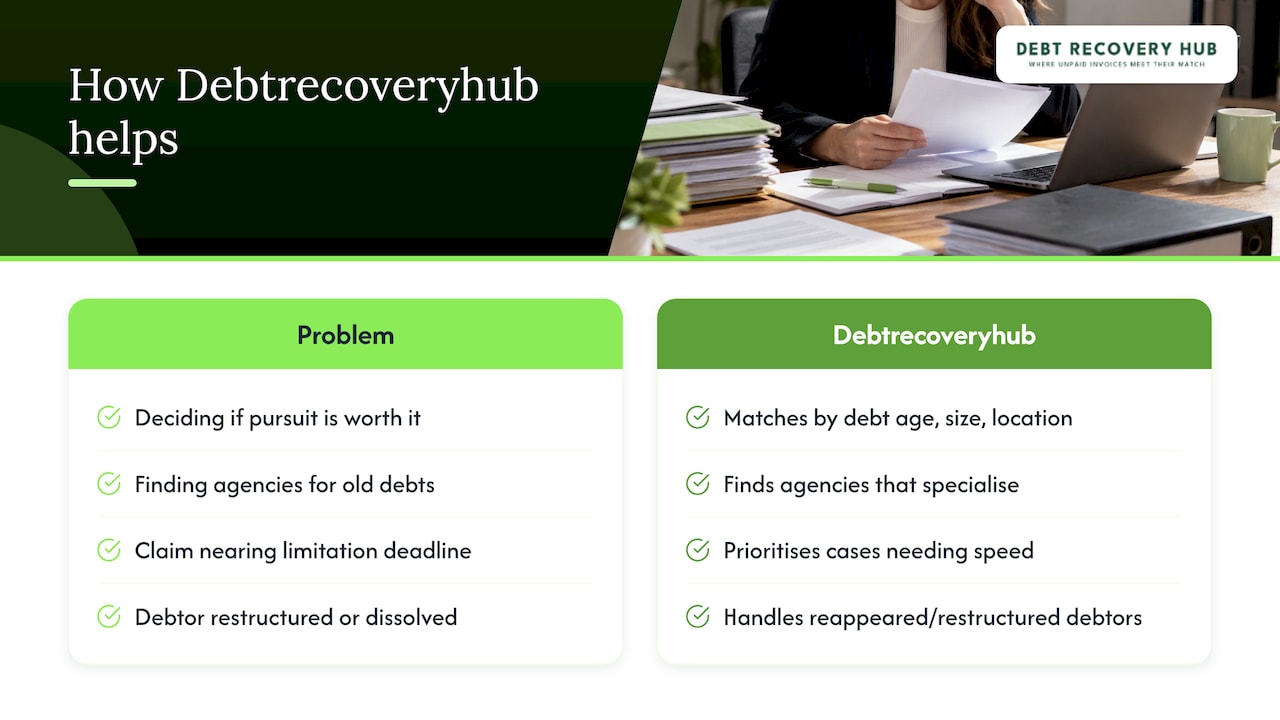
Deciding whether an old invoice is worth pursuing, and finding an agency that actually specialises in debts of that age and type, are two different problems. The platform matches businesses with collection agencies based on the debt’s age, size and location, rather than leaving you to approach providers with no way of knowing which one fits your case.

This is most useful when a debt is complicated: a debtor who has restructured or dissolved and reappeared as a new company, a claim nearing its limitation deadline where speed matters, or a balance that has sat unresolved long enough that in-house credit control has run out of ideas. Rather than contacting agencies at random and hoping one specialises in your situation, submitting the case details once lets Debtrecoveryhub put it in front of a provider suited to it.
If you are weighing whether to escalate a business debt before time runs out, the Business Debt Recovery service page explains how the matching process works and what happens after you submit a case.
Key primary sources and guidance
For the legal detail behind this article, consult the Limitation Act 1980 for the core time limits, the FCA’s CONC 7.15 rules for how regulated firms must handle old debts, and HMRC’s BIM40230 for tax treatment. Citizens Advice offers practical, plain-language steps and sample letters for anyone contacted about an old debt.
This article is general information, not a substitute for advice from a qualified financial advisor. Consult a qualified financial professional about your own circumstances before acting on anything here.
Sources
FAQ
How long before a debt is statute barred in the UK?
Most simple contract and commercial debts become statute barred after six years in England, Wales and Northern Ireland, counted from the payment due date. In Scotland, the equivalent prescriptive period is five years under separate Scottish law.
Can a 10 year old debt still be collected in the UK?
A debt that old has usually passed the standard six-year or five-year limit, so a creditor generally cannot enforce it through the courts. It can still be collected informally if the debtor chooses to pay, but creditors cannot mislead debtors into thinking court action remains possible once it does not.
How can I check if my debt is statute barred?
Start by checking your own records for any payment or signed acknowledgement that might have restarted the clock under section 29 of the Limitation Act 1980, then check court records for any judgment already obtained. Calculate the deadline from the original contractual due date, and get legal advice if the figures involved are significant.
What happens to statute barred debts after they are removed from my credit file?
Once a debt drops off a credit file, typically six years after the default, it stops affecting credit decisions regardless of whether it remains technically owed. The creditor may still ask for payment where the debt is not extinguished, but cannot pursue court action once limitation has genuinely expired.