



UK debt collection agencies typically charge between 20% and 50% of the amount they recover, with the exact rate depending on how old the debt is, how large the balance is, and whether you are dealing with a business or consumer debtor. That range is wide because the risk agencies take on varies enormously from case to case.
Before any recovery work begins, you may also encounter:
- Set-up or account-opening fees: usually a one-off charge per account placed
- Letter Before Action (LBA) or demand-letter fees: sometimes included, sometimes billed per letter
- Skip-tracing charges: for locating debtors whose contact details have changed
- Court filing fees: if litigation becomes necessary, these are typically passed through at cost
- VAT: agencies may charge VAT on their commission, which is not always made clear upfront
Quick verdict: For a fresh commercial invoice under 90 days old, expect a contingency rate of 20–30%. For aged consumer debt over 12 months, that figure can reach 40–50% or higher. Flat-fee pre-collection services suit high-volume, small-balance accounts where a percentage model would be disproportionate.
Key takeaways
| Point | Details |
|---|---|
| Typical contingency range | UK agencies charge 20–50% of recovered amounts; fresh commercial debt attracts the lower end. |
| Age drives rate | Debt over 12 months old typically attracts 40–50% commission; place accounts early to reduce fees. |
| Budget for extras | Setup fees, skip-tracing, VAT on commission, and court costs all add to the headline percentage. |
| Net recovery varies sharply | On a £5,000 fresh commercial debt at 25%, net receipt is approximately £3,475 after fees and VAT. |
| Debtrecoveryhub | The platform matches creditors to vetted agencies by debt type, age, and location at no upfront cost. |
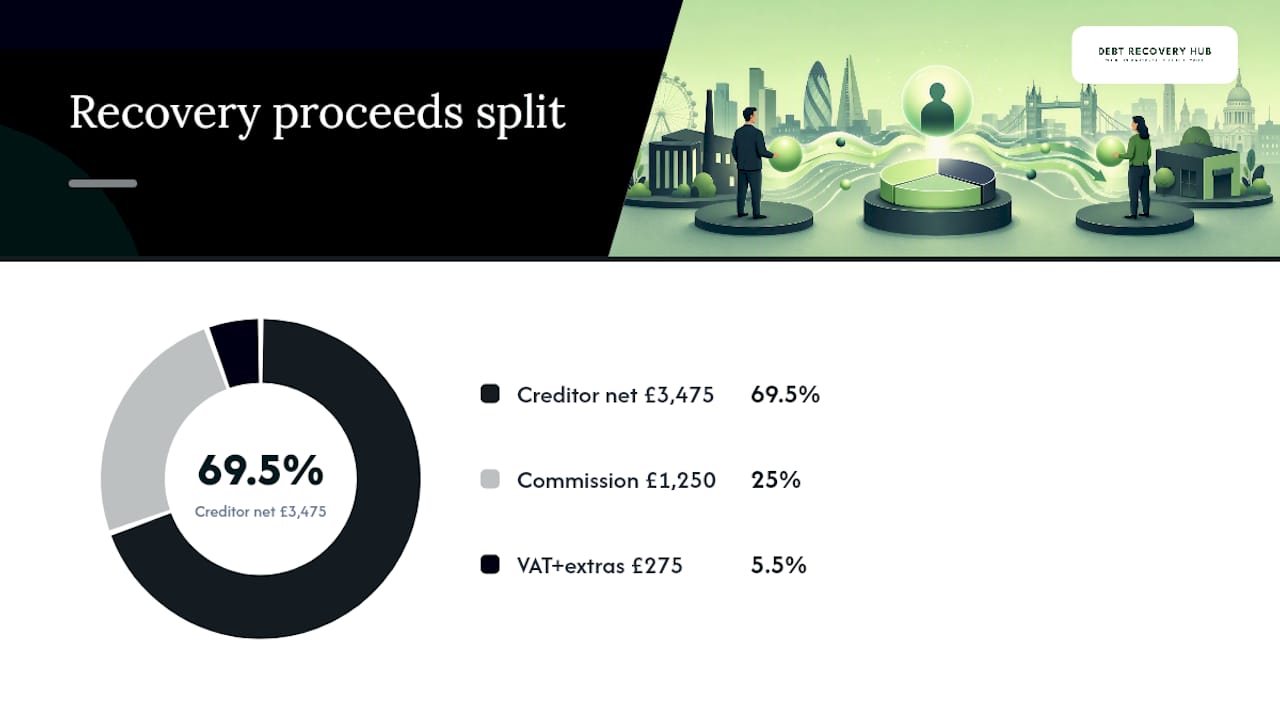
Table of Contents
- How agencies and solicitors usually charge you
- What percentage do UK agencies actually charge?
- What pushes your rate up or down?
- Additional fees to budget for beyond the commission
- Worked examples: what you actually receive after fees
- How to compare quotes and what to ask before signing
- When a solicitor makes more sense than a collection agency
- How Debtrecoveryhub matches creditors to vetted agencies
- The economics of chasing debt: a frank view
- Debtrecoveryhub connects you with the right agency for your debt
- Sources
- FAQ
How agencies and solicitors usually charge you
The three main pricing models each shift risk differently, and knowing which one a supplier is using changes how you read their quote.
Contingency (no-win, no-fee): The agency takes a percentage of whatever it recovers. You pay nothing if nothing comes in. This is the dominant model for commercial collections in the UK because it aligns the agency’s incentive with yours. The downside is that the percentage can feel steep on a large balance.
Fixed or flat fees: Common at the pre-collection stage, where an agency sends a series of demand letters and makes initial contact calls for a set charge per account. Garfield Law’s guidance notes that many firms add setup and administration fees on top of any contingency percentage, so a “flat fee” pre-collection service does not necessarily mean no further charges if the account escalates.
Hybrid or tiered models: A lower contingency percentage applies to larger balances, or a fixed charge is combined with a reduced percentage. Progressive commission structures, where the rate steps down as the recovered amount rises, are increasingly common for high-volume creditor placements. These models give budget predictability without entirely removing the performance incentive.
Solicitors sit in a separate category. They typically charge time-based fees or a slabbed schedule tied to the debt value. Forbes Solicitors publishes a slabbed fee schedule for debts under £10,000, showing how percentage bands apply to different balance brackets. Solicitor involvement usually becomes cost-effective when litigation is likely, the contract is disputed, or enforcement action such as a charging order is needed.
Pro Tip: Ask every supplier to confirm in writing whether their quoted percentage is inclusive or exclusive of VAT, and whether it applies to the gross recovered amount or only to the principal debt, excluding interest.
What percentage do UK agencies actually charge?
Rates cluster into recognisable bands once you map them to the type of account being placed.
- Fresh B2B commercial debt (under 90 days): 15–25% contingency is achievable, particularly for larger balances or volume placements
- Standard commercial debt (90 days to 12 months): 25–35% is typical
- Consumer debt or mixed portfolios: 30–40% is common, reflecting the additional regulatory requirements under the Financial Conduct Authority’s consumer credit rules
- Aged or charged-off accounts (over 12 months): 40–50%, and sometimes above that for very old or low-balance accounts
- Small-balance accounts (under £500): percentage models can become uneconomical; flat-fee pre-collection at a fixed charge per account is often more practical
The 2026 market data from PriceItHere confirms that contingency fees commonly range between 20% and 50% of amounts recovered, with flat-fee pre-collection services typically charged per account. That range has remained broadly stable, though agencies serving specialist sectors such as healthcare or property management sometimes quote outside it.
Rate benchmark: A straightforward commercial invoice placed within 60 days of the due date should attract a contingency rate at the lower end of the 20–30% band. If a supplier quotes 45% for a fresh, well-documented B2B debt, push back or seek a second opinion.
Pro Tip: High-volume creditors placing 20 or more accounts per month have genuine negotiating leverage. Offering a predictable monthly placement volume in exchange for a reduced rate is a conversation worth having before you sign any agreement.
What pushes your rate up or down?
Several factors move the quote materially, and understanding them lets you present a case in the best possible light before instructing.
Age of the debt is the single biggest driver. Every month that passes reduces the statistical likelihood of recovery, so agencies price that risk into a higher percentage. A debt that is six months old is meaningfully harder to collect than one that is six weeks old.

Balance size works in your favour on larger amounts. On a £300 balance, the agency’s economics are tight regardless of the percentage, which is why small-balance accounts often attract flat fees or minimum charges.
Debtor type matters too. Consumer debtors are subject to FCA regulation and the Financial Ombudsman Service, which adds compliance overhead for the agency. Business-to-business collections carry fewer regulatory constraints, which is partly why B2B rates tend to sit lower.
Documentation and evidence affect the agency’s confidence in the case. A clean paper trail, signed contracts, delivery confirmations, and a clear payment history make recovery faster and cheaper. Disputed debts or those with missing paperwork attract a risk premium.
International factors add cost. Cross-border collections involve foreign legal systems, currency risk, and sometimes local agents. International debt recovery for UK businesses typically commands a higher rate than a domestic placement, and some agencies will not take international cases at all.
Volume is the most controllable lever. Agencies price individual placements differently from batch placements. If you have a portfolio of accounts, place them together rather than drip-feeding them one at a time.
Pro Tip: Before instructing an agency, organise your documentation: signed contracts or purchase orders, invoices, delivery receipts, and any written acknowledgement of the debt. A well-prepared case file can reduce the asking rate and speeds up the agency’s assessment.
Additional fees to budget for beyond the commission
The headline contingency percentage rarely tells the whole story. Several additional charges appear regularly in agency contracts, and missing them can turn a seemingly competitive quote into an expensive one.
- Per-account setup or administration fees: charged when accounts are first loaded onto the agency’s system, typically a fixed amount per account regardless of outcome
- Data processing or compliance fees: some agencies charge for running identity checks or screening accounts against suppression registers
- Skip-tracing or debtor-tracing fees: when a debtor has moved or changed contact details, locating them costs money; this is sometimes included in the contingency rate, sometimes billed separately
- Statutory interest and late payment compensation: under the Late Payment of Commercial Debts (Interest) Act 1998, B2B creditors can claim 8% above the Bank of England base rate plus a fixed compensation amount (£40, £70, or £100 depending on the debt value); some agencies recover this on your behalf and take a share, others pass it through in full
- Court filing fees: if the agency or its solicitor issues a County Court claim, the court fee is charged based on the claim value and is typically passed through at cost; enforcement steps such as a warrant of control carry further fees
- Litigation management fees: agencies that handle court proceedings in-house sometimes charge a separate litigation fee on top of the contingency rate
Reputable agencies are upfront about these extras. If a supplier is reluctant to provide a written breakdown of every possible charge, that reluctance is itself a signal worth heeding.
Worked examples: what you actually receive after fees
Two scenarios illustrate how the numbers play out in practice. Both assume the debt is undisputed and the debtor pays in full.
Scenario A: Recent commercial invoice, £5,000
Scenario B: Aged consumer debt, £5,000, placed at 18 months
The difference between the two scenarios is stark: £3,475 versus £2,430 on the same nominal debt, driven almost entirely by the age of the account and the resulting higher commission rate. Statutory interest, if recovered, would partially offset the agency’s fee in Scenario A, but is less likely to be recovered in full on an aged consumer account.
Garfield Law’s worked example guidance for a £5,000 case aligns with these assumptions, confirming that setup and administration charges are standard additions to the headline contingency rate.
How to compare quotes and what to ask before signing
A low headline rate means little if the contract is full of extras or the agency has no clear process for escalating to litigation. Before instructing anyone, work through this checklist.
- What is the exact contingency percentage, and is VAT included or added on top?
- What setup, administration, or per-account fees apply, and are they refundable if the debt is not recovered?
- Does the contingency rate cover court proceedings, or is litigation charged separately?
- Who approves the decision to litigate, and what is the approval process?
- How are partial settlements handled? Does the agency take its percentage on the settled amount or the full claimed amount?
- What is the typical timeline from instruction to first contact, and how long will the agency work the account before closing it?
- What reporting will you receive, and how frequently?
- How is the agency registered, and can you verify its registration at Companies House?
- What data protection and GDPR assurances are in place for debtor information?
Contract clauses worth requesting: a clear written fee schedule attached to the agreement, a clause requiring your written approval before any litigation is issued, a defined reporting cadence, and a termination clause that does not lock you in for more than 30 days after notice.
Red flags: a large upfront retainer with no itemised breakdown; success fee triggers buried in the small print; an agency that cannot provide a written fee schedule on request; contact details that are difficult to find or verify.
Pro Tip: Ask for a sample client report before signing. An agency that cannot show you what reporting looks like in practice is one that probably does not report consistently.
When a solicitor makes more sense than a collection agency
Collection agencies and solicitors are not interchangeable. The right choice depends on where the case is likely to end up.
Solicitors are typically the better choice when:
- The debt is disputed and may require a court hearing
- The debtor is a company and you are considering a winding-up petition or statutory demand
- Enforcement options such as charging orders, attachment of earnings, or third-party debt orders are likely
- The contract contains complex clauses that may need legal interpretation
- The debt exceeds £10,000 and the debtor has identifiable assets
Collection agencies are typically the better choice when:
- The debt is undisputed and the debtor simply has not paid
- You have a volume of accounts to place and want a contingency model
- Speed of initial contact matters more than legal precision
- The balance is too small to justify solicitor time rates
The SRA’s standards and regulations require solicitors to be clear and transparent about fees, which means any solicitor handling debt recovery must provide a written costs estimate upfront. That transparency requirement is a useful benchmark: if a collection agency is less transparent about its costs than a regulated solicitor is required to be, that tells you something.
Solicitor fees for debt recovery vary considerably by firm size and region. Legal 500’s market commentary illustrates how regional practice and firm size affect pricing for legal services, with larger commercial firms typically charging higher hourly rates than regional specialists.
Pro Tip: If the debt is over £5,000, undisputed, and the debtor is a trading business, a statutory demand issued by a solicitor can be a faster route to payment than a standard collection process, because the threat of insolvency proceedings concentrates minds quickly.
How Debtrecoveryhub matches creditors to vetted agencies
Debtrecoveryhub operates as a matching platform rather than a collection agency itself. The intake process collects the details that most affect pricing and fit: debt type (commercial or consumer), age of the debt, total value, number of accounts, documentation available, debtor location, and whether litigation is already in progress.
That information is used to identify agencies from a vetted panel whose specialism, pricing model, and geographic coverage align with the specific case. A creditor with a portfolio of aged consumer accounts in the North West will be matched differently from one with a single large commercial invoice owed by a business in London.
What creditors can expect from the matching process:
- No upfront fee to use the matching service
- Recommendations based on debt type, age, value, and location rather than generic referrals
- Access to agencies that have been assessed for registration, conduct, and fee transparency
- Guidance on which pricing model (contingency, fixed, or hybrid) is likely to suit the case
- Support for specialist cases including international debt recovery and property-related debts
The platform’s approach addresses the most common creditor frustration: not knowing whether an agency is genuinely suited to the type of debt being placed. A mismatch between debt type and agency specialism is one of the most reliable predictors of a poor recovery outcome, regardless of the headline commission rate.
The economics of chasing debt: a frank view
Most creditors focus on the commission percentage and overlook the more important question: what is the realistic probability of recovery, and does the likely net receipt justify the time spent managing the process?
For a fresh, well-documented commercial debt, a moderate commission plus VAT is often acceptable if it results in a substantial net recovery compared to writing off the debt. The calculation becomes harder on aged accounts. At that point, the opportunity cost of management time and the distraction from core business activity starts to matter.
Agencies typically work an account for 90–180 days before recommending closure or escalation to litigation. If an account has not moved after that period, the probability of recovery without court action drops sharply. The honest rule of thumb: if the net expected recovery after fees and the realistic probability of success does not clearly exceed the cost of your own time to manage the process, write the debt off and focus on preventing the next one with better credit controls and accounts receivable software.
Debtrecoveryhub connects you with the right agency for your debt
Searching for a collection agency without knowing which firms specialise in your debt type, age bracket, or sector is how creditors end up with a poor match and a disappointing recovery rate. Debtrecoveryhub removes that guesswork by collecting the details of your case first and then identifying agencies from a vetted panel that are genuinely suited to it.

The service costs nothing to use as a creditor. You describe your debt, and Debtrecoveryhub does the matching. Whether you have a single overdue commercial invoice or a portfolio of aged consumer accounts, the platform connects you with agencies that have the right specialism, the right geographic coverage, and a transparent fee structure.
- No upfront fee for creditors using the matching service
- Matches based on debt type, age, value, and debtor location
- Vetted agencies assessed for registration, conduct, and fee transparency
- Covers commercial debt, consumer debt, property-related debts, and international cases
Submit your case details to receive a tailored agency recommendation, or explore the full range of services to understand which recovery pathway suits your situation.
Sources
- Debt Collection Agency Cost: What Businesses Pay in 2026
- Debt Recovery Costs | Debts Under £10,000| Forbes Collect
- SRA: standards and regulations for solicitors
This article is general information, not a substitute for advice from a qualified financial advisor. Consult a qualified financial professional about your own circumstances before acting on anything here.
FAQ
What percentage do debt collectors charge in the UK?
What extra costs should I budget for beyond the commission?
Expect potential additions including per-account setup fees, skip-tracing charges, VAT on the commission, and court filing fees if litigation is required. Always request a full written fee schedule before placing any accounts.
Can a debt from many years ago still be collected?
In England and Wales, most debts become statute-barred after six years, meaning a creditor cannot enforce them through the courts. However, if the debtor has acknowledged the debt in writing or made a payment within that period, the limitation clock resets.
How do I stop a debt collector contacting me?
A debtor can request in writing that a collector communicates only in a specific way or ceases contact, though this does not extinguish the underlying debt. Collectors must comply with the FCA’s consumer credit sourcebook and the Financial Conduct Authority’s guidance on fair treatment; persistent harassment can be reported to the Financial Ombudsman Service.
Does Debtrecoveryhub charge creditors to use its matching service?
No. Debtrecoveryhub’s matching service is free for creditors. The platform collects details about your debt and connects you with vetted agencies suited to your specific case, with no upfront fee for the referral.