
Send a dated, written demand today, preserve every piece of evidence you have, and set a clear pay-by date. That single sequence resolves more small debts than anything else in this guide, and you can do it in under ten minutes.
Here is what to do right now:
- Record the debt: note the invoice number, amount, due date, and the name and address of the person or business that owes you.
- Gather your evidence: pull together the signed contract or order confirmation, proof of delivery or completion, and any emails or messages where the debtor acknowledged the debt.
- Send a written demand: email or post a short, firm message stating the exact sum owed, the invoice reference, and a pay-by date (a standard period is typically two weeks).
- Log everything: save sent emails with timestamps, photograph posted letters before sending, and keep a running note of every contact attempt.
- Set a diary reminder: if the pay-by date passes with no payment and no reply, move to the next rung.
The rest of this guide follows the same ladder: informal chase, then a formal Letter Before Action, then a county court small claim, then enforcement. Each step costs more time and money than the last, so the goal is always to resolve it at the lowest rung possible.
Key takeaways
The fastest route to recovering a small debt is a dated written demand with a firm deadline, sent the moment informal chasing fails.
| Point | Details |
|---|---|
| Act immediately | Send a written demand within 14 days of the due date; delay is the single biggest reason debts become irrecoverable. |
| Preserve your evidence | Keep every invoice, contract, delivery proof, and correspondence in a dated, chronological file before you do anything else. |
| Use the LBA before court | A Letter Before Action is a legal requirement before filing and often produces payment without a hearing. |
| Know the time limit | Simple contract debts in England and Wales become statute-barred after six years; act well before that point. |
| Debtrecoveryhub | The platform matches your case to a vetted, FCA-compliant agency based on debt size, age, and type, removing the guesswork of agency selection. |
Table of Contents
- How to collect small debts: the step-by-step ladder from invoice to enforcement
- What a Letter Before Action must include
- When and how to make a county court small claim
- Enforcement options after a county court judgment
- Costs, court fees, interest, and time limits you need to know
- When does outsourcing make sense?
- Pre-action checklist: documents to gather before you act
- The mistakes small creditors make most often
- Debtrecoveryhub: matched to a vetted agency in minutes
- Sources
- FAQ
How to collect small debts: the step-by-step ladder from invoice to enforcement
The FSB frames debt recovery as a staged ladder: document the debt, chase informally, send a formal demand, try mediation if available, file in small claims if necessary, then enforce any judgment. Skipping rungs rarely saves time; it usually weakens your position.

Step 1: Document the debt thoroughly
Before you contact the debtor again, build your file. You need:
- The original invoice with a unique reference number and the agreed payment terms
- The contract, purchase order, or written agreement (even a confirming email counts)
- Proof that you supplied the goods or completed the service (delivery notes, sign-off emails, photos)
- A complete record of every payment received and the outstanding balance
- All prior correspondence, including informal chases
Good record-keeping is not just housekeeping. A debtor who disputes the amount or the contract cannot easily do so when you can produce a timestamped paper trail. Accounting software that flags overdue accounts automatically makes this step almost effortless if you set it up before the debt arises.
Step 2: Chase informally, but do it promptly
Most small debts are recovered at this stage, often because the debtor simply forgot or is managing cash flow. A polite but direct phone call or email within a few days of the due date is usually enough.
Timing guidance:
- Day 1 past due: send a brief email reminder with the invoice attached.
- Day 7: follow up by phone if no response; note the date, time, and what was said.
- Day 14: send a firmer written reminder stating that a formal demand will follow if payment is not received within seven days.
Keep the tone professional throughout. Threatening language at this stage can backfire and, in some cases, crosses into conduct the Financial Conduct Authority’s debt collection guidance flags as inappropriate.
Pro Tip: If the debtor makes a verbal promise to pay, follow it up immediately in writing: “As discussed today, you confirmed payment of £X by [date].” That email becomes evidence if they later deny the conversation.
Step 3: Send a Letter Before Action
If informal chasing produces nothing, a Letter Before Action (LBA) is your next move. This is a formal written notice that tells the debtor you intend to take court action if they do not pay within a set period. Courts expect creditors to have sent one before filing a claim, and a well-drafted LBA often triggers payment on its own.
Step 4: Decide whether to escalate
Once the LBA deadline passes, you have three realistic options: accept a payment plan, file a county court claim, or pause and reassess. The right choice depends on the debt’s size, the debtor’s apparent ability to pay, and whether the cost of court action is proportionate. A £200 debt with a £35 court fee is worth pursuing; a £150 debt where the debtor is insolvent probably is not.
What a Letter Before Action must include
A strong LBA does not need to be long, but it does need to be precise. Courts and debtors take it seriously when it contains the right elements. Practical demand-letter guidance consistently shows that a letter stating the debt, the basis, the deadline, and the consequence of non-payment is the most effective pre-court tool available.
Mandatory elements:
- Your full name or business name and contact address
- The debtor’s full name or registered company name and address
- The invoice number(s) and the total amount outstanding, broken down if there are multiple invoices
- The basis of the debt (contract, verbal agreement, services rendered)
- A firm pay-by date, typically 14 days from the date of the letter
- A clear statement that you will begin court proceedings if payment is not received by that date
- Your preferred payment method and bank details
A plain-language template structure:
[Your name / business name]
[Your address]
[Date]Letter Before Action
Dear [Debtor’s name],
I am writing to formally request payment of £[amount], which remains outstanding under invoice [number], dated [date], for [brief description of goods or services].
Despite previous requests, this amount has not been paid. I require payment in full by [a date approximately two weeks from today].
If I do not receive payment by this date, I intend to begin proceedings in the county court without further notice, which may result in a county court judgment (CCJ) being registered against you.
Please contact me on [phone/email] if you wish to discuss this matter.
Yours sincerely,
[Signature]
Sending options and how to log them:
- Email with a read receipt requested: paste the letter text into the body, attach a PDF, and save the sent copy with the timestamp.
- First-class post with proof of postage: photograph the envelope and the certificate of posting before you leave the post office.
- Recorded delivery: the tracking number and delivery confirmation become part of your evidence file.
You can find detailed guidance on pre-action obligations, including what courts expect before a claim is filed, in Debtrecoveryhub’s pre-action protocol guide.
Pro Tip: Avoid the phrase “I reserve the right to take legal action.” It sounds vague and experienced debtors know it is often empty. Instead, write “I will begin county court proceedings on [specific date].” A named date signals genuine intent and produces a measurably higher response rate.
When and how to make a county court small claim
If the LBA deadline passes with no payment and no credible response, the county court is the next step. Gov explains that you can apply online or by post, and the small claims track is specifically designed for people representing themselves without a solicitor.
Eligibility and claim limits
The small claims track in England and Wales handles most straightforward money claims. Check the current financial limits on GOV.UK before filing, as thresholds can change. For Scotland and Northern Ireland, separate processes apply.
How to file, step by step
- Gather your evidence file: invoice, contract, LBA, proof of sending, and any debtor responses.
- Go to GOV.UK’s Money Claim Online (MCOL) or complete form N1 if filing by post.
- Complete the claim form: state the debt amount, add interest if applicable, and write a brief particulars of claim (one or two sentences describing what is owed and why).
- Pay the court fee (calculated on the claim amount; current fees are listed on GOV.UK).
- The court serves the claim on the defendant, who has 14 days to respond.
- If the defendant does not respond or disputes the claim, the court will either enter a default judgment or list the case for a hearing.
- Attend the hearing if one is listed. Small claims hearings are informal; bring your evidence file and a clear, chronological summary of events.
What to expect after filing
A typical timeline from filing to judgment runs roughly 3–6 months for a defended claim, though undefended claims can produce a default judgment in a matter of weeks. GOV.UK notes that mediation is often available and can resolve a dispute faster and more cheaply than a full hearing.
One point that catches many creditors off guard: winning a judgment is not the same as being paid. A county court judgment gives you the legal right to enforce the debt; it does not move money into your account. Enforcement is a separate set of steps.
Enforcement options after a county court judgment
A county court judgment (CCJ) is the court’s formal decision that the debtor owes you the money. It is also the legal gateway to enforcement. The right enforcement tool depends on what you know about the debtor’s finances.
| Enforcement method | Best used when | Approximate speed | Key limitation |
|---|---|---|---|
| Warrant of control (bailiffs) | Debtor has physical assets or cash | Weeks to months | Bailiffs cannot force entry to a home for most civil debts |
| Attachment of earnings | Debtor is employed | Months | Useless if debtor is self-employed or unemployed |
| Third-party debt order | Debtor has a known bank account with funds | Weeks once granted | Bank must hold sufficient funds at the moment of the order |
| Charging order | Debtor owns property | Months to years | Only converts to cash if the property is sold or you apply for an order for sale |
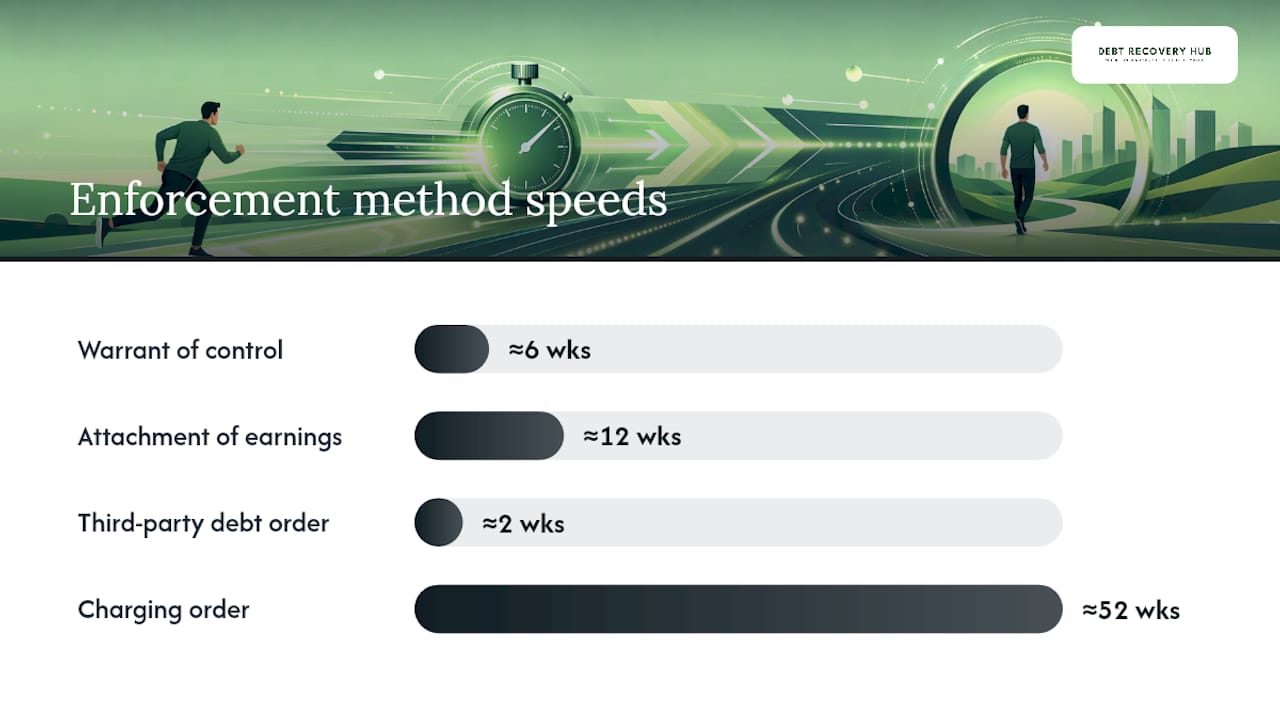
Before choosing a method, find out as much as you can about the debtor’s circumstances. If you do not know where they bank or whether they are employed, you can apply to the court for an order to obtain information, which requires the debtor to attend court and answer questions about their finances under oath.
Pro Tip: Run a basic Companies House search before filing against a limited company. If the company has filed dormant accounts or has a winding-up petition registered against it, enforcement is likely to be futile and you may be better served submitting a proof of debt in any insolvency proceedings instead.
Costs, court fees, interest, and time limits you need to know
Court fees
Court fees for money claims are set by HMRC and published on GOV.UK. They scale with the claim amount. As a rough guide, claims under £300 attract a lower fee than claims in the £1,000–£5,000 band. Always check the current fee schedule on GOV.UK before filing, as fees are updated periodically.
Statutory interest
For business-to-business debts, the Late Payment of Commercial Debts (Interest) Act 1998 entitles you to charge statutory interest at 8% above the Bank of England base rate on overdue invoices, plus a fixed compensation amount depending on the debt size (£40 for debts under £1,000, £70 for debts between £1,000 and £9,999, and £100 for debts of £10,000 or more). You can add this interest to your court claim. For consumer debts, the court has discretion to award interest under the County Courts Act 1984.
Limitation periods
This is the point most small creditors miss until it is too late. In England and Wales, the standard limitation period for a simple contract debt is six years from the date the debt became due, under the Limitation Act 1980. After six years, the debt becomes statute-barred and a court will not enforce it. The clock can be reset if the debtor makes a written acknowledgement of the debt or makes a partial payment, so keep records of both.
For Scotland, the equivalent period under the Prescription and Limitation (Scotland) Act 1973 is five years. Northern Ireland follows broadly similar rules to England and Wales.
Key figure: a defended small claim in England and Wales often takes several months from filing to hearing, while some undefended claims may produce a default judgment within a few weeks.
When does outsourcing make sense?
DIY debt recovery works well for straightforward, recent debts where you have good documentation and the debtor is traceable. It starts to make less sense when the debt is aged, the debtor is evasive, or you simply do not have the time to manage the process.
Decision rules for outsourcing:
- The debt is more than 90 days overdue and informal chasing has produced nothing.
- You do not know the debtor’s current address or employer.
- The debtor is a limited company and you suspect insolvency.
- Your internal time cost of chasing exceeds the likely recovery.
- The debt is large enough that a professional agency’s success fee is proportionate.
How to vet a collection service:
- Ask for a clear pricing model upfront: fixed fee, percentage of recovery, or no-win no-fee.
- Check that the agency is authorised and regulated by the Financial Conduct Authority.
- Ask about their success rate for debts of a similar age and size to yours.
- Confirm they operate within the FCA’s debt collection guidelines and will not use conduct that could expose you to a complaint.
- Get references or case studies from businesses in your sector.
Weighing the likely cost of recovery against the debt’s value is the core calculation. A no-win, no-fee model removes the upfront risk, but the percentage taken on recovery can be significant for smaller debts.
DIY vs using a collection agency:
| DIY | Collection agency | |
|---|---|---|
| Upfront cost | Court fees only | Often nil (no-win, no-fee) |
| Time commitment | High | Low |
| Success rate | Variable | Often higher for aged debts |
| Debtor tracing | Your responsibility | Usually included |
| Suitable for | Recent, well-documented debts | Aged, disputed, or complex debts |
Debtrecoveryhub’s debt collection platform matches your case to vetted agencies based on the debt’s size, age, type, and location, removing the guesswork of finding a compliant, experienced agency yourself.
Pre-action checklist: documents to gather before you act
A strong file makes every subsequent step faster and more persuasive, whether you are sending an LBA, filing a court claim, or handing the case to an agency.
| Document | What to include | Why it matters |
|---|---|---|
| Invoice | Invoice number, date, amount, payment terms | Establishes the sum and the due date |
| Contract or order | Signed agreement, purchase order, or confirming email | Proves the basis of the debt |
| Proof of supply | Delivery note, completion sign-off, photos, or access logs | Counters any “goods not received” defence |
| Payment history | Bank statements showing any partial payments | Clarifies the outstanding balance |
| Correspondence | All emails, texts, letters, and call notes with dates | Demonstrates you chased and the debtor’s responses |
| Debtor identity | Full legal name, registered address, company number if applicable | Needed for court forms and enforcement |
| Informal promises | Written follow-ups to any verbal payment commitments | Prevents the debtor denying the conversation |
When organising the file, arrange documents in chronological order and number each page. Courts and agencies both work faster when the file is clear. If you made contemporaneous notes of phone calls, include them with the date, time, and a summary of what was said. A note written on the day of the call carries far more weight than one reconstructed weeks later.
Capturing informal promises: if a debtor says “I’ll pay you Friday” in a phone call, send an email within the hour: “Confirming our call today, you agreed to pay £X by [date].” If they do not reply to correct it, that email stands as an acknowledgement.
The mistakes small creditors make most often
The single most common error is waiting. A debt that is 30 days overdue is recoverable in the vast majority of cases. The same debt at 180 days is a different problem entirely, and at six years it is statute-barred. Every week of inaction narrows your options and reduces the debtor’s sense of urgency.
Poor record-keeping is a close second. Creditors who cannot produce a signed contract, a delivery confirmation, or a clear invoice often find their claim disputed on grounds they cannot counter. The debtor does not need to prove they did not owe the money; you need to prove they did.
Unrecorded payment arrangements are a particular trap. A debtor who agrees to pay in instalments and then stops can claim the arrangement was different from what you recall, or that they never agreed to it at all. Every arrangement, however informal, should be confirmed in writing immediately.
Underestimating enforcement costs is the fourth predictable mistake. Many creditors assume that winning a judgment ends the matter. It does not. Enforcement can cost additional fees and take months, and it fails entirely if the debtor has no assets or income to pursue.
Pro Tip: The best time to prevent a bad debt is before you supply. Add clear payment terms to every invoice (due date, late payment interest clause, and your right to claim under the Late Payment of Commercial Debts Act), and consider a short credit check on new business customers before extending credit. A 30-second Companies House search costs nothing.
One pattern that comes up repeatedly: a sole trader sends an invoice, hears nothing, sends two more emails, then gives up and writes the debt off. Six months later they discover the debtor is still trading and has paid other suppliers throughout. The fix is almost always the same: a formal written demand, sent promptly, with a specific deadline and a named consequence. That single step, done early, changes the dynamic.
Debtrecoveryhub: matched to a vetted agency in minutes
Chasing a debt yourself through the courts is entirely possible, and this guide gives you the tools to do it. But there is a point where the time cost, the complexity, or the debtor’s behaviour makes professional help the more sensible route.

Debtrecoveryhub’s platform at DebtCollect.org does one thing well: it matches your case to a vetted, FCA-compliant collection agency based on the specifics of your debt, including its size, age, type, and the debtor’s location. You do not need to research agencies, compare fee structures, or worry about whether the agency you pick has experience with your type of debt. The platform handles that matching for you, and the agencies it works with operate on transparent, ethical terms.
Getting started takes three steps: describe your debt using the online intake form, receive a matched agency recommendation, and decide whether to proceed. There is no obligation to continue, and you will know exactly what the agency charges before you commit.
For debts that are aged, disputed, or where the debtor is proving difficult to trace, a matched agency typically achieves better outcomes than a solo court claim, and at a lower time cost to you. Submit your case details to see which agency fits your situation.
Sources
- Make a court claim for money
- FSB | What is the process for debt recovery?
- How to Collect Money Owed: The DIY Playbook (2026)
- How to collect debts effectively | Comerica
This article is general information, not a substitute for advice from a qualified financial advisor. Consult a qualified financial professional about your own circumstances before acting on anything here.
FAQ
How do you recover a small debt in the UK?
Follow the escalation ladder: document the debt, chase informally, send a Letter Before Action with a 14-day deadline, then file a county court claim online via GOV.UK’s Money Claim Online service if payment is still not received.
How long before a debt becomes uncollectible in the UK?
In England and Wales, a simple contract debt becomes statute-barred after six years under the Limitation Act 1980. The clock resets if the debtor makes a written acknowledgement or a partial payment.
What is the 11-word phrase to stop debt collectors?
The phrase “I do not acknowledge this debt and require proof of it” is sometimes cited as a way to request verification before engaging further. It does not cancel a legitimate debt but it does require the collector to pause and provide documentation before continuing.
Is it worth taking someone to small claims court for a small debt?
Usually yes, if you have clear evidence and the debt exceeds the court fee by a meaningful margin. Court fees for small claims start at a modest amount relative to the debt, and an undefended claim can produce a default judgment in as little as four weeks.
When should you use a debt collection agency instead of going to court?
When the debt is more than 90 days overdue, the debtor is difficult to trace, or your time cost of managing the process outweighs the likely recovery. Debtrecoveryhub matches cases to vetted, FCA-compliant agencies based on debt size, age, and type, which removes the risk of choosing the wrong agency.