
Debt collection in the UK moves through four stages: amicable pre-legal contact, the Letter Before Action, a County Court claim ending in judgment, then enforcement. Debtors who receive contact should check the paperwork and ask for written proof of the debt if anything looks wrong. Creditors should never skip a compliant Letter Before Action before issuing court proceedings. One number matters more than any other: after six years without payment or written acknowledgement, most contract debts become statute-barred and unenforceable through the courts.
TL;DR:
- Most debts are resolved within the first 60 days through reminders, calls, and negotiated repayment plans before any legal action begins.
- A compliant Letter Before Action must clearly specify the owed amount, response deadline, and include an income form when applicable; skipping it risks costs penalties.
- A default judgment or CCJ remains on a debtor’s credit record for six years, making early settlement more attractive to avoid long-term damage.
- Enforcement methods like bailiffs and charging orders are slower and depend on the debt’s size, with larger debts often transferred to High Court enforcement officers.
- Debtors should verify debt details and dispute inaccuracies within the response window, while creditors must keep organized records and ensure legal protocols are followed.
Table of Contents
- The four stages of debt collection and how long each takes
- Stage 1: how amicable pre-legal collection actually works
- What must a Letter Before Action contain?
- How does a County Court claim lead to a CCJ?
- What enforcement options follow a CCJ?
- What should debtors and creditors do right now?
- Why staged, compliant recovery beats chasing harder
- Getting matched with the right collection agency
- Primary sources and further reading
- Sources
- FAQ
The four stages of debt collection and how long each takes
Most unpaid debts never reach a courtroom. Advisers who work with people in financial difficulty describe the same broad sequence: in-house reminders and negotiation, a formal pre-action notice, a court claim if that fails, and enforcement if the judgment still isn’t paid. The bulk of recoveries happen in that first stage, often within 60 days of an account going overdue.
- Stage 1, amicable/pre-legal: reminders, calls and negotiated repayment, typically 0 to 60 days.
- Stage 2, pre-action: the Letter Before Action, with a statutory 14 to 30 day reply window.
- Stage 3, legal: a County Court claim, which can take a few months from issue to judgment if contested.
- Stage 4, enforcement: bailiffs, charging orders or attachment of earnings, often running for many months after judgment.
Every stage sits inside two boundaries that rarely get enough attention: the Limitation Act 1980, which caps enforceable contract debts at six years, and FCA conduct rules, which govern how collectors are allowed to behave at every one of these steps.
Stage 1: how amicable pre-legal collection actually works
This stage is where creditors either win the debt back cheaply or lose the chance to. A predictable cadence works better than sporadic chasing, because it signals seriousness without tipping into harassment, which the FCA explicitly prohibits.
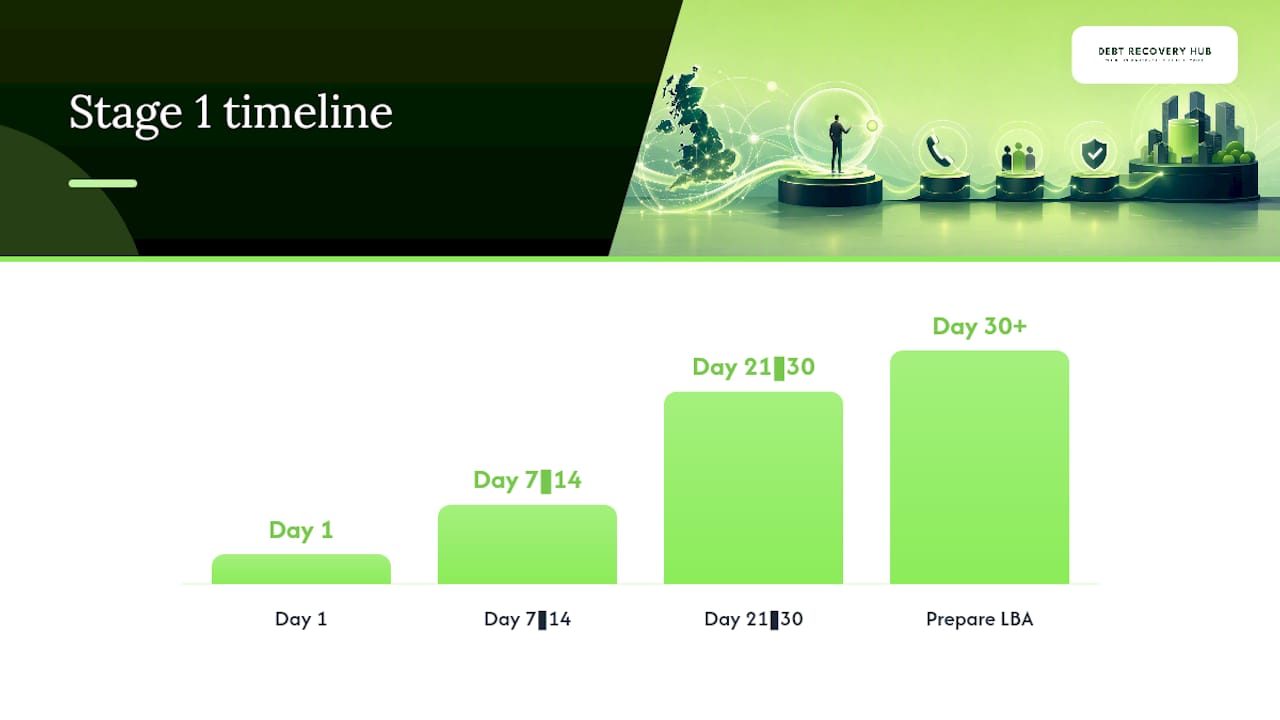
- Day 1: send a friendly reminder, ideally by the channel the customer usually responds on.
- Day 7 to 14: escalate to a firmer written notice, referencing the original invoice or agreement.
- Day 21 to 30: call directly, propose a repayment plan, and put any account hold or service suspension on the table.
- Beyond day 30: if there’s still silence, prepare the file for a Letter Before Action.
Any repayment offer accepted at this stage should be confirmed in writing, with the amount, instalment dates, and consequences of missed payments spelled out. That written record becomes evidence if the account later ends up in court.
Pro Tip: Keep a dated log of every call, letter, and reply, even the ones that go nowhere. If the case reaches Stage 3, that log is often the difference between a quick default judgment and a drawn-out dispute.
What must a Letter Before Action contain?
The Letter Before Action, or LBA, is the formal notice that tells a debtor court proceedings are being considered. It’s governed by the Pre-Action Protocol for Debt Claims, and skipping it is one of the costliest mistakes a creditor can make.
A compliant LBA needs to include:
- The exact amount owed and how it was calculated, including any interest or fees.
- Full contact details for query resolution before any claim is filed.
- A clear deadline, usually 30 days, for the debtor to respond.
- An income and expenditure form where the debt relates to an individual.
- A statement that court action will follow if there’s no response.
Debtors receiving an LBA have three real options: dispute the debt, propose a payment plan, or admit it and negotiate terms. Courts take a dim view of creditors who file a claim without following the protocol properly, and can penalise them on costs even after winning the case.
How does a County Court claim lead to a CCJ?
A creditor starts a County Court claim online or by post, attaching evidence such as the original contract, invoices, and the LBA correspondence trail. If the debtor doesn’t respond within the deadline, the court issues a default judgment, known as a County Court Judgment or CCJ, without a hearing.
- Defendants can apply to set aside a default judgment if they can show a genuine dispute or procedural error.
- A contested claim moves to a hearing, where the judge weighs the evidence from both sides.
- Outcomes range from a straightforward payment order to instalments spread over months, or dismissal if the creditor’s evidence falls short.
A CCJ stays on the debtor’s credit file for six years regardless of whether it’s later paid off in full, which is exactly why so many debtors settle before judgment rather than risk one. Court fees scale with the claim amount, so smaller debts sometimes cost more to chase through the courts than they’re worth recovering that way.
What enforcement options follow a CCJ?
Winning a judgment doesn’t guarantee payment. Enforcement is a separate, often slower stage, and the Limitation Act 1980 still shapes how long a creditor can wait before acting.
- County court bailiffs handle smaller judgments; High Court Enforcement Officers (HCEOs) take over larger debts once a judgment is transferred, usually for balances above a set threshold, and tend to move faster.
- A charging order secures the debt against the debtor’s property, sometimes followed by an order for sale if payment still doesn’t materialise.
- Attachment of earnings deducts payments directly from wages; a bank account freeze can secure funds already held.
Enforcement changes the negotiating balance sharply. Once a debtor understands a charging order or wage deduction is genuinely on the table, settlement offers tend to arrive far faster than they did during the amicable stage.
What should debtors and creditors do right now?
The right move depends entirely on which side of the letter you’re reading. Debtors need to protect their position; creditors need to protect their case.
If you’re the debtor:
- Check your credit report for any judgment or default already logged against you.
- Ask the collector for a validation notice if you’re not certain the debt, or the amount, is correct.
- Dispute in writing within the response window given, usually 30 days, rather than letting it lapse.
- Keep copies of everything sent and received.
- Put forward a realistic repayment figure rather than one you’ll break within a month.
If you’re the creditor:
- Document every stage of your dunning process before you send an LBA.
- Segment accounts by size, age, and debtor type rather than chasing everyone the same way.
- Never issue a claim without a compliant LBA behind it.
- Ask any agency you’re considering for proof of FCA-relevant compliance and a clear audit trail before handing a case over.
Pro Tip: Have your invoices, contracts, and correspondence organised before you approach an agency. A case that arrives with a clean paper trail gets matched and worked far faster than one that turns up as a folder of loose emails.
Debt Recovery Hub exists for the moment a creditor decides internal chasing has run its course: matching the case to a vetted agency suited to the debt’s type, size, and age, rather than picking blind.
Why staged, compliant recovery beats chasing harder
Skipping stages rarely speeds anything up. A creditor who fires off a court claim without a proper Letter Before Action usually ends up back at square one, facing cost penalties and a debtor who now has grounds to dispute rather than pay. Staged escalation, done properly, protects the relationship as much as the balance. And sometimes the right call isn’t another letter. It’s recognising a debt has gone cold, writing it off, and moving on rather than pouring more time into a case the numbers no longer justify.
— Jack
Getting matched with the right collection agency
Chasing a stubborn invoice through four stages alone is slow, and picking a random agency at Stage 2 is a gamble most creditors can’t afford to lose twice. Debt Recovery Hub is the practical alternative to guessing: it matches your case to a vetted agency chosen for the debt’s type, size, age, and location, rather than leaving you to cold-call firms and hope one specialises in cases like yours.

The intake is straightforward. You describe the debt, its age, and any correspondence already sent, and Debt Recovery Hub recommends agencies suited to that exact profile, whether it’s a stubborn commercial invoice or a smaller consumer balance. Having your invoices, the original agreement, and any LBA correspondence ready speeds the match considerably. If you’re weighing whether a case still belongs in-house or needs a specialist, start with the debt collection matching service and see which agencies fit before the six-year limitation clock runs any lower.
Primary sources and further reading
- Pre-Action Protocol for Debt Claims, GOV.UK: the LBA requirements creditors must follow.
- Debt collection explainer, StepChange: how the stages work from a debtor’s perspective.
This article is general information, not a substitute for advice from a qualified financial advisor. Consult a qualified financial professional about your own circumstances before acting on anything here.
Sources
FAQ
What are the stages of debt collection?
Debt collection typically runs through four stages: amicable pre-legal contact, a Letter Before Action, a County Court claim leading to a possible CCJ, and enforcement such as bailiffs or a charging order. Most debts are resolved before the court stage is ever reached.
Do debt collectors eventually give up?
Collectors sometimes stop chasing a debt that looks uneconomical to pursue further, but the debt itself doesn’t disappear until it’s paid, written off, or becomes statute-barred. Creditors will often sell or refer the debt to another agency rather than abandon it outright.
How long before a debt becomes uncollectible in the UK?
Most contract debts become statute-barred after six years with no payment or written acknowledgement, after which they generally can’t be enforced through the courts. The debt can still appear on record and be requested informally, but it can’t be legally forced.
What is the 7 in 7 rule for collections?
There’s no single official “7 in 7” rule in UK debt collection regulation; the phrase is used inconsistently across guides and isn’t a defined legal standard. What is fixed is the LBA response window, generally 30 days, under the Pre-Action Protocol for Debt Claims.