

Statutory law entitles a UK business to a fixed £40, £70 or £100 sum when a commercial debt runs late, depending on the amount owed. That fixed sum is rarely the whole story: once you factor in court fees, enforcement charges and professional costs, a straightforward unpaid invoice can end up costing several hundred pounds to recover, and a defended claim can run into the thousands.
TL;DR:
- The fixed statutory sums of £40, £70, or £100 only apply once per qualifying payment and do not cover the full recovery costs, which can reach into thousands.
- Courts may award additional reasonable costs if documented, but vague claims for extra expenses without proof are likely to be rejected.
- Court fees depend on the claim value, including accrued interest and compensation, which can push the fee band higher, especially after July 2026 updates.
- Enforcement fees are staged, often include fixed and percentage-based charges, and are recoverable only if enforcement successfully seizes assets; abortive fees may still be payable.
- Professional recovery costs vary widely, with low-value cases often cheaper with fixed-fee agencies, while high-value or contested claims typically require solicitor involvement with substantial expenses.
Table of Contents
- Statutory fixed sums under the Late Payment rules: legal basis and qualifying conditions
- When you can claim additional reasonable recovery costs above the fixed sum
- Court and tribunal fees you must budget for including the July 2026 updates
- Enforcement fees and staged charges: enforcement agents, HCEOs and how fees are recovered
- Typical professional fees and cost drivers
- Practical cost checklist to estimate likely costs at each recovery stage
- VAT, disbursements and abortive costs and their effect on net recovery
- What UK creditors get wrong about the true cost of recovery
- How DebtCollect.org can help you find a vetted UK collection agency
- Sources
- FAQ
Statutory fixed sums under the Late Payment rules: legal basis and qualifying conditions
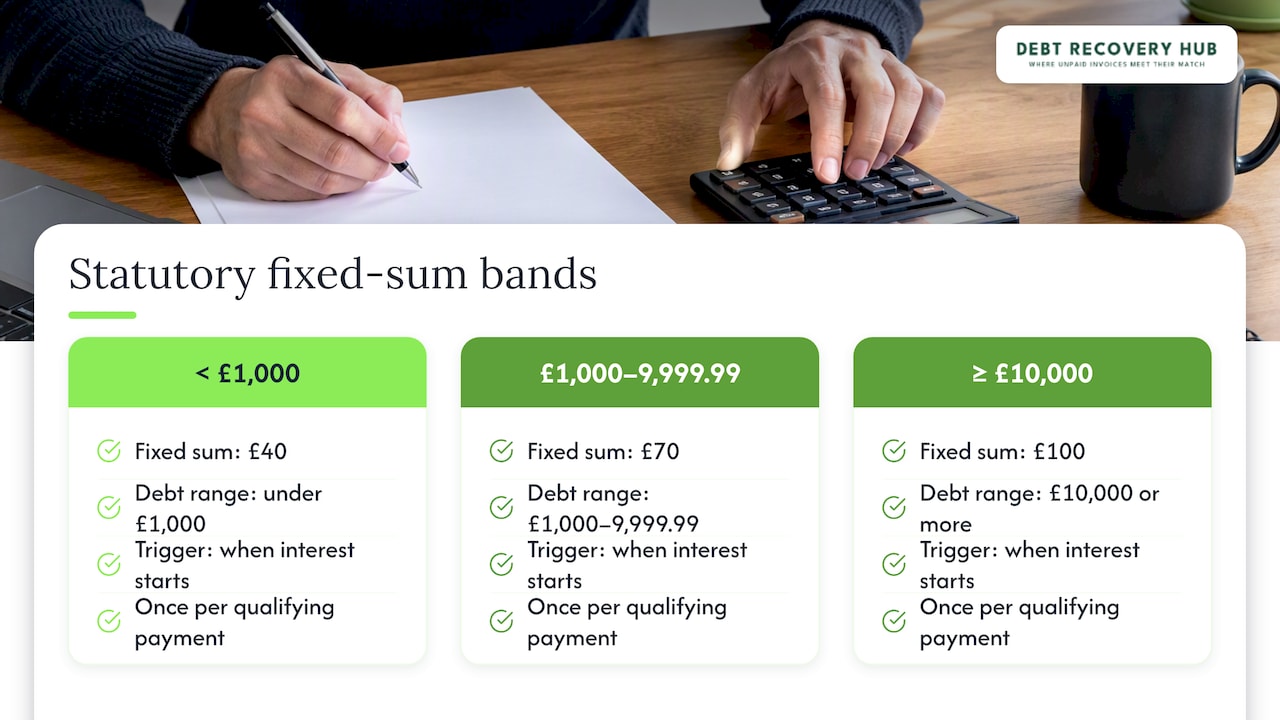
The Late Payment of Commercial Debts (Interest) Act 1998 gives every business a statutory right to a fixed compensation sum once interest starts running on a qualifying commercial debt. The bands are £40 for debts under £1,000, £70 for debts between £1,000 and £9,999.99 and £100 for debts of £10,000 or more. Entitlement is triggered the moment statutory interest begins on the debt, not when you send a chasing letter or issue proceedings.
The Act applies to business-to-business contracts for goods or services. It does not cover consumer transactions, so a sole trader chasing a private customer cannot rely on these bands; the rules are built for commercial creditor relationships.
A frequent mistake is assuming the fixed sum applies per letter or per chase. It does not. The entitlement attaches once per qualifying payment, so a single overdue invoice generates one fixed sum regardless of how many reminders you send. Businesses that invoice in instalments should check whether each instalment counts as a separate qualifying debt, since that affects whether multiple fixed sums can be claimed on the same contract.
When you can claim additional reasonable recovery costs above the fixed sum
The same statutory regime allows a creditor to claim reasonable additional costs where the fixed sum does not cover the actual expense of recovery, as Gov confirms. This matters most on higher-value debts, where £100 barely touches solicitor time or tracing costs.
Courts expect documentary proof before awarding anything above the fixed sum: invoices for solicitor letters, records of tracing agent fees, and receipts for enforcement disbursements. A vague claim for “extra costs” without a paper trail is likely to be rejected or reduced.
Contract terms can also affect what is recoverable. A clause that tries to exclude the statutory fixed sum or cap recovery costs unreasonably may fall foul of unfair contract terms protections, so it is worth checking your standard terms of business rather than assuming a clause will hold up.
Court and tribunal fees you must budget for including the July 2026 updates
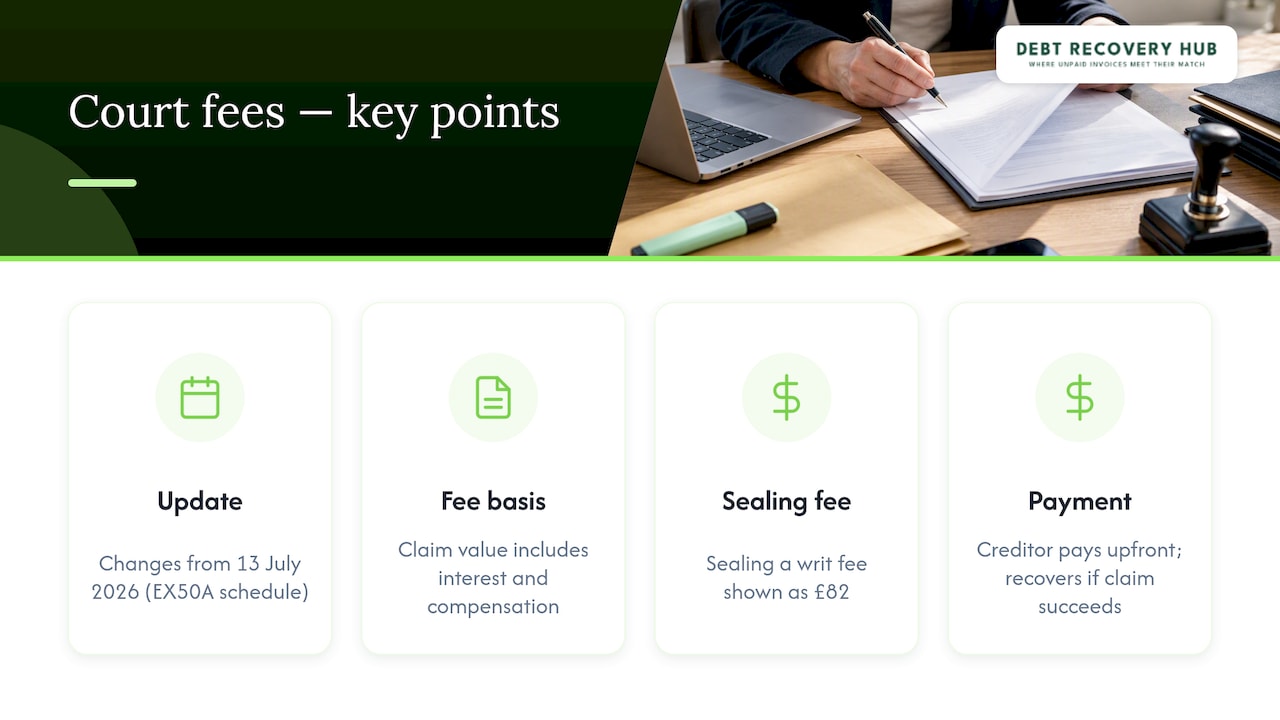
Court fees changed from 13 July 2026, and the update matters for how you calculate what a claim will cost, according to GOV.UK’s announcement on court and tribunal fees. The key point for budgeting is that the claim value used to set the fee band includes accrued interest and compensation, not just the principal debt. Add statutory interest to a £9,500 invoice and you may tip into a higher fee band without realising it.
The current issue fees, sealing fees and application fee codes are listed in EX50A, the HMCTS civil and family court fee schedule for July 2026, which also shows the fee for sealing a writ at £82. Because these tables are updated periodically, check the live schedule before you issue rather than relying on a figure from a previous year.
In practice, the creditor pays court fees upfront and recovers them from the debtor only if the claim succeeds and the debtor actually pays. Businesses on tight margins may qualify for Help with Fees, though this is aimed at individuals rather than companies, so most commercial creditors should treat court fees as real cash-flow outlay from day one.
Enforcement fees and staged charges: enforcement agents, HCEOs and how fees are recovered
Winning a judgment does not guarantee payment. If the debtor still will not pay, enforcement introduces its own fee structure. High Court Enforcement Officers work through staged charges, as set out by the HCEO Association’s fee schedule for recovering a debt: a compliance stage fee, followed by enforcement-stage charges that combine fixed sums with a percentage element, often around 7.5% above certain thresholds, and further charges if goods reach sale or disposal.
These fees are generally recoverable from the debtor once enforcement succeeds, but the creditor can still be left holding abortive compliance fees if the debtor has no assets worth seizing. Enforcement through the County Court uses a different fee scale to High Court enforcement, so the first practical step is confirming which enforcement power applies to your judgment, since transferring a claim to the High Court for enforcement (where the value qualifies) can change both the process and the fee structure entirely.
Typical professional fees and cost drivers
Professional fees vary enormously depending on how far a case travels. As illustrative practitioner ranges, a Letter Before Action typically runs £275 to £500 plus VAT, negotiation and settlement work often sits between £2,500 and £5,000 plus VAT, and a defended claim that reaches trial can run into many tens of thousands once counsel and expert evidence are involved, a pattern reflected in the cost ranges cited in GOV.UK’s late payment guidance.
These figures exclude VAT, court fees, enforcement disbursements and any barrister or expert witness fees, which are billed separately. For straightforward, low-value debts, a fixed-fee collection agency or contingency-based collector is usually cheaper than instructing a solicitor. For contested claims involving disputed facts or significant sums, solicitor involvement becomes worthwhile despite the higher hourly exposure, and reviewing alternatives to hiring a lawyer for small claims is a sensible first step before committing to litigation.
Practical cost checklist to estimate likely costs at each recovery stage
Building a realistic budget means costing each stage before you commit to it, not after.
- Pre-claim: cost of chasing calls, a compliant Letter Before Action, and any tracing needed to confirm the debtor’s current address.
- Issue: the court fee for your claim value, remembering that accrued interest and compensation can shift the fee band.
- Judgment: application fees if the claim is undefended, or additional hearing and disclosure costs if it is contested.
- Enforcement: enforcement agent or HCEO compliance and enforcement-stage fees, plus any sale or disposal charges.
- Failure: abortive fees payable even if enforcement finds no assets to seize.
Low-value debts rarely justify court action once fees and time are weighed against the amount owed; mid-value invoices usually make sense to pursue formally; high-value or disputed debts often need solicitor input from the outset.
Pro Tip: Ask any solicitor, agency or enforcement provider for a full, written fee and disbursement schedule before you instruct them, not after the first invoice arrives.
VAT, disbursements and abortive costs and their effect on net recovery
Most statutory enforcement fees are quoted exclusive of VAT, and whether that VAT is recoverable depends on the creditor’s own VAT status, so it is worth checking this before assuming a quoted fee is the final figure. Common disbursements include tracing agent fees, process server costs, storage charges for seized goods and auctioneer fees on disposal; these are usually recoverable from the debtor if enforcement succeeds, but sit with the creditor if it fails.
On low-value debts, the combined effect of court fees, enforcement fees and disbursements can come close to, or exceed, the amount actually recovered. Get written confirmation upfront of which fees are abortive (payable regardless of outcome) and which are contingent on successful recovery before committing to a route.
What UK creditors get wrong about the true cost of recovery
The biggest misjudgement businesses make is treating the £40/£70/£100 statutory sums as a meaningful deterrent to late payers. They are not designed to cover real recovery costs on anything beyond a trivial invoice, and debtors who intend to stall know this. The more useful lesson from the 2026 court fee changes is that timing decisions, not just fee tables, drive total cost: issuing early while interest is still modest keeps you in a lower fee band, while waiting months to act can push accrued interest high enough to tip a mid-value claim into a more expensive tier.
Escalating to enforcement the moment a judgment is granted is not always the efficient choice either. A brief pause to check whether the debtor has identifiable assets can save an abortive compliance fee. One approach to debt recovery involves matching creditors with vetted agencies based on debt type, value and age rather than providing a generic referral, aiming to reduce wasted spend on enforcement routes unlikely to recover anything.
— Jack
How DebtCollect.org can help you find a vetted UK collection agency

Working out which fee schedule applies, which agency actually collects debts like yours, and whether formal enforcement is worth the abortive risk takes time most business owners do not have. A tailored service matches users with vetted UK-capable agencies based on the debt’s type, value and age, rather than leaving users to contact providers without guidance and compare fee structures themselves.
- Tell us the debt type, amount and how long it has been outstanding.
- Get matched with agencies suited to that specific case rather than a generic list.
- Compare your options before committing to any fee structure.
Start with our Business Debt Recovery page for a tailored match, or see our Corporate Debt Recovery service for larger commercial claims.
This article is general information, not a substitute for advice from a qualified financial advisor. Consult a qualified financial professional about your own circumstances before acting on anything here.
Sources
- Late Payment of Commercial Debts (Interest) Act 1998 (primary legislation)
- EX50A: Civil and family court fees (July 2026) – HMCTS
- Fees & charges for recovering a debt – HCEO Association
FAQ
How much does it cost to recover a debt?
Costs depend on the route taken. The statutory fixed sum alone is £40, £70 or £100 depending on the debt band under the Late Payment of Commercial Debts Act, but once court fees, professional fees and any enforcement charges are added, total costs for a contested claim commonly run into the hundreds or thousands of pounds.
What are the current court fees for debt recovery in the UK?
Court fees for issuing a claim and related applications were updated from 13 July 2026, as confirmed in the GOV.UK fee announcement, with the exact figures set out in the EX50A fee schedule. The fee band is calculated on the claim value including any accrued interest and compensation, so it is worth checking the current schedule before issuing.
Can a debt from ten years ago still be collected in the UK?
Older debts can become unenforceable through the courts once the relevant limitation period has passed, which for most simple contract debts in England and Wales is six years from when the debt became due. Whether a specific ten-year-old debt is still recoverable depends on whether that limitation period was interrupted by a payment, acknowledgement or court action, so it is worth having the individual case reviewed rather than assuming either way.
What are typical fees for debt collection services in the UK?
Fees vary by provider and case type: some agencies work on a fixed fee, others on a percentage of the amount recovered, and solicitor-led routes charge for letters, negotiation and any litigation separately. A Letter Before Action typically costs in the low hundreds of pounds plus VAT, while contested litigation can run considerably higher once court and enforcement fees are included.