
If your debtor has gone quiet and the address you hold no longer works, a specialist tracing agency is usually your fastest lawful route to a verified new address. DIY tracing only makes sense when the debt is small and the person’s identity is straightforward (no name changes, no company layers, no suspected evasion).
Before you order a trace or approach an agency, gather:
- Full name (and any known aliases or previous names)
- Date of birth
- Last known address and postcode history
- Any reference numbers: account, invoice, or court claim numbers
Most UK tracing providers turn results around in 24 hours to 7 days, and many operate on a no-find, no-fee basis, so you only pay when they locate the debtor. If you would rather skip the agency-hunting altogether, DebtCollect.org matches your case to a vetted tracing and recovery partner based on debt type, size, and location.
Key Takeaways
Verified debtor tracing through regulated data sources, backed by a documented lawful basis, is what makes UK debt recovery enforceable rather than a guessing game.
| Point | Details |
|---|---|
| Hire a specialist for anything non-trivial | Reserve DIY checks for small, simple cases; use an agency once value, evasion, or cross-border issues appear. |
| Prepare identifiers before ordering | Full name, date of birth, last known address, and reference numbers reduce misidentification risk. |
| Check verification tiers, not just addresses | A single-source hit is weaker evidence than one corroborated across credit, electoral roll, and registry data. |
| Confirm ICO registration and lawful basis | Legitimate interest under UK GDPR must be proportionate and documented, not assumed. |
| Let DebtCollect.org handle the matching | The platform pairs your case with a vetted, compliance-checked tracing or recovery partner based on debt type, size, and location. |
This article is general information, not a substitute for advice from a qualified financial advisor. Consult a qualified financial professional about your own circumstances before acting on anything here.
Table of Contents
- What is debtor tracing UK creditors rely on?
- When should you trace a debtor yourself vs hire an agency?
- How do you commission a trace and act on the results?
- What are the legal limits on tracing a debtor in the UK?
- How to verify the accuracy and reliability of debtor tracing information before taking further action
- How do you evaluate and choose a tracing agency?
- How to get started with DebtCollect.org
- Sources
- FAQ
What is debtor tracing UK creditors rely on?
Debtor tracing is the process of confirming a person’s or company’s current address using verified data sources, rather than guessing from an old invoice or expired tenancy agreement. For UK creditors, it applies equally to individuals who’ve moved without a forwarding address and to companies that have relocated, dissolved, or restructured.
A verified address matters because almost every formal recovery step depends on it. Statutory demands, court claim forms, and enforcement action all require you to serve documents at a correct, provable address. Get it wrong and a county court judgment can be set aside, wasting months of work and legal fees.
Tracing also protects your budget. Chasing a debtor at the wrong address means:
- Solicitor and court fees spent on a claim that never gets properly served
- Collection agency time wasted contacting a dead number or empty property
- A weaker negotiating position once the debtor realises you’ve lost the trail
A trace typically costs a fraction of what a failed enforcement attempt costs, which is why most credit-control teams treat it as a first step, not an afterthought.
When should you trace a debtor yourself vs hire an agency?
A handful of free checks are worth trying before you spend anything. Search Companies House for a business debtor’s registered office, run a basic search of the debtor’s name and old address, and check any recent correspondence for a forwarding clue. These work for simple, low-value cases where the debtor hasn’t actively hidden.
Hand it to a specialist agency once any of the following apply:
- The debt is large enough that a wrong address risks real legal cost
- You suspect the debtor has moved deliberately to avoid contact
- The case crosses borders, which needs different tools entirely, as covered in our guide to international debt recovery
- You’re dealing with a company that’s dissolved, merged, or restructured
Pricing generally falls into three models: no-find, no-fee (you pay only on a successful trace), flat-fee tracing regardless of outcome, and premium retrace packages that guarantee a follow-up search, often within a 30 to 60 day window, if the first address turns out stale.
Before instructing any agency, check they’re ICO registered, ask what happens if the trace fails (does the no-find guarantee actually apply, or are there exclusions based on the identifiers you supplied?), confirm which data sources they use, and ask whether their report meets the evidence standard courts expect.
How do you commission a trace and act on the results?
Getting this right the first time saves you a second round of fees.
Before you order:
- Compile every identifier you hold: full name, date of birth, last known address, National Insurance or company number if available.
- Gather supporting documents (the original contract, invoice, or credit agreement) in case the agency needs to verify the debt relationship.
- Confirm with the agency what “verified” means in their report; a single database hit is weaker evidence than a cross-referenced address with a confidence score.
On receipt of the trace:
- Check the verification level stated in the report and ask what the retrace terms are if it turns out wrong
- Send a formal demand or letter before action to the confirmed address without delay, following the structure in our pre-action protocol guide
- If the debt is contested or large, instruct a solicitor to issue court proceedings using the verified address as the service address
- Keep the trace report itself. Courts want to see how you found the address, not just that you found it, so file it alongside your other case evidence
What are the legal limits on tracing a debtor in the UK?
Tracing sits within UK GDPR, and the usual lawful basis agencies rely on is legitimate interest: pursuing a genuine debt is a recognised reason to process someone’s personal data, provided the search is proportionate and documented.
That’s why choosing the right partner matters. Look for:
- ICO registration, which confirms the agency is accountable for how it handles personal data
- Use of regulated credit reference sources rather than scraped or unverifiable data
- A documented, ethical collection process once the address is confirmed
Avoid any provider that can’t explain its data sources, or that suggests pretexting (posing as someone else to extract information), unsolicited bulk scraping of social media, or contacting a debtor’s employer or neighbours to apply pressure. These practices breach both data protection law and the standards the Financial Conduct Authority and ICO expect from debt-related activity, and they can undermine your case if it ever reaches court.
How to verify the accuracy and reliability of debtor tracing information before taking further action
A trace report is only as useful as its confidence level, so read it critically before you spend money acting on it. Most reputable reports state a verification tier, showing whether the address was confirmed by a single source (weaker) or corroborated across two or more independent sources such as credit activity, electoral roll, and a property registry (stronger).

Cross-check the report yourself where you can. If the address is a company’s registered office, verify it against Companies House directly rather than trusting the report alone. If it’s a residential address, a simple check of Land Registry ownership records can confirm whether the debtor genuinely owns or has a documented connection to that property.
Ask the agency how recent the underlying data is. Credit reference data can be weeks old; electoral roll entries update annually. A trace that leans entirely on a year-old electoral roll entry is far less reliable than one backed by recent credit activity.
Finally, treat the trace as a starting point, not a guarantee. Success rates fall sharply when a debtor is deceased, has emigrated, or has genuinely gone off-grid, and no amount of cross-referencing fixes a case where the underlying records simply don’t exist. If your agency offers a retrace guarantee, use it before committing to court action on a shaky address.
How do you evaluate and choose a tracing agency?
Start with compliance, not price. Ask directly whether the agency is ICO registered and what lawful basis it relies on for processing personal data. A provider that can’t answer this clearly in one sentence isn’t one to trust with a live case.
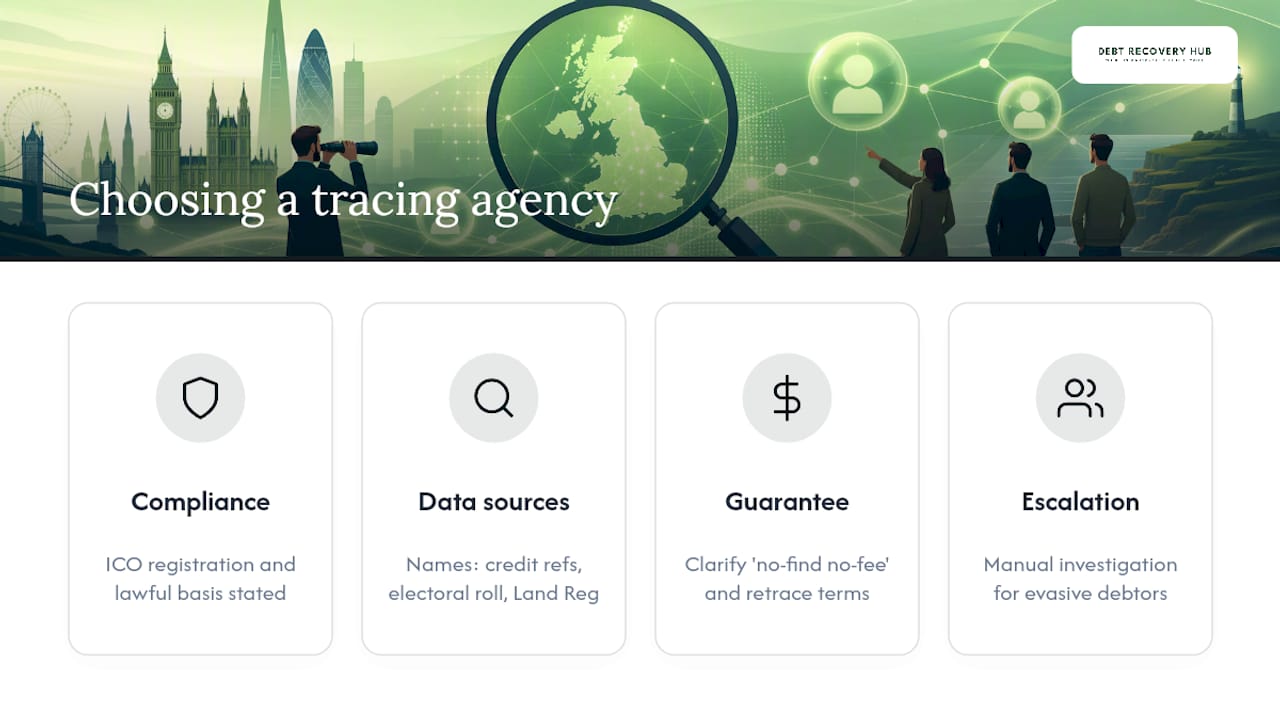
Next, ask about data sources. A credible agency should name the sources it uses, credit reference data, electoral roll, Land Registry, Companies House, without hesitation. Vague answers (“we have our own database”) are a red flag.
Check the guarantee structure. Does “no find, no fee” genuinely mean no payment if they fail, or are there hidden conditions tied to the quality of identifiers you supplied? Ask what a retrace involves and whether it’s included or charged separately.
Finally, ask how they handle difficult cases. Do they escalate to manual investigation when a debtor is evading contact, or do they simply rerun the same automated search and report back “no address found”? The answer tells you a lot about whether you’re dealing with a genuine specialist or a database reseller.
Practitioner notes: what evasive debtors teach you about tracing
The debtors who genuinely disappear rarely do so by accident. Automated batch checks catch most people because most people still apply for credit, register to vote, or pay a phone bill somewhere. The hard 5% need a human looking at mail-forwarding patterns and utility links, not another database query.
Ethical tracing matters beyond compliance. Get it wrong, harass the wrong person, use dodgy pretexting, and you don’t just risk a complaint. You burn the one good address you might get.
— Jack
How to get started with DebtCollect.org
Debtrecoveryhub is the alternative to hunting through agency directories yourself: instead of vetting compliance, pricing, and data sources for every provider on the list above, you complete one intake and get matched to a partner already screened against those exact criteria.

The intake takes a few minutes. You provide the debtor’s details, the debt type, its age and value, and your location, and DebtCollect.org matches you with a tracing or recovery partner suited to that specific case rather than a generic one-size-fits-all provider. That matters because a £500 consumer debt and a £50,000 commercial debt need very different approaches, and matching by debt type and amount means you’re not paying for a service built for the wrong scale of problem.
Every partner in the network has been checked for compliance, so you skip the ICO-registration guesswork covered earlier in this guide. Depending on your case, you’ll see fixed-fee tracing, no-find/no-fee arrangements, or outcome-based recovery options, whichever fits how you want to pay. Head to the debt collection page to start your intake and see which partners match your case.
FAQ
How do you trace a debtor in the UK?
Gather the debtor’s full name, date of birth, and last known address, then either run basic checks through Companies House and public records yourself or instruct a specialist tracing agency that uses credit reference data, electoral roll, and Land Registry records for a verified result.
How long can you legally chase a debt in the UK?
Most unsecured debts in England and Wales become statute barred after 6 years of no payment or written acknowledgement, though this varies for certain debt types and in Scotland, so check the specific limitation rules for your case before relying on this timeframe.
What happens if a debtor ignores a trace and recovery attempt?
If a traced debtor ignores formal demands, creditors can escalate to a county court claim and, following judgment, to enforcement action such as a warrant of control or attachment of earnings, provided the address used for service was accurately verified.
Can you chase a UK debt if the debtor moves abroad?
Yes, though cross-border recovery involves different legal routes and often a local agent or reciprocal enforcement arrangement, which is why cases involving overseas debtors typically need a specialist rather than a standard UK trace.
Is a no-find, no-fee tracing service really free if it fails?
In most cases, yes, you pay nothing if the agency can’t locate a verified address, though some providers tie the guarantee to the quality of identifiers you supplied, so it’s worth confirming the exact terms before instructing anyone.