

A third-party debt order can freeze money sitting in a debtor’s bank account and, once made final, force that money over to you as payment against an unpaid CCJ. It works in two stages: an interim order freezes whatever is in the account the moment it’s served, then a final hearing decides whether that money gets paid across. Whether it actually delivers cash depends on timing, the quality of your evidence, and whether the account is held solely by your debtor.
TL;DR:
- A third-party debt order only works if you have concrete evidence of the debtor’s bank details and funds at the time of application, not if you rely on guesswork.
- Timing the application immediately after payday or invoice settlement increases the likelihood that the funds will be frozen and recovered.
- The bank must search for solely held debtor accounts and disclose balances within seven days, but joint accounts typically cannot be frozen unless all holders are judgment debtors.
- If the account is insufficiently funded, charges outweigh recoveries, or the evidence is weak, pursuing alternative enforcement options like charging orders or writs may be more effective.
- Working with a specialist enforcement agency through debt recovery services often leads to quicker and more successful outcomes than filing solo, especially for complex cases.
Table of Contents
- How third-party debt orders freeze funds and force payment
- When a TPDO makes sense, and the evidence you’ll need
- Applying for a TPDO: forms, fees and the hearing
- What banks must do, and where creditors go wrong
- Charging orders, writs of control and attachment of earnings
- Your pre-application checklist
- Why preparation decides whether a TPDO actually pays out
- Let Debt Recovery Hub match you with the right enforcement partner
- Sources
- FAQ
How third-party debt orders freeze funds and force payment
A TPDO doesn’t ask the debtor to pay. It compels a third party, usually a bank or building society, to hand over money it’s already holding on the debtor’s behalf. The mechanism sits under Part 72 of the Civil Procedure Rules, and it runs in two distinct phases.
The interim order comes first, and the court usually grants it without a hearing. Once served, it freezes whatever funds the bank holds at that exact moment. The bank then has to act:
- Search its records for accounts held in the debtor’s name.
- Disclose, within seven days, whether the balance covers the debt.
- Hold that sum until the court decides what happens next.
The final order follows a short hearing where the judge decides whether to convert the freeze into a payment instruction. Once made, the bank pays the creditor directly and is legally discharged of that amount, meaning it owes the debtor that much less. No hearing, no hidden shortcut. If the debtor wants to contest the order, the hearing is where that happens.
When a TPDO makes sense, and the evidence you’ll need
A TPDO only works if you already have a strong idea of where the debtor banks and that money sits there when it matters. It’s not a fishing tool. Practice guidance is blunt about this: courts reject applications built on guesswork, and judges expect you to show why you reasonably believe funds exist at the named bank.
Before filing, gather:
- The bank or building society’s name and branch, if known.
- Any account number or sort code you’ve previously received (from a cheque, invoice payment, or standing order).
- Evidence of regular income, such as salary dates or recurring client payments, if you’re trying to time service.
- Copies of tenancy, contract, or invoice records showing where the debtor has previously paid from.
If you’re enforcing against someone whose banking details are unclear, an order to obtain information beforehand can save you a wasted application fee.
Pro Tip: Time your application so the interim order lands just after payday or a known invoice settlement date. Funds only freeze if they’re in the account the moment the bank is served, so a well-timed Tuesday morning can catch far more than a random Friday afternoon.
Applying for a TPDO: forms, fees and the hearing
Applications go in on Form N349, submitted to the court that issued your judgment. The process runs roughly like this:
- Complete Form N349 with the judgment details, the sum owed (including interest and costs), and the third party’s name and address.
- Pay the application fee, or apply for help with fees if your income qualifies.
- The court issues an interim order, usually without you attending, and arranges service on the bank.
- The bank searches its records and reports back within seven days.
- A hearing date is set for the final order, where the judge decides whether payment proceeds.
You can ask the court to serve the order, or serve it yourself if timing matters to you. Serving yourself means filing an N215 certificate of service afterwards to confirm it reached the bank.
For the hearing itself, bring:
- A clear calculation of the debt, interest, and costs claimed.
- Copies of the original judgment and any prior correspondence.
- A short witness statement explaining why you believe the named account holds the debtor’s money.
What banks must do, and where creditors go wrong
Once served, a bank has a legal duty to search for accounts held solely in the debtor’s name and disclose balances within seven days. It cannot simply ignore the order or delay indefinitely.
There’s a quirk worth knowing: building societies operate under a rule meaning a final order can never reduce an account balance below a minimal protected amount. Banks don’t carry the same statutory floor, but in practice most apply similar caution around joint accounts.
Joint accounts cause the most confusion. Unless every named holder is a judgment debtor, the account is effectively out of reach. Confirming sole ownership before you file avoids a wasted application.
Other pitfalls that repeatedly trip up creditors:
- Targeting the wrong branch or an outdated account.
- Serving too early or too late, missing the window when funds actually clear.
- Underestimating the bank’s own administration fee, which can eat into modest recoveries.
- Weak evidence that leads a judge to adjourn or dismiss the final order.
Debtors aren’t left without protection either. If freezing the account threatens rent, food, or essential bills, the court can grant a hardship payment order, releasing limited sums for genuine necessities.
Charging orders, writs of control and attachment of earnings
A TPDO isn’t always the right tool. If you don’t know where the debtor banks but they own property, a charging order secures your debt against that asset, though it may take years to realise through a forced sale.
If the debtor has valuable goods, such as vehicles or stock, a writ of control allows enforcement agents to seize and sell items to cover the debt. It moves faster than a charging order but yields less if the debtor has little of value.
Where the debtor holds steady employment, an attachment of earnings order deducts a set amount from wages each pay period, paid through the employer. It’s slower and depends on continuous employment, but it’s reliable once set up.
- No known account, but known assets: charging order.
- Known goods worth seizing: writ of control.
- Stable employment, no urgency: attachment of earnings.
- Known bank details with cleared funds expected soon: TPDO.
Your pre-application checklist
Before you file Form N349, confirm you have:
- The judgment reference number and exact sum owed, including interest and costs.
- The debtor’s current address and any known banking details.
- Evidence the account is solely the debtor’s, not joint.
- Intelligence on when predictable payments clear, such as salary dates.
- A short witness statement and a concise bundle of supporting documents.
- A realistic view of the court and bank fees against the sum you expect to recover.
If the bank reports insufficient funds, or its charges would outweigh what’s recovered, it’s often more sensible to pause and pursue a charging order or writ of control instead of repeating the application.
Why preparation decides whether a TPDO actually pays out
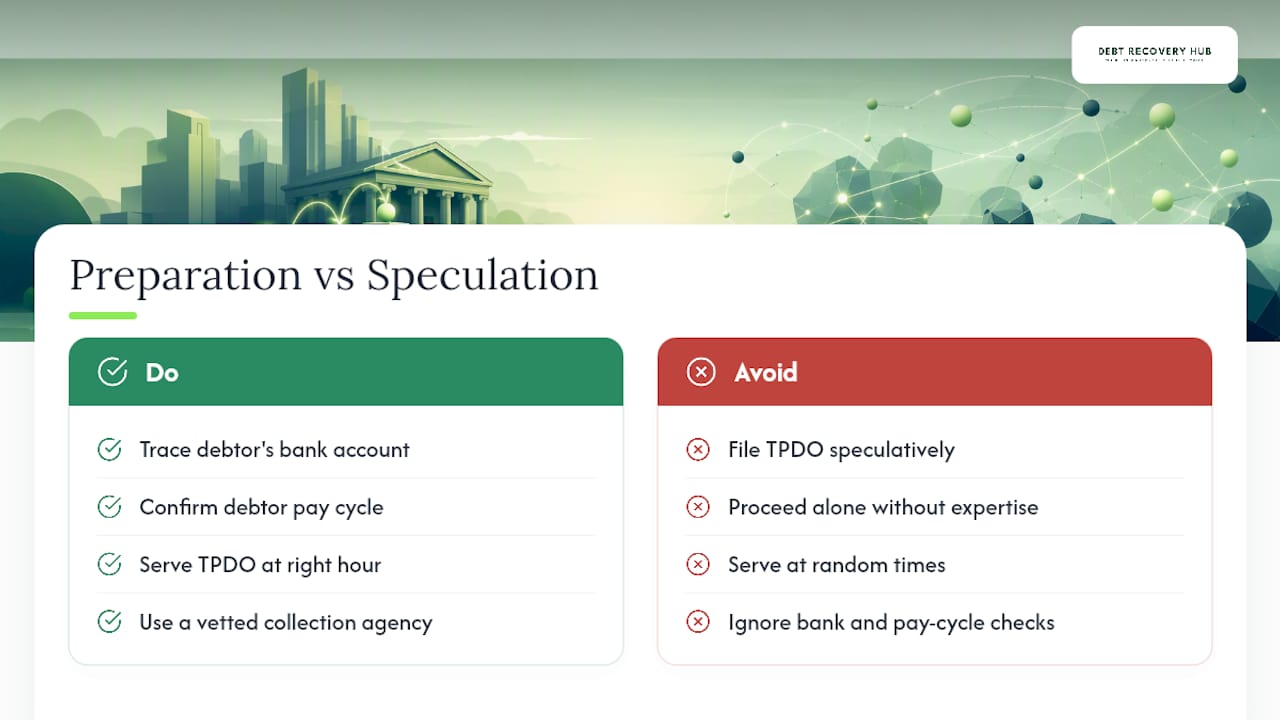
Enforcement work rewards preparation over persistence. The creditors who recover money through a TPDO are almost always the ones who knew the bank, knew the pay cycle, and served the order at the right hour. The ones who don’t tend to file speculatively, get a “nil balance” response, and lose the fee along with the momentum.
Working with a vetted collection agency rather than going alone tends to cut out the guesswork: agencies that specialise in judgment enforcement already know how to trace accounts and time service properly. If you’re weighing up your options after winning a judgment, it’s worth reading through CCJ debt recovery routes before deciding which enforcement method actually fits your case.
— Jack
Let Debt Recovery Hub match you with the right enforcement partner
Chasing a TPDO alone means gathering evidence, timing service, and handling court paperwork on top of your day job. Debt Recovery Hub is the alternative to going it alone or hiring blind: tell us the debt type, amount, and what you already know about the debtor, and we match you with a vetted agency that specialises in exactly that kind of enforcement.

That intake process matters more than it sounds. Agencies matched through Debt Recovery Hub already handle the evidence gathering, timing intelligence, and paperwork that trip up creditors filing solo, cutting weeks off cases that otherwise stall at the “insufficient funds” stage. Whether you’re enforcing a single CCJ or managing recurring corporate debt recovery, the right specialist agency knows which enforcement route actually fits your debtor’s circumstances. Start by requesting a debt recovery quote and get matched with an agency built for your case.
Sources
For the official rules and documents behind everything above:
- PART 72 – THIRD PARTY DEBT ORDERS (Civil Procedure Rules)
- Creditor takes money from your bank account (Citizens Advice)
- Third Party Debt Orders (LexisNexis practice note)
- CCJ enforcement: how to enforce a court order for payment (Howells Solicitors)
This article is general information, not a substitute for advice from a qualified lawyer. Consult a qualified legal professional about your own circumstances before acting on anything here.
FAQ
What is a third-party debt order?
It’s a court order compelling a bank or other third party holding a debtor’s money to pay that money to the creditor, enforcing an unpaid CCJ under Part 72 of the Civil Procedure Rules.
Who can legally freeze your bank account?
Only a court can authorise a freeze, and it does so through an interim third-party debt order served on your bank, which then must search and disclose account details within seven days.
How long can you legally be chased for a debt in the UK?
Most consumer debts become unenforceable through court action after six years without acknowledgement or payment, though a CCJ itself can be enforced for longer once judgment has been obtained.
Can a TPDO freeze a joint bank account?
Almost never, unless every account holder is named on the judgment as a debtor, which is why confirming sole ownership before filing matters so much.
What happens if the frozen account leaves the debtor unable to pay essentials?
The debtor can apply for a hardship payment order, allowing the court to release a limited sum for rent, food or other essential costs.