

Before offering credit or trade terms to any new customer, run three checks: a business credit report from a recognised credit reference agency, a Companies House search for status and insolvency notices, and at least two verified trade references. Back this with a signed credit application that gives explicit consent to run those checks. Don’t extend credit until all four pieces are in hand. The sections below show how to run each check and set a sensible limit.
TL;DR:
- Running all three checks—credit report, Companies House search, and trade references—provides multiple independent insights into a customer’s financial health.
- Significant red flags include insolvency notices, recent County Court Judgments, or address inconsistencies, and should prompt immediate caution or refusal.
- Verbal or vague trade references often hide underlying risk, especially if referees avoid specific questions about balances or payment terms.
- Adjust credit limits downward and tighten payment terms if any check raises concern rather than extending full credit without caution.
- Maintaining thorough documentation at onboarding accelerates debt recovery and simplifies engagement with collection agencies if needed later.
Table of Contents
- How do you run a credit check on new customers?
- How to run a business credit report and read it
- Checking Companies House and insolvency records
- Getting trade references that actually mean something
- Setting the credit limit, terms, and red flags that stop the deal
- What paperwork and consent do you need to collect?
- When and how to re-check existing customers
- Why thorough intake makes recovery faster if things go wrong
- When checks reveal high risk, what’s the next move?
- Where to check the facts yourself
- Sources
- FAQ
How do you run a credit check on new customers?
Copy this straight into your onboarding process. It’s the sequence Debtrecoveryhub recommends to any business or landlord weighing up whether a new account is worth the risk.
- Credit application with consent: get the prospective customer to sign a form authorising you to run credit checks and contact their trade referees.
- Business credit report: buy one from a recognised UK credit reference agency such as Experian, Dun & Bradstreet or Equifax. Reports typically cost a small fee depending on depth, and most arrive within minutes to a couple of hours.
- Companies House search: free, and gives you company status, filed accounts and director details within seconds.
- Two verified trade references: ask specific, numeric questions rather than accepting a vague “yes, they pay fine.”
- Address and company number verification: cross check what the customer told you against Companies House to guard against shell companies.
- Immediate stop signs: an open insolvency notice, a refusal to give a company number, or a credit report showing recent County Court Judgments (CCJs) should all pause the decision.
A comprehensive credit assessment combining a CRA report, Companies House data and primary-source trade references gives you three independent views of the same risk. When they agree, you can move fast. When they disagree, that’s exactly the point of running all three.
How to run a business credit report and read it

A business credit report pulls together CCJs, filed accounts, payment performance data reported by other suppliers, and a suggested credit limit. Experian, Dun & Bradstreet and Equifax all offer this service for UK-registered companies, and prices vary by depth and volume commitment.
Don’t just glance at the headline score. Prioritise these fields:
- CCJs and legal judgments: even one recent CCJ is worth a direct conversation before you proceed.
- Payment days history: how many days late does this company typically pay its existing suppliers?
- Recent financial deterioration: has the suggested credit limit dropped since the last update?
- Filed accounts age: accounts filed late or overdue often precede insolvency by months.
Treat the CRA’s suggested limit as a starting point, not a verdict.
Checking Companies House and insolvency records
Companies House gives you free, public access to everything you need to confirm a company is real, active and not heading towards insolvency. Here’s the order to work through it.
- Search find-and-update. Confirm the company number, current status (active, dormant, in liquidation) and the date of the last filed accounts.
- Check filed accounts. Late or overdue accounts are one of the most reliable early warning signs of cash flow trouble.
- Search The Gazette and the insolvency register. The Gazette publishes official insolvency notices, covering winding-up petitions, provisional liquidation and administration. No result there means no current formal proceedings, not a clean bill of health forever.
- Cross-check officer and address details. Compare the registered office and director names against what the customer put on their credit application.
Businesses building their own monitoring tools can pull this programmatically. Companies House exposes an insolvency API endpoint that returns any insolvency resource tied to a company number, which is worth knowing if your finance system supports integrations.
Getting trade references that actually mean something
Most applicants nominate referees who will say nice things about them. That’s not dishonesty. It’s self-preservation. So your job is to ask questions specific enough that a generic “they’re great, no issues” answer becomes impossible to give.
Ask each of the two or three referees:
- How long have you traded with this company?
- What’s the average balance outstanding at any given time?
- What are their typical payment days against your terms, and has that changed recently?
- Have there been any disputes, part payments, or requests to extend terms?
Then verify the referee itself is a real trading business, not a shell set up to inflate the applicant’s credibility. Refusal to give references, or vague, unquantified answers, is itself useful information.
Pro Tip: If a referee dodges the “average balance” question but happily talks about how long they’ve worked together, that’s usually evasion, not forgetfulness. Press for the number before you move on.
Reluctance to cooperate with checks is strongly correlated with higher payment risk according to credit-control specialists, so treat it as a genuine signal rather than an inconvenience.
Setting the credit limit, terms, and red flags that stop the deal
Once you’ve got the CRA report, Companies House data and trade reference answers, combine them into a decision rather than treating each in isolation. Start with the CRA’s suggested limit, then adjust down if you have no direct trading history, if accounts are overdue, or if trade references gave vague answers.
Where risk looks moderate rather than clean, use mitigations instead of an outright refusal:
- Start with a low rolling limit and increase it after two or three clean payment cycles.
- Shorten payment terms from 30 days to 14, or ask for part payment upfront.
- Request a deposit or prepayment on the first order.
- Add a retention of title clause so goods remain yours until paid for.
Some findings should stop the process outright rather than trigger a workaround.
| Red flag | Why it matters |
|---|---|
| Open insolvency notice or winding-up petition | Company may cease trading before invoice is due |
| Recent CCJs | Signals existing unpaid debt and litigation history |
| Registered address doesn’t match trading address | Possible shell company or fraud risk |
| Refusal to give company number or trade references | Correlates with concealment of payment problems |
| Accounts filed significantly late | Common early indicator of financial distress |
If two or more of these show up together, decline the account or insist on full prepayment until the picture improves.
What paperwork and consent do you need to collect?
A proper credit application form does two jobs: it gathers the facts you need, and it creates a legal record that you had permission to check them. Build your form around these fields.
- Legal company name and trading name, if different.
- Company registration number.
- Registered office address and trading address.
- Names of directors or partners.
- Requested credit limit and preferred payment terms.
- Bank details for reference purposes.
- A signature explicitly consenting to credit checks, bank references and trade reference contact.
A well-drafted trade credit application form should request this consent in plain terms, not bury it in small print. Keep the signed form, the CRA report, and reference replies together in one file per customer. If you ever need to pursue a debt through collections or court, that paper trail is what makes the case easy to prove. When you’re processing director personal data as part of the checks, hold only what’s proportionate to the credit decision and keep it secure in line with UK data protection obligations.
When and how to re-check existing customers
Credit checking isn’t a one-off gate at onboarding. It should be an ongoing process that quietly runs in the background.
Reassess whenever:
- A payment arrives late for the first time, or lateness becomes a pattern.
- Companies House shows a new filing, especially accounts filed later than usual.
- The customer’s order volume or behaviour changes suddenly, in either direction.
For monitoring itself, Tide’s guidance on running credit checks points to a mix of Companies House’s free follow service, paid CRA alert subscriptions, and accounts payable software that automatically flags overdue accounts. A good accounts receivable system can fold this straight into your existing workflow rather than requiring separate manual checks. When monitoring flags a genuine problem, tighten terms first: shorten payment days, cap the limit, or move to prepayment before you consider suspending supply entirely.
Why thorough intake makes recovery faster if things go wrong
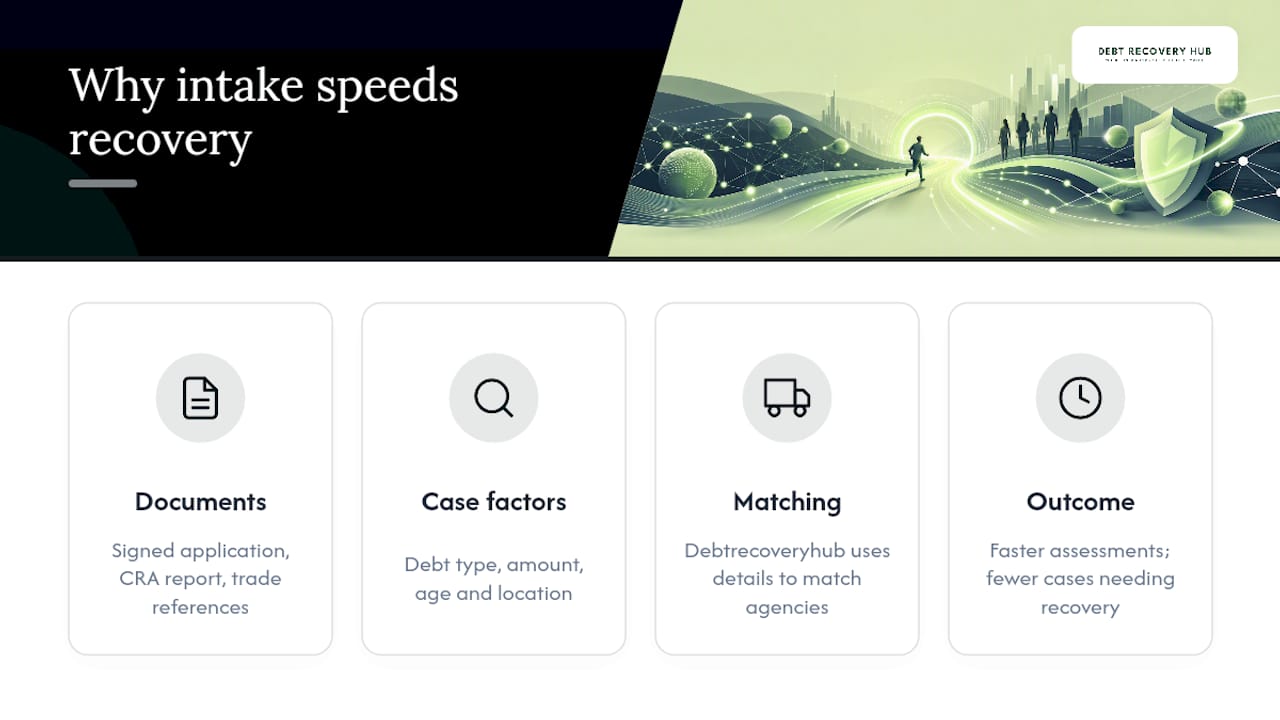
The businesses that recover unpaid debt fastest are almost always the ones that documented everything at onboarding. A signed application, a CRA report, and trade reference notes aren’t just protective paperwork. They’re the exact details a debt collection agency needs to assess a case quickly, because debt type, amount, age and the debtor’s location all shape which recovery route actually works.
That’s precisely the information Debtrecoveryhub asks for when matching a business to a specialist agency. Thorough checks at the start rarely eliminate every bad debt, but they consistently shrink the number of cases that end up needing recovery at all, and speed up the ones that do.
— Jack
When checks reveal high risk, what’s the next move?
Sometimes the checks do exactly what they’re meant to do: they tell you this customer is too risky to extend credit to, or a previously good account has gone quiet on payment. At that point, chasing the debt yourself with generic reminder emails rarely gets results, and it costs you time you don’t have.

Debtrecoveryhub matches your case to a vetted debt collection agency based on the debt type, amount, age and location, rather than leaving you to pick a name from a search results page and hope for the best. That intake process mirrors the same detail you’ve already gathered from your credit checks, so the handover is fast rather than starting from zero. It’s particularly useful for cross-border cases, construction and trade debts, or accounts where in-house chasing has already failed. If you’ve got an overdue account that credit checks flagged as high risk from the start, or one that’s simply stopped paying, start the debt collection matching process and get connected to an agency suited to that specific case.
Where to check the facts yourself
- Companies House find-and-update: free, real-time company status, filed accounts and officer details. Follow a company to get alerted to new filings.
- The Gazette insolvency notices: official record of winding-up petitions and insolvency proceedings.
- nibusinessinfo credit check guidance: practical UK onboarding templates and checklists.
Sources
Ask for multiple recent suppliers, and pose specific questions about average balance and payment days rather than accepting general praise.
FAQ
How long does a credit check on a new customer take?
Companies House searches are instant and free; a business credit report from a CRA typically arrives within minutes to a couple of hours once purchased, and trade reference verification is the slowest step, usually taking a day or two to chase replies.
How much does a business credit report cost?
Costs vary by provider and depth of report, generally ranging from a few pounds to around £30 per check, with volume discounts available for businesses running frequent checks.
What should I do if a customer refuses to give their company number?
Treat it as an immediate red flag and pause the credit decision. Reluctance to authorise checks correlates strongly with higher payment risk.
What if the customer becomes a bad debt despite passing checks?
Keep the signed application, CRA report and reference notes on file, since that documentation speeds up any recovery route. Debtrecoveryhub can match the case to a suitable debt collection agency if in-house recovery attempts stall.