


A charging order secures a business debt against a debtor’s interest in property, stocks or funds, but it does not hand you the money. It creates a legal charge that ranks you for payment when the asset is eventually sold or refinanced. Applications run through form N379 for land or N380 for securities and funds, filed with the Civil National Business Centre.
TL;DR:
- A charging order creates a legal claim on assets like land, property, securities, or funds but does not guarantee immediate cash payment.
- Applying involves specific court forms, accurate land or asset details, and serving processes within strict deadlines; failure can lead to rejection.
- Enforcing a sale requires a separate court order, which is often complicated by existing charges, co-ownership, or insolvency issues.
- Debtors can oppose or delay a charging order through procedural defects, hardship claims, or competing interests, making proper documentation vital.
- Charging orders are most effective for substantial debts with assets likely to be sold or refinanced soon, but may be ineffective for low-value or minimal equity assets.
Table of Contents
- What a charging order is and how it works
- How to apply using forms N379 and N380
- Interim and final charging orders: service and timelines
- Enforcing the charge: order for sale and practical hurdles
- Opposing, varying or discharging a charging order
- When a charging order is worth it versus cheaper alternatives
- Impact of a charging order on business operations and creditworthiness
- Interaction between charging orders and insolvency procedures
- Legal consequences for business owners or directors when a charging order is granted
- Strategies to prevent or mitigate the risk of charging orders in business debt management
- Realistic expectations when using charging orders in business-debt cases
- How a vetted agency match can reduce the procedural risk
- FAQ
- Sources
What a charging order is and how it works
The statutory basis sits in the Charging Orders Act 1979, with procedure set out in CPR Part 73 and Practice Direction 73. Once a county court judgment exists and remains unpaid, a creditor can ask the court to convert that judgment into a charge over specific assets the debtor owns or holds a beneficial interest in.
A charging order can attach to several kinds of asset:
- Land or property the debtor owns, including a beneficial interest in jointly owned property.
- Company stocks, shares or securities registered in the debtor’s name.
- Funds held in court on the debtor’s behalf.
The practical effect is narrower than many creditors expect. A charging order gives you an equitable charge and a place in the queue for proceeds when the asset is sold. It does not give you any say in how the business is run, and it does not force a sale on its own. Think of it as staking a claim rather than cashing one in.
How to apply using forms N379 and N380
Applying for a charging order follows a defined sequence, and missing a step is the most common reason applications stall.
- Confirm you hold an unsatisfied county court judgment and calculate the exact outstanding balance, including any interest accrued.
- Choose the correct form: N379 for land or property, or N380 for securities and funds in court.
- Attach an office copy of the Land Register entry showing the title number and the debtor’s registered interest, plus a signed statement of truth.
- File the application with the Civil National Business Centre, which handles most county court charging order applications.
- Pay the relevant court fee and wait for the court to consider the application, usually without a hearing at this stage.
Pro Tip: Run a Land Registry priority search before you file, so the title details on your application match the register exactly and the court has no reason to query ownership.
Once the court is satisfied, it typically grants an interim order first. Registering that order at HM Land Registry protects your priority against any later dealings with the property.
Interim and final charging orders: service and timelines
An interim charging order is usually made without notice to the debtor, giving you temporary protection while the court decides whether to confirm it. That protection comes with strict obligations attached.
- You must serve the interim order and supporting documents on the debtor and any other interested parties, generally within 21 days.
- A certificate of service must be filed with the court, usually within 28 days, confirming that service was properly carried out.
- The interim order prevents the debtor from disposing of or dealing with the charged securities or funds in the meantime, though land transactions are governed separately through the Land Registry entry.
- A final hearing then determines whether the charge becomes final, interim arrangements can be refused, or the matter is transferred to the debtor’s home court.
Getting service wrong is one of the most frequent reasons courts decline to make an order final, so diarise the deadlines the moment the interim order lands.
Enforcing the charge: order for sale and practical hurdles
A charging order does not itself force a sale. To realise the asset, you need a separate application for an order for sale under CPR rule 73.10C, and the court retains discretion over whether to grant it.
Several factors commonly work against a straightforward sale:
- Existing mortgages or prior charges that rank ahead of yours and absorb most of the sale proceeds.
- Co-owners with their own beneficial interest in the property, which the court must weigh.
- Insolvency proceedings affecting the debtor, which can override or complicate a charging order.
- Low-value debts where the legal costs of forcing a sale outweigh any likely recovery.
One factor practitioners weigh heavily is the debtor’s equity position: where existing mortgages and prior charges leave little free equity, an order for sale is unlikely to recover meaningful funds even if the court grants it. Budget for court fees, Land Registry fees and legal costs, and expect the process from application to any sale to take months rather than weeks.
Opposing, varying or discharging a charging order
Debtors and other interested parties have several standard grounds for resisting a charging order, and creditors should prepare for them before filing.
- The debtor may argue they hold no beneficial interest in the charged asset, despite being named on the title.
- Procedural defects, particularly failures in service or missed certificate deadlines, give grounds to have an interim order refused at the final hearing.
- Hardship arguments, for example where the property is the debtor’s only home and a forced sale would cause disproportionate harm, can influence the court’s discretion.
- Competing creditors with earlier-registered charges may apply to have their priority recognised ahead of yours.
To reduce the risk of refusal, assemble accurate Land Registry evidence confirming the debtor’s title, compile a clear list of other known creditors, and keep a full payment history ready to demonstrate the debt is genuinely outstanding. Courts also have power to vary or discharge an order entirely where circumstances change, so keeping your paperwork current matters even after an order is granted.
When a charging order is worth it versus cheaper alternatives
A charging order makes commercial sense when the debt is substantial relative to the likely legal costs, and there is a reasonable prospect the asset will be sold or refinanced within a timeframe that suits you. For smaller debts, or where the debtor has no identifiable property or securities, cheaper routes usually make more sense first.
- A letter before action often prompts payment without any court involvement.
- A statutory demand can apply pressure where insolvency is a realistic prospect for the debtor.
- Instructing enforcement agents may recover smaller debts faster and more cheaply than a charging order.
- A negotiated settlement, even at a discount, can beat a lengthy enforcement process on cost and certainty.
Pro Tip: Before filing, estimate the asset’s likely sale value against any prior charges. If the sums suggest little free equity, a charging order may only secure a place in a queue that never pays out. Free templates such as those from TradeTally can help with the earlier, cheaper stages before you commit to court fees.
Impact of a charging order on business operations and creditworthiness
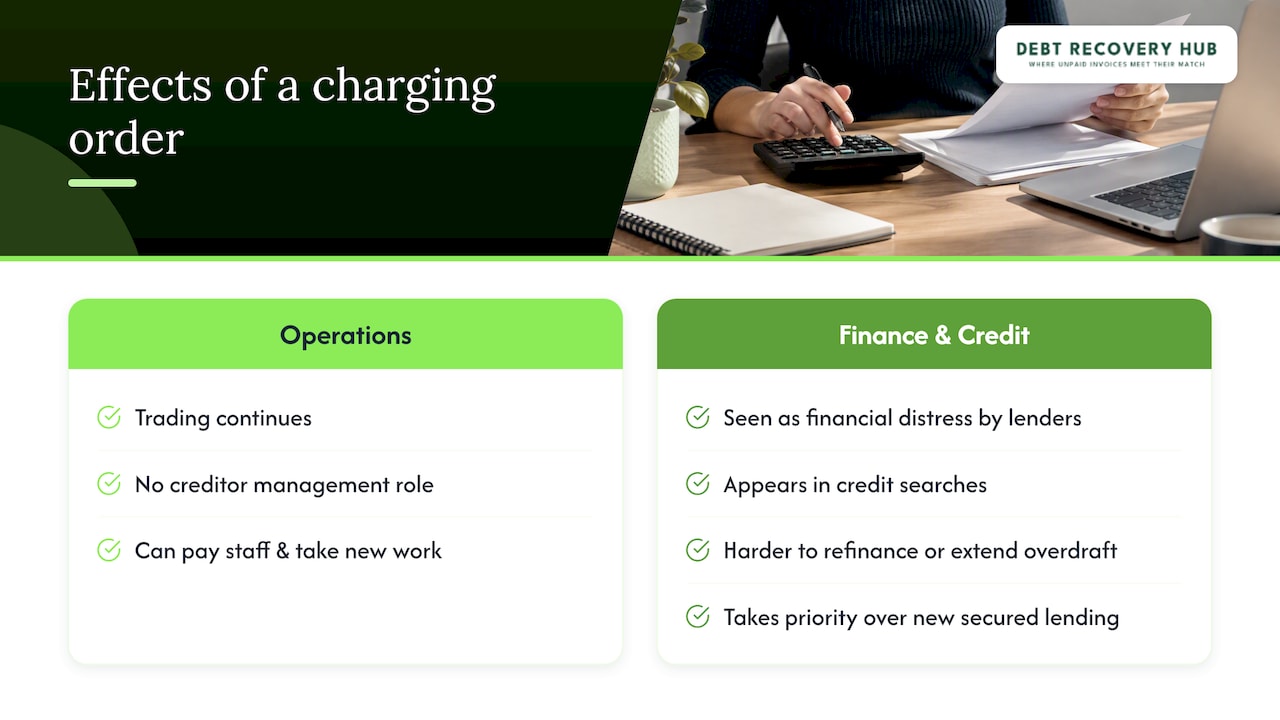
A charging order against business premises or company securities does not halt trading and does not give the creditor any management role. The business can continue operating, paying staff and taking on new work exactly as before, because the charge sits over an asset rather than over the company’s conduct.
The effect is felt most in financing and perception. Lenders and credit reference agencies treat a registered charging order as a signal of financial distress, and it can appear in credit searches run by suppliers, landlords or future lenders. That visibility often makes refinancing, extending an overdraft or securing new trade credit harder, since the order effectively sits in the queue ahead of any new secured lending against the same asset.
Directors should also expect scrutiny from existing secured lenders. A bank holding a first charge over premises may want reassurance that a second charge from an unrelated creditor does not threaten its own position, and some facility agreements contain covenants triggered by a charging order being registered. For a business that depends on property as collateral for working capital, a charging order can therefore constrain borrowing capacity even while day-to-day operations continue unaffected.
The reputational dimension matters too. Trade suppliers checking a company’s credit file before extending payment terms may see the charge and respond by tightening terms or demanding payment upfront, which can squeeze cash flow indirectly even though the charging order itself demands no immediate payment.
Interaction between charging orders and insolvency procedures
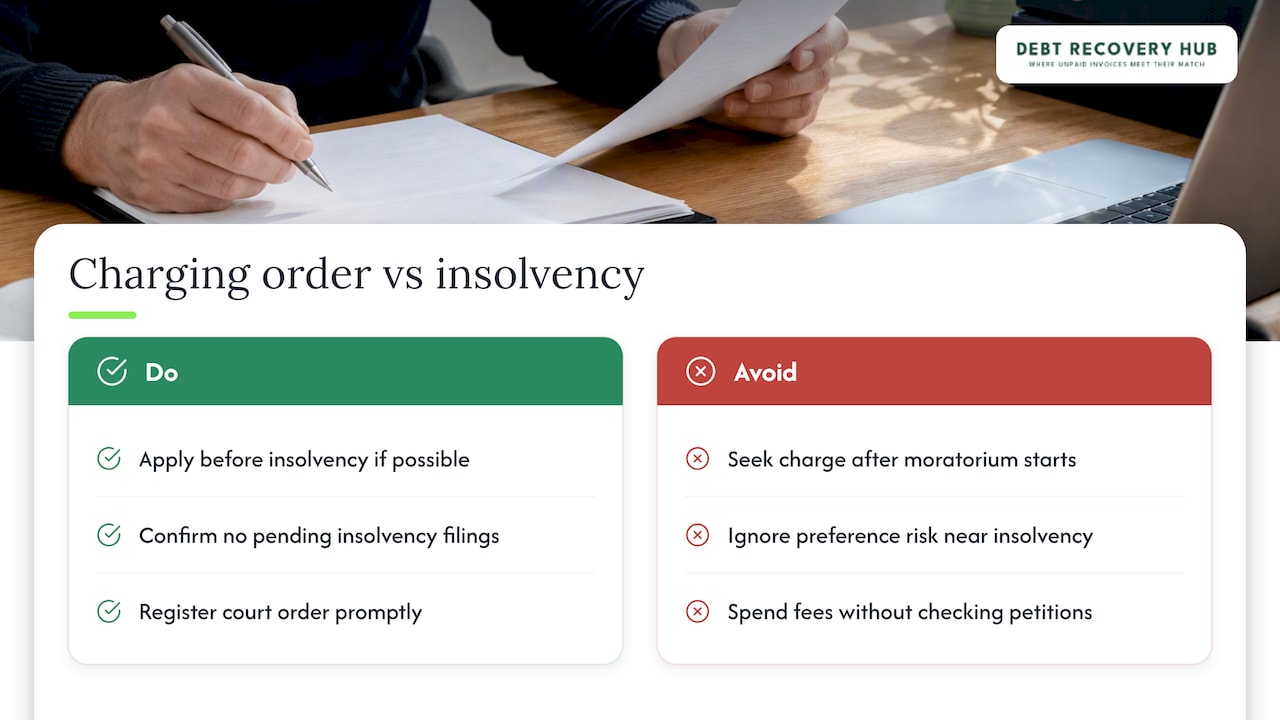
A charging order and a formal insolvency process can both apply to the same debtor, and the order in which they happen matters considerably. If a company enters administration or liquidation after a charging order has already been registered, the charge generally retains its priority as a secured interest, meaning the creditor stands ahead of unsecured creditors for proceeds relating to that specific asset.
The picture changes if insolvency proceedings begin before a charging order is finalised. A moratorium or the appointment of an administrator can prevent new enforcement action, including an application for a charging order, without the court’s permission. Creditors already holding an interim order may find the final hearing delayed or complicated by the insolvency practitioner’s involvement, since the practitioner now controls the company’s assets on behalf of all creditors.
Charging orders obtained shortly before an insolvency event can also attract scrutiny. An insolvency practitioner may investigate whether the charge amounts to a preference, where one creditor was put in a better position than others shortly before insolvency, and ask the court to set it aside. This is a real risk for creditors who secure a charge against a company already showing signs of financial difficulty, since the timing can undo the benefit entirely.
For creditors weighing whether to pursue a charging order against a business showing early distress signals, checking for any pending insolvency filings or winding-up petitions before investing in court fees is a sensible precaution.
Legal consequences for business owners or directors when a charging order is granted
A charging order against company assets does not, by itself, create personal liability for directors. The charge attaches to the company’s property or securities, and directors are not personally on the hook simply because the company they run has had an order registered against it.
The position changes where a director has given a personal guarantee for the debt, or where the debt relates to a sole trader or partnership rather than a limited company. In those cases, a charging order can be sought against the individual’s own property, including their home, and the consequences become personal rather than corporate.
Directors also carry ongoing duties once a charging order is registered. They must ensure the company’s statutory records and accounts accurately reflect the charge, since failing to disclose a known liability or charge can raise questions in later insolvency investigations. A pattern of charging orders against a company, combined with continued trading while insolvent, can expose directors to wrongful trading claims if the business later fails, since courts and insolvency practitioners look closely at what directors knew and when.
Directors of companies with multiple charging orders registered against them should also expect closer scrutiny from credit insurers and from HMRC, both of which monitor public charge registrations as part of their own risk assessment.
Strategies to prevent or mitigate the risk of charging orders in business debt management
The most effective way to avoid a charging order is straightforward: do not let a judgment debt go unpaid long enough for a creditor to apply for one. Responding promptly to a letter before action or a statutory demand, even to negotiate a payment plan, closes off the route to court action before it starts.
Where a judgment has already been obtained against the business, engaging with the creditor immediately, rather than waiting for enforcement, gives far more room to negotiate instalments or a reduced settlement. Courts and creditors both tend to look more favourably on a debtor who responds than one who goes silent.
Keeping clean, well-documented accounts and maintaining a realistic cash flow forecast helps identify looming payment problems early enough to renegotiate supplier terms, refinance, or seek professional advice before a creditor escalates to judgment. Businesses that rely heavily on property as working capital security should also monitor their own credit file, since an unexpected charge from one creditor can trigger covenant reviews with other secured lenders.
Where multiple debts are mounting, seeking advice on a company voluntary arrangement or other formal restructuring option, before any single creditor reaches the charging order stage, often preserves more value for the business and its owners than reacting to enforcement action after the fact. Reviewing UK debt collection timelines can help you see how much warning typically precedes court action, and plan accordingly.
Realistic expectations when using charging orders in business-debt cases
A charging order usually buys you a seat at the table for a future payout, not cash today. It works best as one stage in a longer enforcement strategy, backed by continued pressure and solid evidence of the debtor’s assets.
Before committing, weigh the likely realisation date against other creditors already ranked ahead of you, and run the numbers on litigation costs versus probable recovery. A charge against an asset with no free equity secures very little in practice.
— Jack
How a vetted agency match can reduce the procedural risk
Getting a charging order application right the first time, correct form, accurate Land Registry evidence, service completed within the court’s deadlines, is where many creditors lose time and money. Businesses pursuing unpaid debts are matched with vetted debt collection agencies suited to the specific case, including enforcement work that leads up to and through charging order applications.

The intake gathers the debt type, amount, age and location upfront, so the agency matched with already understands whether a charging order, a statutory demand or a negotiated settlement fits the case best.
- Tailored matching based on debt type, value and the debtor’s known assets.
- Support for CCJ enforcement, legal debt recovery and corporate debt cases.
- A single intake process instead of contacting multiple agencies individually.
| What you need | How we help |
|---|---|
| Business debt with a known judgment | Matched to agencies experienced in charging order and CCJ enforcement |
| Corporate or contract debt | Matched through Corporate Debt Recovery |
| Legal enforcement route | Matched through Legal Debt Recovery |
Submit your case details through our Business Debt Recovery page and get matched with an agency suited to your debt, rather than guessing which one to approach first.
This article is general information, not a substitute for advice from a qualified lawyer. Consult a qualified legal professional about your own circumstances before acting on anything here.
FAQ
What is a charging order?
A charging order is a court order that secures a business or personal debt against a debtor’s interest in land, securities or funds held in court, under the Charging Orders Act 1979. It does not force immediate payment: the creditor is paid only when the asset is eventually sold or refinanced, and a separate order for sale is needed to compel that sale.
What happens if bailiffs come and you have nothing?
Enforcement agents cannot force entry into a home to seize goods for most civil debts, and if there are no sellable goods on the premises, they will typically report back to the creditor that enforcement was unsuccessful. For a business debt, this often pushes the creditor towards other routes, including a charging order against company-owned property or assets, if a county court judgment already exists.
What are the rules for debt collection in the UK?
UK debt collection for businesses typically follows a sequence: a letter before action, a county court judgment if the debt remains unpaid, and then an enforcement method such as a charging order, a warrant of control through enforcement agents, or a third-party debt order against a bank account. The method used depends on the debtor’s assets, the debt size and the court’s directions at each stage.
What is a debt relief order in the UK?
A debt relief order is an insolvency procedure for individuals with low income, low assets and relatively modest debt, allowing qualifying debts to be written off after a set period without the cost of bankruptcy. It applies to individuals, not limited companies, so a business creditor dealing with a struggling company would instead look at options such as a company voluntary arrangement, administration or liquidation.
Can a charging order be placed on jointly owned business property?
Yes, a charging order can attach to a debtor’s beneficial interest in jointly owned property, even where the other owner has no connection to the debt. The court will weigh the co-owner’s interest carefully, and any later order for sale under CPR rule 73.10C accounts for the co-owner’s share of the proceeds separately.
Sources
- Gov
- N379 – Application for charging order on land (PDF)
- The Civil Procedure Rules 1998 – Part 73 (charging orders)