

Most debt disputes turn on five documents: a letter of claim with a full statement of account, the original contract or a clear explanation of why it is missing, proof that the debt was properly assigned, payment records, and a completed reply form with financial statement. Creditors and debtors typically have 28 to 30 days to exchange these. If any item is missing, request it in writing and keep a copy, and get debt advice if the picture still is not clear.
TL;DR:
- Missing or incomplete documents, such as the original contract or assignment proof, can weaken enforceability and give the debtor leverage in disputes.
- Returning the debtor reply form within 30 days extends the time before court proceedings can be initiated, promoting negotiation opportunities.
- Debt sale details and chain of assignment must be clearly documented; gaps here can result in rejection or disputes over who owns the debt.
- Creditors are now expected to send the letter of claim to a debtor’s personal email, increasing transparency and response likelihood.
- Debtors should gather detailed evidence, including full statements and payment records, to challenge the debt’s validity or enforceability effectively.
Table of Contents
- Documents creditors should provide with a letter of claim
- Documents a debtor should gather or request to check a debt
- What to enclose with a letter of claim
- Disclosure, document requests and timelines: how the exchange works
- Documents for formal applications: court forms, DROs and official evidence
- How to check documents are valid and what to look for
- Practitioner perspective: how advisers and agencies build the case file
- [Our platform takes the case details and documents you already have and matches them to an agency vetted for your specific situation, by debt type, amount, age and location, rather than leaving you to contact providers at random, following a customer enquiry workflow designed specifically for UK SMEs.](#our-platform-takes-the-case-details-and-documents-you-already-have-and-matches-them-to-an-agency-vetted-for-your-specific-situation-by-debt-type-amount-age-and-location-rather-than-leaving-you-to-contact-providers-at-random-following-a-customer-enquiry-workflowhttpsaimagencycoukcustomer-enquiry-workflow-a-2026-guide-for-uk-smes-designed-specifically-for-uk-smes)
- FAQ
- Sources
Documents creditors should provide with a letter of claim
A letter of claim, sometimes called a letter before action, is the opening move in formal debt recovery. The Pre-Action Protocol for Debt Claims sets out what it must contain before a creditor can reasonably expect to issue court proceedings afterwards.
A compliant letter of claim includes:
- The notice itself, stating the amount owed and who the creditor is.
- A full statement of account, with interest and charges itemised line by line.
- A copy of the original contract, or an explanation of why one cannot be supplied.
- Details of any assignment, if the debt has changed hands since it was first agreed.
- Payment instructions and contact details for resolving the matter.
- An Information Sheet, Reply Form (Annex 1) and Financial Statement (Annex 2) where relevant.
Each item does a specific job. The statement of account lets the debtor check the arithmetic rather than take the balance on trust. The contract copy establishes that the debt exists on the terms claimed. The assignment details confirm the creditor actually has the legal standing to collect, which matters because debts bought from a previous lender sometimes arrive with incomplete paperwork.
A debtor who returns the Reply Form gains an extra 30 days before the creditor can issue proceedings, time meant for both sides to discuss repayment or settle a dispute without going to court. Ignoring the letter forfeits that breathing space, so returning the form, even to say the debt is disputed, is almost always worth doing.
The 2026 update to the Protocol also pushes creditors to send the letter of claim to a debtor’s personal email or other personal electronic contact where one is known, rather than relying only on post.
Documents a debtor should gather or request to check a debt
Before responding to a letter of claim, pull together your own file. It does two things: it tells you whether the debt is enforceable as claimed, and it gives you leverage if the creditor’s paperwork turns out to be incomplete.
- The original agreement or contract, including any terms and conditions referenced within it.
- Full statements covering the life of the account, not just the current balance.
- Bank records and receipts showing every payment you have made.
- Correspondence where either side admitted the debt or proposed a settlement.
- Any notice of assignment, if the account was sold to a new creditor.
- Copies of settlement offers or negotiation records, even informal ones.
Sort these by what you are actually disputing. If you are questioning whether the debt is enforceable at all, the contract and assignment paperwork matter most. If the dispute is about the amount, the statements and payment records carry more weight. If you suspect the debt is too old to pursue, the dates on your correspondence and statements become the central evidence.
When something is missing, ask for it in writing rather than over the phone. A short letter stating exactly what you need, the account reference, and a reasonable deadline is enough; our guide to pre-action protocol steps has example wording you can adapt.
Pro Tip: Send document requests by a method that gives you proof of posting or a read receipt, and keep a dated copy of everything you send.
What to enclose with a letter of claim
A letter of claim is judged on its enclosures as much as its wording. Courts expect to see that a creditor made a genuine effort to let the debtor understand and challenge the claim before proceedings started, which is why the Protocol lists specific attachments rather than leaving it to discretion.
A compliant pack includes:
- The Information Sheet explaining the debtor’s rights and options.
- The Reply Form (Annex 1) for the debtor to respond within the set window.
- The Financial Statement (Annex 2), often based on the Standard Financial Statement, for debtors who want to propose a repayment plan.
- A full statement of account showing the balance, interest and any charges applied.
- A copy of the contract, or a written explanation of why no copy exists.
- Details of any assignment and a clear calculation of how interest and charges were reached.
A debtor checking a letter of claim should work through this list item by item. If the statement of account jumps from an opening balance to a final figure with no interest breakdown shown, that is a gap worth challenging. If there is no mention of assignment on a debt you know was sold, ask who currently owns it before paying anyone.
These enclosures exist partly to keep cases out of court. A creditor who sends a complete, itemised pack and gives the debtor a genuine chance to respond demonstrates to a judge, later if needed, that litigation was a last resort rather than a first response. Our letter before action guide walks through assembling each enclosure if you are drafting one yourself.
Disclosure, document requests and timelines: how the exchange works
Once a debt is disputed, the Protocol does not leave disclosure to goodwill. If the debtor raises a genuine query about any aspect of the debt and asks for supporting documents, the creditor has a defined window to respond.
- The creditor must provide the requested document, or explain clearly why it cannot, within 30 days of receiving the request.
- The debtor’s request should name the specific document wanted, the account reference, and the date by which a reply is expected.
- Both sides should keep a record of what was sent, how, and when, since this evidence matters if the case later reaches court.
If the 30 days pass with no document and no explanation, that is a breach of the Protocol’s expectations and strengthens the debtor’s position if the case escalates. It does not, on its own, cancel the debt, but it can affect how a court views the creditor’s conduct and whether costs are awarded later.
Where informal requests stall entirely, the next step is a formal disclosure application under the Civil Procedure Rules once proceedings are under way, asking the court to order production of the missing documents. This is a step for a solicitor or a debt adviser rather than something to attempt alone, since the application has its own procedural rules.
Pro Tip: Date-stamp every letter you send and received, and keep a simple log of method, date and reference number; it turns a messy dispute into a file a court or adviser can follow in minutes.
Documents for formal applications: court forms, DROs and official evidence
If a dispute is not resolved through the pre-action stage, two very different routes open up: the creditor issues a court claim, or the debtor applies for a Debt Relief Order (DRO) if they qualify. Each has its own paperwork.
For a court claim, the key forms are:
- Form N1, the claim form itself, which typically needs a statement of account, a copy of the contract or an explanation of its absence, and clear particulars of claim attached.
- Form N9, the response pack sent to the debtor, with N9A and N9B variants depending on whether the debtor is admitting the claim in full, in part, or disputing it.
For a DRO, which lets someone with low income, few assets and debts under a set threshold apply for protection from creditors, the requirements are stricter on evidence. The DRO guidance for approved intermediaries and the Insolvency Rules set out what is needed:
- Identity evidence for the applicant.
- A full list of qualifying debts with each creditor’s name, address and account reference.
- Evidence supporting a Standard Financial Statement showing income, outgoings and assets.
- Verification by the approved intermediary, who must substantiate the information before the application is submitted electronically to the official receiver.
A DRO can only be applied for through an approved intermediary, never directly, and once it is granted, a moratorium takes effect that stops most creditors pursuing the listed debts for its duration.
How to check documents are valid and what to look for
Not every document handed over in a debt dispute holds up to scrutiny. A few checks separate solid paperwork from paperwork that will not survive a challenge.
- Trace the chain of assignment back to the original creditor; a debt that has changed hands twice should have two linked assignment notices, not a gap.
- Reconcile every interest and charge figure against the original contract terms, or against statutory limits if the contract is silent.
- Match claimed payments against your own bank records and receipts; discrepancies here are common and easy to prove.
- Watch for a missing original agreement, vague or unexplained charge calculations, continued demands after you have formally disputed the debt, or inconsistent names and addresses across documents.
Missing chain of title is one of the most frequent reasons a collection case gets rejected by agencies, because without it nobody can confirm who legally owns the debt.
Pro Tip: If a creditor cannot produce the original agreement or a clear assignment trail, treat the debt as disputed until they can, not as settled in their favour by default.
Practitioner perspective: how advisers and agencies build the case file
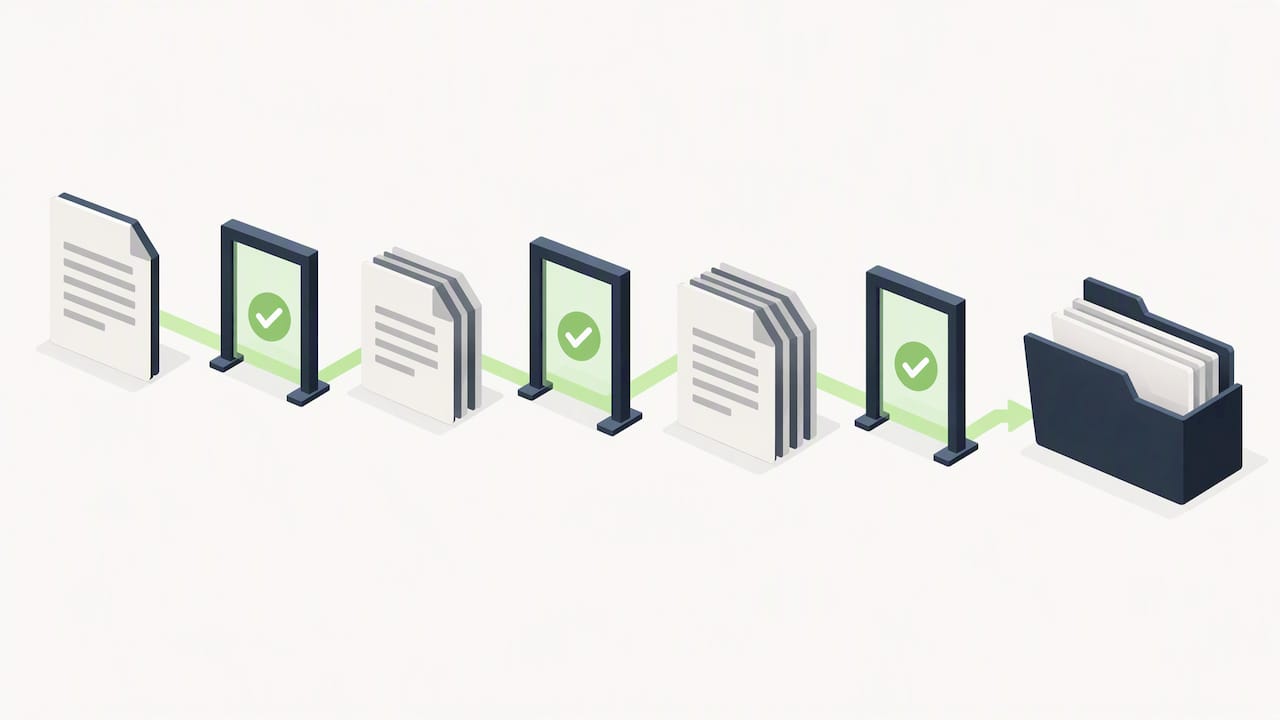
Advisers and collection agencies tend to assemble a case in a fixed order: identity checks first, then the contract, then the statement of account, then assignment paperwork, then a reconciliation of payments against charges. Readers who skip straight to chasing payment often lose weeks later redoing that groundwork.
A complete file shortens everything that follows, because an agency or court is not left chasing gaps mid-process. Vetted agencies routinely check identity and assignment before they will even accept a referral, which is a filter worth doing yourself first.
— Jack
Our platform takes the case details and documents you already have and matches them to an agency vetted for your specific situation, by debt type, amount, age and location, rather than leaving you to contact providers at random, following a customer enquiry workflow designed specifically for UK SMEs.

This is particularly useful when:
- The assignment history is unclear or the debt has changed hands more than once.
- The debt involves an overseas party or cross-border recovery.
- You would rather hand the file to a specialist than manage reconciliation and disclosure requests yourself.
The intake process asks for the documents covered above, the statement of account, contract, assignment evidence and payment history, and uses them to recommend an agency suited to the case rather than a generic shortlist. For business debts, start with Business Debt Recovery; for personal debts, the Consumer Debt Recovery page covers the equivalent intake for individuals.
This article is general information, not a substitute for advice from a qualified financial advisor. Consult a qualified financial professional about your own circumstances before acting on anything here.
FAQ
What proof do debt collectors need?
Collectors need a full statement of account, evidence of how the debt was calculated, and, where the debt was bought from another lender, proof of assignment showing they legally own it. Under the Pre-Action Protocol, they must also be able to produce the original contract or explain why it is unavailable.
What documents do I need for a debt relief order?
You need identity evidence, a full list of qualifying debts with each creditor’s name and amount owed, and evidence supporting a Standard Financial Statement covering your income and outgoings. An approved intermediary must verify this information before submitting your application electronically.
Can you provide an example of a debt collection letter?
A compliant letter of claim states the amount owed, encloses a full itemised statement of account, includes a copy of the contract or an explanation of its absence, and attaches an Information Sheet, Reply Form and Financial Statement. The Protocol template sets out the exact structure creditors are expected to follow.
Do I have to pay my debt if it was sold to a debt collector?
Yes, a sold debt remains legally owed, but the new owner must be able to prove the assignment before you are obliged to deal with them as the creditor. Ask for assignment notices tracing the debt back to the original lender before making any payment.
Sources
- Pre-Action Protocol for Debt Claims
- The Insolvency (England and Wales) Rules 2016: Chapter 2 — Application for a debt relief order
- Form N1 claim form (CPR Part 7)