

A collection agency expects a signed contract or order confirmation, an itemised statement of account, the underlying invoices, proof of delivery or completed work, a full record of payments and correspondence, and copies of any judgment already obtained. These files should sit in chronological order, and any personal data you hand over must be shared on a lawful basis.
TL;DR:
- Evidence must be carefully organized, including a full chronological bundle of documents such as invoices, delivery proof, and payment records, to ensure quick agency action.
- Special case debts like tenancy arrears, retained title goods, or old debts near limitation require additional documentation like tenancy agreements, repossession records, or last acknowledgment dates.
- Sharing debtor data with collection agencies requires a lawful basis, secure transfer channels, and limiting information to what is strictly necessary to avoid delays or legal issues.
- Verifying debtor identity involves cross-checking contact details and company information before referral, especially for long-inactive accounts or those with restructuring risks.
- Well-prepared, transparent files with clear chronology and flagged disputes reduce delays, increase the likelihood of case acceptance, and support fair recovery processes.
Table of Contents
- The complete itemised evidence checklist
- How to package the evidence so an agency can act fast
- Special-case evidence: tenancy arrears, retained title, old debts and existing judgments
- Data protection and lawful transfer of referral information
- What agencies look for, and where referrals go wrong
- Steps to verify debtor identity to prevent fraud
- Why witness statements and affidavits can strengthen a claim
- Fair recovery starts with the paperwork, not the pressure
- How we help you prepare a referral agencies accept quickly
- FAQ
- Sources
The complete itemised evidence checklist
Agencies move fastest when every figure on the account is traceable to a document. Start with an itemised debt schedule: invoice references, dates, principal amounts, interest calculations, any fees added, the date the balance was calculated, and the debtor’s current contact and billing details. A schedule without a calculation date is one of the most common reasons a case stalls at intake.
Contractual proof comes next. A signed contract, purchase order, accepted quote or terms and conditions page shows the debtor agreed to pay, and a record of acceptance or sign-off closes the loop on when the obligation became due. Where goods or services were delivered rather than simply agreed, performance evidence matters just as much: delivery notes, photographs, completion certificates or a signed acceptance form. These documents answer the question an agency always asks first: can we show the debtor actually received what they’re being billed for?
Payment evidence should show the full picture, not just the outstanding figure. Bank statements, remittance advices and a reconciled ledger that nets off any part-payments or credits let an agency see exactly how the current balance was reached.
Correspondence rounds out the file:
- Dated reminder letters or emails sent to the debtor.
- Notes from any phone calls, including date and outcome.
- Any offer to pay, payment plan proposal or dispute raised by the debtor.
- The Letter of Claim and the debtor’s reply, where the pre-action protocol for debt claims has already been triggered.
Finally, where court action has already happened, include the sealed judgment, the claim number, a note of any enforcement steps attempted and the balance that remains outstanding after those steps.
How to package the evidence so an agency can act fast
A strong bundle is ordered so an assessor never has to hunt for a figure. Put these in sequence:
- A one-page case summary stating who owes what, since when, and the remedy you want (payment, a payment plan, or court action).
- A chronology of key dates: contract signed, goods or services delivered, invoice raised, payment due, reminders sent, dispute (if any) raised and resolved.
- The itemised statement of account, with principal, interest, fees and recoverable costs shown as separate lines rather than one lump figure.
- The supporting documents themselves, numbered and indexed so each one can be matched back to a line in the chronology or statement.
Keep originals rather than summaries wherever you can. Full email chains with headers intact, rather than screenshots, preserve the metadata that shows when a message was sent and to whom, a point practical file-evidence guidance stresses because disputes can resurface long after the original transaction. Flag any dispute, credit note or return openly rather than leaving it to surface later: explain why it does or does not affect the balance claimed. Hiding a credit note rarely delays recovery, it just moves the delay later and adds cost.
Pro Tip: Number every page of the bundle and reference those numbers in your case summary, so an assessor can find any document in seconds rather than searching the whole file.
Special-case evidence: tenancy arrears, retained title, old debts and existing judgments
Some debts need an extra layer of documentation beyond the standard bundle.
- Tenancy arrears: the signed tenancy agreement, a rent schedule showing payments and gaps, copies of any prescribed statutory notices served, inspection photographs and repair invoices where deductions are in dispute.
- Retained title goods: the delivery note alongside the clause reserving title until payment, an inventory of what remains unpaid for, and any inspection or repossession records.
- Older debts near a limitation deadline: the date of the last payment or last written acknowledgement from the debtor, since this date usually determines how much time remains to act, and a short note explaining the limitation position so the agency can assess risk immediately.
- Debts with an existing County Court Judgment: the sealed judgment itself, the claim number, a record of enforcement methods already attempted and the balance still outstanding after those attempts.
Each of these categories changes what “proof” looks like, so matching the right documents to the right case type at referral stage avoids a second round of requests later.
Data protection and lawful transfer of referral information
Before you hand any debtor’s personal data to a collection agency, you need a documented lawful basis for sharing it, whether that is a legitimate interest in recovering a debt owed to you or consent captured elsewhere in your contract terms.
- Record which lawful basis applies and keep that note on file alongside the referral.
- Share only the data the agency genuinely needs to pursue the debt: contact details, the debt schedule and supporting documents, not unrelated personal records.
- Send files through a secure confidential waste policy channel and log what was shared, when, and why, so you have an audit trail if questioned.
- If you’re referring through a marketplace or lead-generation platform rather than directly to an agency, check it can explain how it meets Financial Conduct Authority expectations on lawful data transfers, since the FCA expects firms moving customer data to document that the transfer is lawful and the customer is appropriately informed.
Our GDPR and debt collection guidance covers the practical steps for UK creditors in more depth.
What agencies look for, and where referrals go wrong
Agencies triage incoming cases on three things: how clear the liability is, how much of the debt is realistically recoverable, and how easily the debtor can be traced and contacted. A file that answers all three in the first few pages gets picked up faster than one that buries the answer across fifty unordered attachments.
The most common faults we see in referral bundles are an unindexed pile of documents with no chronology, invoice references that don’t match the statement of account, and a dispute or part-payment that only surfaces after the agency has already started work. Any one of these can delay acceptance or see a case bounced back for more information.
Platform intake built around debt type, amount, age and location exists precisely to catch these gaps before a case reaches an agency. By capturing the supporting documents alongside those details upfront, a referral arrives at a vetted agency already shaped the way that agency expects to see it, rather than needing a back-and-forth to fill holes. That’s the difference between a case accepted on first contact and one left in a queue while someone chases missing paperwork.
Steps to verify debtor identity to prevent fraud
Before committing resources to a claim, confirm you’re pursuing the right person or entity. Start with the name and address on the original contract or invoice and cross-check it against any later correspondence: a debtor who has moved, changed a trading name or restructured a company can otherwise cause a collection effort to stall or be misdirected entirely.
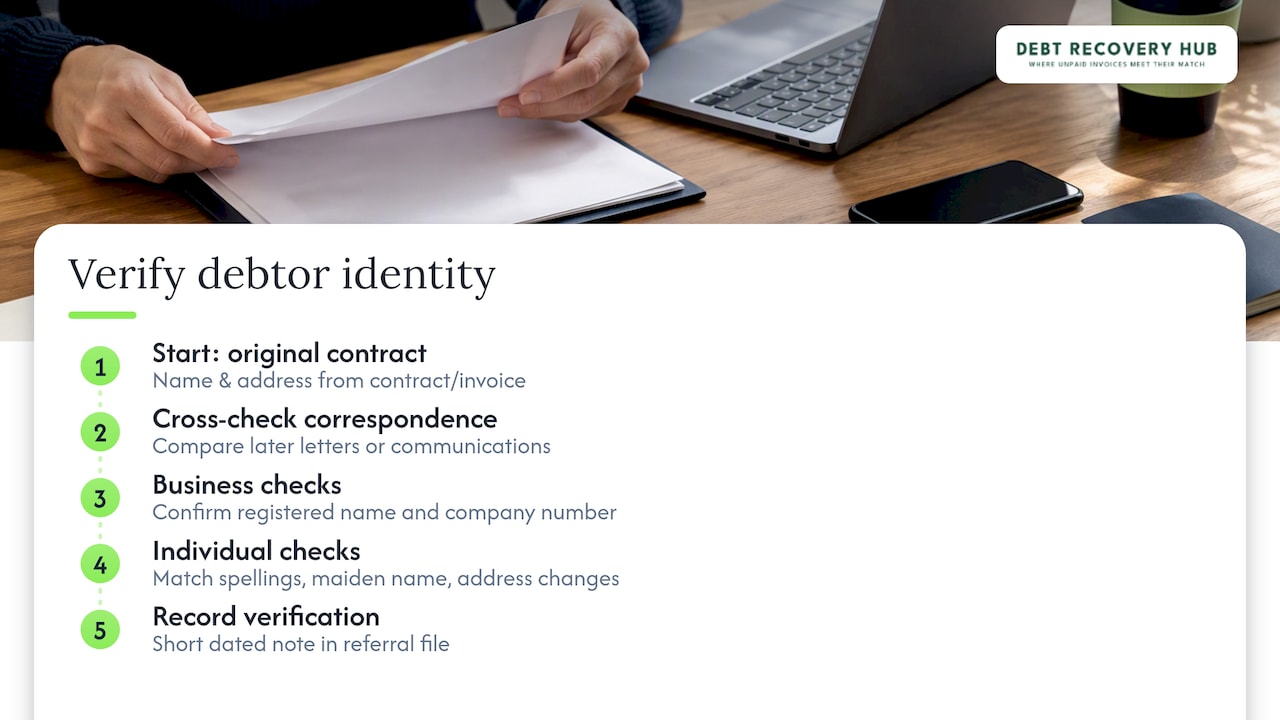
For business debtors, confirm the registered company name and number against the entity that actually signed the contract, since a similarly named sole trader or a dissolved company is a frequent source of wasted effort. For individuals, match the name on the agreement against any later identification provided, such as a different spelling, a maiden name or a change of address notified during the relationship.
Keep a short note of how identity was confirmed and when, as part of the referral file. This matters doubly where a debt has been inactive for some time: an old address or contact number increases the risk of pursuing the wrong person, and a documented identity check protects you if the debtor later disputes being the correct party. Where there’s genuine doubt, it’s worth resolving this before referral rather than after, since an agency acting on a misidentified debtor wastes time on both sides and can expose you to a complaint.
Why witness statements and affidavits can strengthen a claim
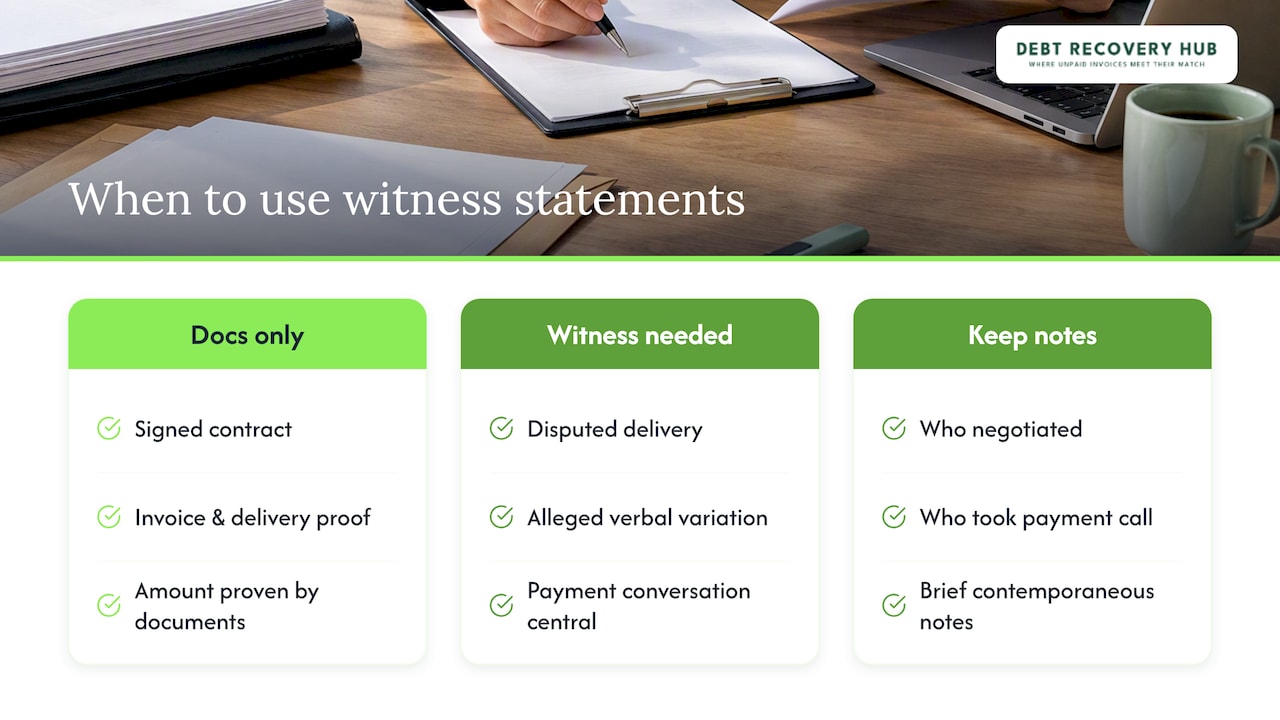
Most straightforward invoice or contract debts don’t need a witness statement. Documents alone, a signed contract, an invoice and proof of delivery, usually tell the whole story. Civil Procedure Rules Part 16 require particulars of claim to set out the facts relied on and, for a money claim, to prove the amount and any interest claimed, which documentary evidence generally does well on its own.
Witness statements matter more once a case moves towards a defended claim or a dispute over what actually happened, rather than how much is owed. If a delivery was disputed, if a verbal variation to the contract is alleged, or if a conversation about payment terms is central to the claim, a statement from the person who was present, written in their own words and signed as a statement of truth, can fill a gap that paperwork alone leaves open.
Keep a brief note of who was involved in key events (who negotiated the contract, who took the call where payment was promised) even if you never need a formal statement from them. Having that information ready means you’re not trying to reconstruct events from memory months later if the case does become contested.
Fair recovery starts with the paperwork, not the pressure
The best referrals we see aren’t the largest files, they’re the clearest ones. A creditor who gathers evidence early, keeps a straight chronology and discloses disputes rather than burying them tends to get paid faster and spends less on the process getting there.
Good evidence also protects debtors who are struggling rather than avoiding payment: flagging vulnerability or financial hardship, and pointing someone towards independent debt advice where it’s warranted, costs you nothing and often prevents a case escalating unnecessarily.
— Jack
How we help you prepare a referral agencies accept quickly
Cases can be matched to vetted collection agencies based on the debt type, amount, age and location provided, rather than leaving users to guess which agency suits their situation. Intake processes can be built around the evidence checklist above.

What that means in practice:
- Users provide the debt type (commercial, consumer, property or international) to generate a shortlist of agencies that handle that category.
- Supporting documents can be uploaded against the same checklist agencies use for triage, so nothing is missing at referral stage.
- Cases are passed to agencies suited to their size, age and complexity rather than generalists handling every kind of debt.
If your case is a business debt, our Business Debt Recovery page is the fastest way to start a referral with your evidence already organised the way this checklist describes.
FAQ
What documents does a debt collection agency need first?
A signed contract or order, an itemised statement of account, the invoices themselves, and proof the goods or services were delivered. Payment history and any correspondence about the debt usually follow close behind, since they show what’s already been tried.
What counts as proof of delivery for a service rather than goods?
A signed completion certificate, sign-off email, or a dated record from whoever carried out the work is usually sufficient. Photographs of completed work or a client’s written acknowledgement that the job was finished can also support the claim.
Do I need a contract if I only have a verbal agreement?
A written contract isn’t mandatory. The pre-action protocol for debt claims allows a creditor to explain why no contract exists, provided the Letter of Claim still sets out how the debt arose and how it was calculated.
How do I prove a debt is still owed after years of no contact?
The date of the last payment or the last written acknowledgement from the debtor is the key piece of evidence, since it affects how much time remains to act. A clear note explaining this, alongside the original contract and statement of account, lets an agency assess the position quickly.
Can I share a debtor’s personal information with a collection agency?
Yes, provided you can point to a lawful basis for the transfer, such as a legitimate interest in recovering money owed to you, and you share only what the agency needs. The Financial Conduct Authority expects firms handling such transfers to document that basis and keep an audit trail of what was shared.
Sources
- Pre-action protocol for debt claims (redraft) – Ministry of Justice
- Financial Conduct Authority
- CCMS provider: file evidence guidance – Legal Aid Learning