
When a business customer does not pay, UK debt collection follows a fairly fixed path. You chase the invoice yourself, send a formal letter before action, and then either hand the case to a collection agency or solicitor or start a county court claim. If you win a judgment and the debtor still does not pay, you enforce it. Each stage costs more and takes longer than the one before, so most creditors try to settle early.
This guide covers the business-to-business process in England and Wales, the laws behind it, the time limits that can end a claim, and how to decide when to bring in outside help. Scotland and Northern Ireland have their own procedures, so check them separately if your debtor is based there.
TL;DR
- Commercial debt recovery runs in stages: credit control, formal demand, letter before action, court claim, judgment, enforcement. Most cases should be settled before court.
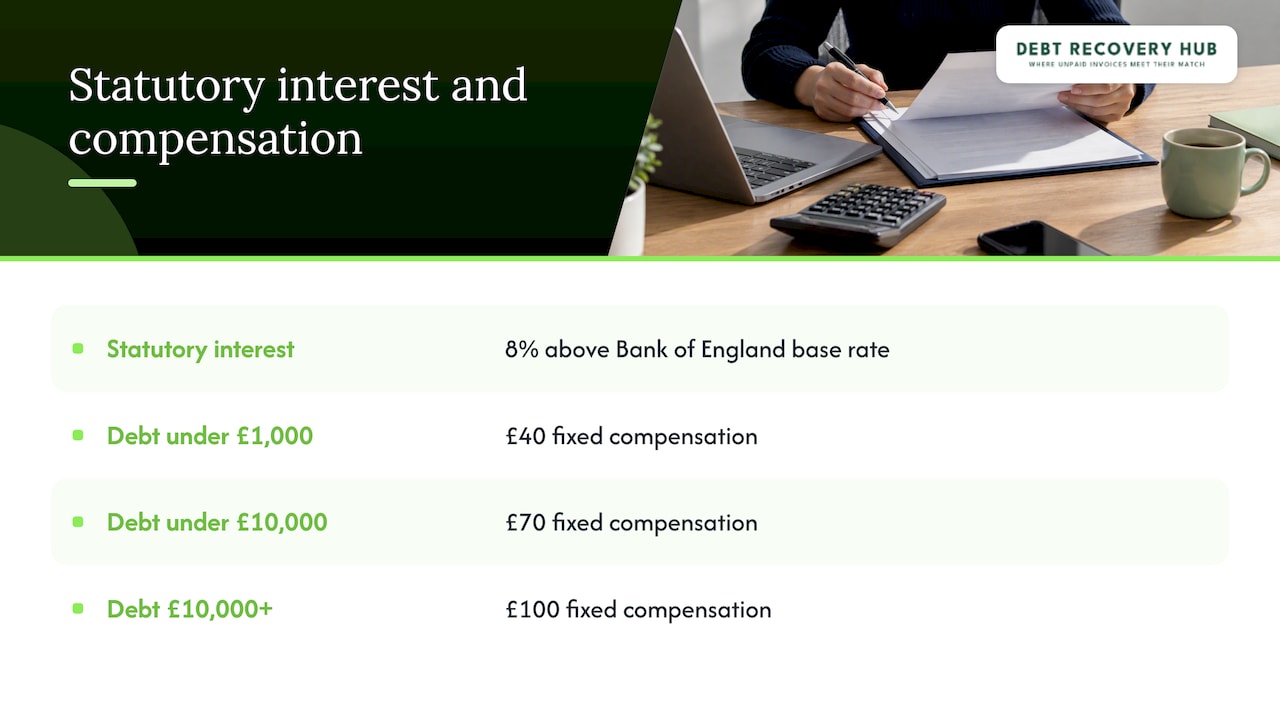
- Under the Late Payment of Commercial Debts (Interest) Act 1998 you can claim statutory interest at 8% above the Bank of England base rate, plus fixed compensation of £40, £70 or £100 per invoice depending on the debt size.
- A simple contract debt generally cannot be taken to court more than six years after the cause of action arose.
- A collection agency or solicitor is worth considering once your own reminders have failed. Matching the case to the right one matters more than picking the first name you find.
Table of Contents
- The stages of commercial debt recovery
- Where a collection agency fits
- Going to court
- The six-year time limit
- The rules collectors must follow
- Our view: the match matters more than the agency
- Getting help with your case
- What to prepare before you hand over a case
- FAQ
- Sources
The stages of commercial debt recovery
Creditors rarely jump straight to court. The usual sequence is below, and each step builds the evidence you need for the next. Our own debt collection stages guide goes deeper on the decision points, and the timelines page shows when to escalate.
| Stage | What happens | Typical aim |
|---|---|---|
| 1. Credit control | Reminders by email and phone after the due date | Prompt payment or an explanation |
| 2. Formal demand | Written demand citing the contract, invoice and interest | Put the debt on record |
| 3. Letter before action | Final notice with a deadline, usually 7 to 14 days | Settle or prepare for court |
| 4. Court claim | Claim issued in the county court | Obtain a judgment |
| 5. Enforcement | Bailiffs, charging orders, attachment of earnings or third party debt orders | Turn the judgment into cash |
An agency or solicitor can take over at stage 2 or 3. Court action is generally treated as a last resort, partly because the Pre-Action Protocol for Debt Claims describes the conduct the court normally expects before proceedings begin.
Stage 1: credit control
Most recoveries are won or lost here. Send a polite reminder the day after the due date, follow with a phone call, and keep a dated record of every contact. Confirm the debtor has the invoice, that the purchase order matches, and that nothing is in dispute. A surprising share of “non-payment” is a missing PO number or an invoice sent to the wrong person.
If the customer raises a genuine dispute, say so in writing and try to resolve it. GOV.UK sets out the options if you are owed money, including mediation, going to court, a statutory demand or a bankruptcy petition against an individual.
Stage 2: formal demand and statutory interest
Once friendly reminders fail, write formally. State the invoice number, the amount, the due date, the contract terms and the date by which you expect payment. If the debt is between businesses, add the interest and compensation you are entitled to.
The government’s 2026 late payment announcement records that statutory interest is 8% above the Bank of England base rate. It also gives the fixed compensation for recovery costs: £40 for debts under £1,000, £70 for debts under £10,000 and £100 for debts of £10,000 or more. The same announcement covers a 60-day cap on payment terms for large firms paying small suppliers and expanded powers for the Small Business Commissioner. Check the current position and start dates before you rely on the new measures in a letter.
Our late payment act interest guide explains how to calculate the figure. For wording, see what to include in debt recovery letters.
Stage 3: the letter before action
The letter before action is the last step before a claim. It should say what is owed and why, give a firm deadline, state that you will issue proceedings if it passes, and enclose or refer to supporting documents such as the contract and invoices. A deadline of 7 to 14 days is common practice.
The formal protocol is aimed at debts owed by individuals and sole traders. Between two companies it does not strictly apply, but courts expect reasonable conduct before a claim, and a sensible letter protects you if costs are argued later. We have a guide to the letter before action for England and Wales, a set of business debt collection letter templates and an explainer on the pre-action protocol for debt.
Where a collection agency fits
A commercial collection agency chases debts on your behalf, usually by phone, letter and negotiation, and often on a no-collection, no-fee or commission basis. Others charge fixed fees. Terms vary, so get them in writing before you hand over a case.
A solicitor can do the same and also issue proceedings, which is why some agencies work alongside law firms. The choice depends on the case:
- Small, undisputed invoice, debtor still trading: an agency is often enough.
- Large or disputed debt: a solicitor may be needed to deal with the legal arguments.
- Debtor abroad or hard to trace: you need a provider with international reach. See our guides to international debt recovery for UK businesses and the three stages of international recovery.
What to ask any provider before you agree:
- How are fees calculated, and what extra costs can arise?
- Do they handle your type and size of debt, and the debtor’s location?
- Will they treat your customer fairly and professionally?
- What happens if the debtor disputes the debt?
- Who owns the relationship if the case goes to court?
The last two matter because aggressive tactics can damage your reputation and sometimes complicate the debt itself.
Going to court
If the letter before action fails, you can issue a money claim in the county court. The debtor then has a set time to pay, admit, dispute or ignore the claim. If they ignore it, you can usually ask for a default judgment. If they dispute it, the case may be allocated to a track based on its value and complexity, and costs rise.
Legal costs are the part many business owners underestimate. If you manage property, it is worth checking whether your cover includes legal expenses, because policy wording can limit what you can recover. Legal expenses cover for blocks of flats shows how lease wording can affect that cover for managers of residential blocks.
A county court judgment is not payment
A CCJ is a court order, not money in your account. If the debtor does not pay, you must choose a method of enforcement:
- Bailiffs (warrant of control): goods are taken and sold, which suits a trading business with assets.
- Third party debt order: money is taken from the debtor’s bank account.
- Attachment of earnings: deductions from a sole trader’s or individual’s wages, where relevant.
- Charging order: secures the debt against property.
Each has its own fee and conditions, and the right one depends on what the debtor owns and where their money sits. This is where tracing and information about the debtor become valuable. If your claim involves a debtor who is a company, check Companies House for its status before you spend money. A company in liquidation changes your options completely, and a solicitor or licensed insolvency practitioner should advise you at that point.
The six-year time limit
Time limits are the most common reason good claims fail. Under section 5 of the Limitation Act 1980, an action founded on simple contract cannot be brought after six years from the date the cause of action arose. For an unpaid invoice, that is normally the date payment fell due.
Some acknowledgements of the debt, such as a written promise to pay or a part payment, can restart the clock, but the rules are technical. Contracts made by deed have a longer period. If you are near the limit, take legal advice from a solicitor straight away rather than sending another reminder. Scotland has different prescription rules, covered in our debt discoverability reform article.
The rules collectors must follow
Commercial debt is not governed by the same conduct rules as consumer debt, but a few principles apply to everyone:
- Be accurate about the amount, the interest and the consequences of non-payment.
- Do not threaten action you do not intend or cannot take.
- Do not harass, and avoid contacting a debtor’s staff or customers in ways that could be defamatory.
- Where the debtor is a sole trader or an individual, expect a more protective approach, and treat the protocol as binding in practice.
If you instruct an agency, you remain responsible for what is done in your name, so choose carefully. For individual, non-business debts, see our consumer debt recovery page.
Our view: the match matters more than the agency
This is our perspective on how the process goes wrong. Most creditors do not fail because the law is hard. They fail because they pick a provider blindly, send the case in too late, or present it without the documents. A £3,000 invoice that is eight months old, owed by a company that has gone quiet, needs a different approach from a £60,000 contract debt that the customer disputes. International debts differ again.
That is why we collect the details first: the type of debt, its amount and age, and where the debtor is. We use them to recommend vetted agencies that suit that case, instead of leaving you to ring around and repeat your story. It costs you nothing to use our guidance, and you decide whether to go ahead.
If you remember one thing, it is to act while the paper trail is fresh. Debts rarely get easier to collect with age.
— Jack
Getting help with your case
If your own chasing has stalled, our business debt recovery service takes the details of your case and points you to vetted collection agencies suited to it. You can also start from our unpaid invoice recovery page or work through our debt collection checklist first.
What to prepare before you hand over a case
Whoever takes the case, speed depends on your paperwork. Gather:
- the signed contract or terms and conditions, and any purchase order;
- invoices, delivery notes or proof the work was done;
- your correspondence with the debtor, including promises to pay;
- the debtor’s full legal name, company number and addresses;
- a statement of what has been paid and what interest you are claiming.
A clear file lets a provider assess the case in a day rather than a week. If you want to avoid court altogether, our article on pre-litigation debt recovery shows how to build the file with that aim.
FAQ
Can I charge interest on a late business invoice?
Yes, if the debt is between businesses and your contract has no substantial alternative remedy. Statutory interest is 8% above the Bank of England base rate, with fixed compensation of £40, £70 or £100 depending on the invoice value. Add them to your formal demand.
How long do I have to pursue an unpaid invoice?
Usually six years from the date the cause of action arose, under the Limitation Act 1980. Different rules apply to deeds and in Scotland. If you are close to the deadline, speak to a solicitor promptly.
Do I need a solicitor to use the county court?
No, a business can bring a money claim without one. A solicitor helps most where the debt is disputed, large or involves a company in financial difficulty. For straightforward undisputed invoices, many creditors begin with a letter before action or an agency.
What if the debtor ignores a county court judgment?
You have to apply for enforcement, because the court does not collect the money for you. Options include bailiffs, a third party debt order and a charging order, and the right one depends on the debtor’s assets.
Sources
- Time to Pay Up: Government unveils toughest crackdown on late payments, GOV.UK
- Limitation Act 1980, legislation.gov.uk
- Options if you’re owed money, GOV.UK
- Pre-Action Protocol for Debt Claims, Ministry of Justice