

If an invoice is between 7 and 30 days overdue, send a friendly reminder first and a formal late payment demand if that lapses. If payment still does not arrive, move to a Letter of Claim that meets the Pre-Action Protocol for Debt Claims, since this is the step courts expect before you issue proceedings. Keep every invoice, letter and proof of posting: you may need them as evidence later.
TL;DR:
- Sending a Letter of Claim is required after a late payment demand lapses and must include detailed account information, attachments, and a 28-day reply window.
- The interest rate charged must be the Bank of England base rate plus 8%, with fixed compensation calculated based on the debt size, and both should be clearly stated in the letter.
- Escalation from friendly reminders to court claims typically occurs on a 30-day cycle, with specific stages and documentation required at each step to maintain legal compliance.
- Skipping the Protocol can lead to penalties or delays in court, so proper documentation and proof of postage are essential before proceeding to litigation.
- When letters are ineffective, businesses can use vetted debt collection agencies matched to the case to increase recovery chances, especially for unresponsive or cross-border debts.
Table of Contents
- Types of debt collection letters and when to use each
- Legal requirements: Pre-Action Protocol, evidence and timelines
- What to include in every business debt collection letter
- Statutory interest and fixed compensation: how to calculate and state them
- Timing and next steps: when to escalate
- Sample templates: copy-ready wording for each stage
- How Debtrecoveryhub helps when letters alone are not enough
- Why most businesses undersell their own letters
- Let a vetted agency take it from here
- Sources
- FAQ
Types of debt collection letters and when to use each
Most UK businesses recover overdue invoices through a staged sequence rather than one letter. Each stage has a different purpose, and sending the wrong one too early or too late weakens your position.
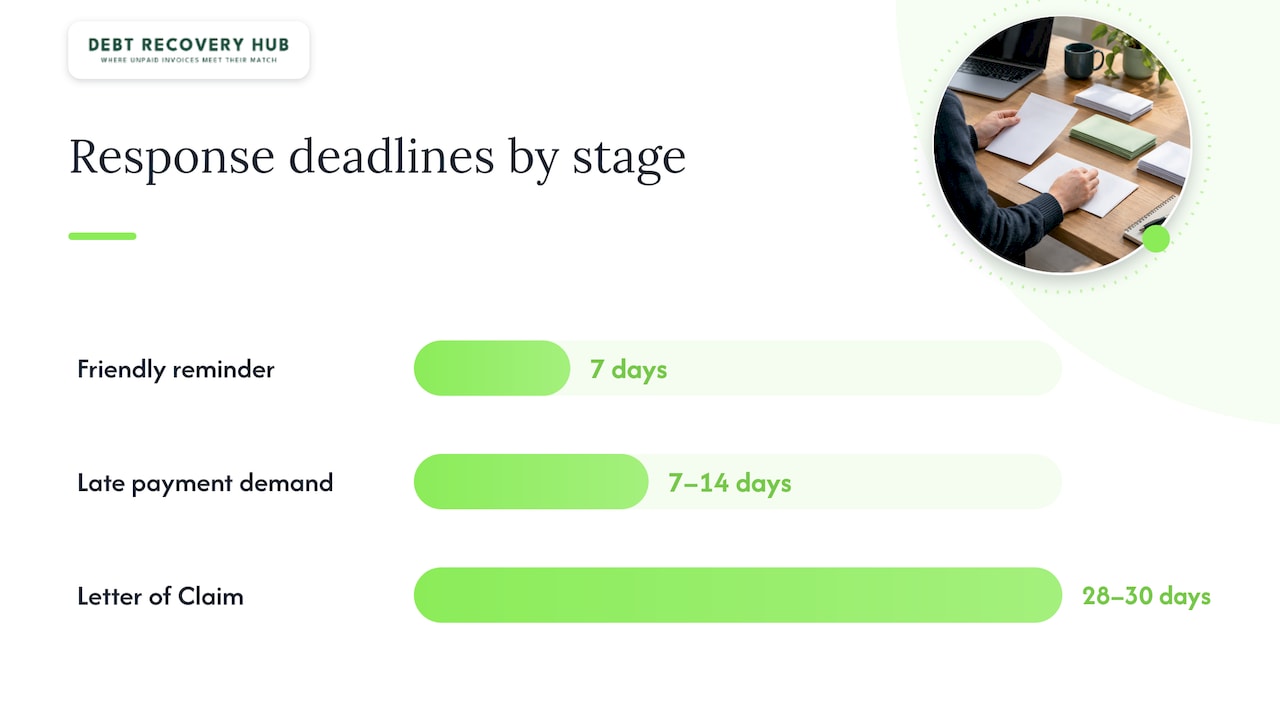
- Friendly reminder: sent around 7 to 14 days after the due date, this assumes an oversight and asks for payment or a response within a short window, usually a week.
- Late payment demand (LPD): sent once the reminder has lapsed, this states the amount owed, the original due date, and notes that statutory interest and fixed compensation may apply under the Late Payment of Commercial Debts (Interest) Act 1998.
- Letter before action (Letter of Claim): used when the LPD has failed, this is the formal pre-court notice and carries weight especially when the debtor is a sole trader, since the Protocol applies to them directly.
- Statutory demand: a narrower, more formal tool typically used ahead of insolvency proceedings, reserved for cases where the debtor appears unable rather than simply unwilling to pay.
Skipping stages rarely speeds things up. A debtor who never received a reminder has a reasonable excuse to delay, and a court will expect to see that you gave them a fair chance before escalating.
Legal requirements: Pre-Action Protocol, evidence and timelines
The Pre-Action Protocol for Debt Claims applies to most business-to-consumer debt claims and is widely followed as good practice for business-to-business claims too, particularly where the debtor is a sole trader or small partnership. Its purpose is straightforward: give the debtor a genuine last chance to pay, dispute, or propose a repayment plan before court proceedings begin.
- Send a Letter of Claim that sets out the amount owed, how it has built up, and the consequences of non-payment.
- Attach a statement of account, a copy of the underlying contract or terms, and an information sheet and reply form, as required by the Pre-Action Protocol for Debt Claims.
- Allow the debtor at least 28 days to reply before issuing a court claim.
- Send by a traceable method, post with a certificate of posting or a tracked email, and keep copies of everything sent and received.
Skipping the Protocol does not block you from going to court, but a judge can penalise a creditor who ignored it, through cost orders or a stay of proceedings while the step is completed properly. A common mistake is sending a Letter of Claim without the reply form or statement of account attached, which can mean starting the clock again.
Pro Tip: Post your Letter of Claim and keep the certificate of posting with the letter itself, stapled together, so the proof of sending never gets separated from the document it supports.
Our guide to the letter before action covers the format in more detail for England and Wales.
What to include in every business debt collection letter
A collection letter works as both a prompt to pay and a piece of evidence, so precision matters more than tone.
- Header details: your business name, the debtor’s name, the invoice number, invoice date and original due date.
- A clear debt summary: the principal sum owed, any part payments already received, and the current outstanding balance.
- Interest and compensation wording: a plain statement that statutory interest and fixed compensation apply under the 1998 Act, with the figures shown rather than just referenced.
- Attachments for a Letter of Claim: a statement of account, the relevant contract or terms of business, and the Protocol’s information sheet and reply form.
Keeping the tone neutral matters. Industry practice treats factual, measured letters as more effective at preserving payment and the relationship than aggressive ones, since a debtor who feels threatened is more likely to dispute the debt outright rather than pay it. Our guide to what to include in debt recovery letters sets out wording examples for each section.
Statutory interest and fixed compensation: how to calculate and state them
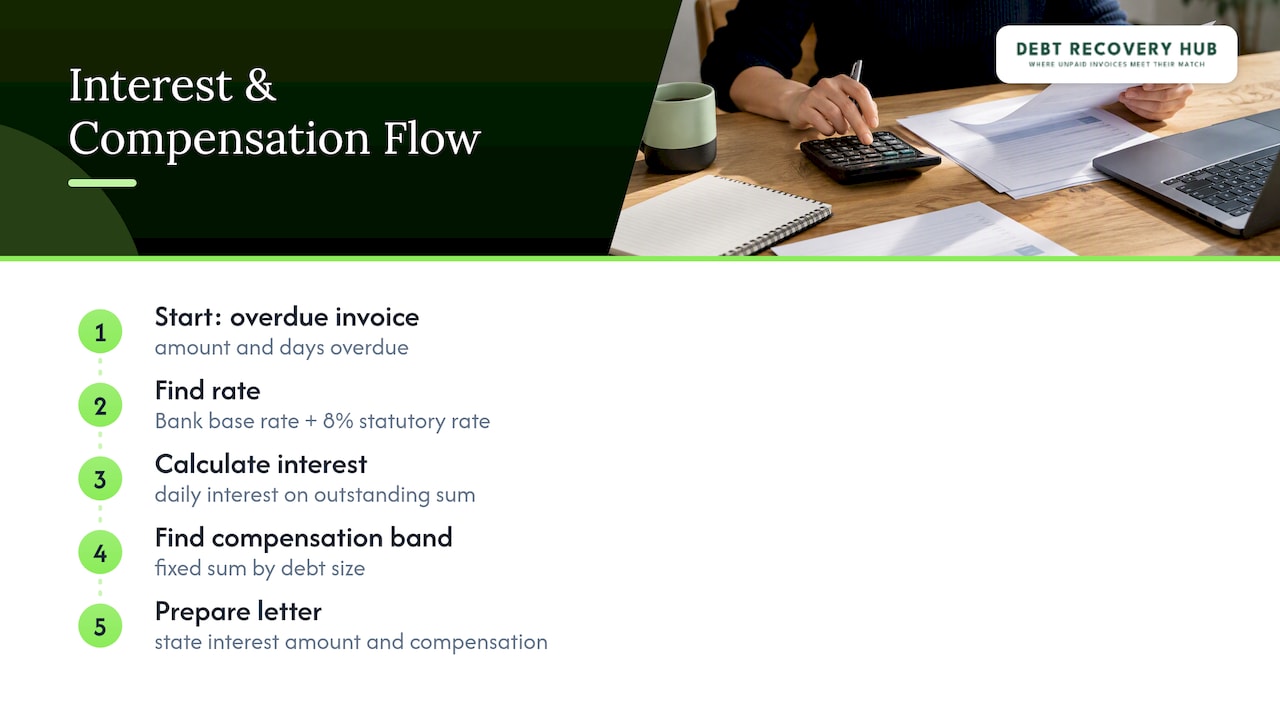
Under the Late Payment of Commercial Debts (Interest) Act 1998, UK businesses owed money by another business can charge statutory interest at the Bank of England base rate plus 8%, along with a fixed compensation sum that depends on the size of the debt.
Say an invoice for an amount is overdue by several weeks. At the statutory rate of 8% above the current base rate, you calculate daily interest on the outstanding sum and add the appropriate fixed compensation payment banded by the debt size. State both figures in the letter rather than leaving the debtor to calculate them. For the current base rate and a ready calculator, see our guide to Late Payment Act interest and our breakdown of late payment compensation.
Timing and next steps: when to escalate
Most overdue invoices follow a predictable rhythm from first reminder to court claim, and knowing the typical timeline helps you decide when patience has run out.
- Day 1 to 14 overdue: send the friendly reminder.
- Day 15 to 30: send the late payment demand with interest and compensation stated.
- Day 31 to 45: send the Letter of Claim, starting the 28 to 30 day Protocol reply window.
- After the reply window lapses with no payment or agreement: issue a claim through Money Claim Online, which lets you file online and request judgment if the claim is undisputed.
Before issuing, gather your invoices, correspondence and proof of posting, since the court will expect evidence that you followed the Protocol. Alternative dispute resolution, such as mediation, is worth considering for disputed debts, while an undisputed claim often reaches judgment without a hearing. Court fees and time vary with the size of the claim, so weigh the sum owed against the cost and effort of pursuing it. Our timeline guide sets out the stages in more depth.
Sample templates: copy-ready wording for each stage
You do not need to draft every letter from scratch. Business Debtline’s sample letter library offers ready-to-use templates for England, Wales and Scotland, and the structure below adapts to most invoices.
- Friendly reminder: a short note referencing the invoice number, due date, and a polite request for payment within seven days, with a payment link or bank details included.
- Late payment demand: restates the invoice details, adds the statutory interest and compensation figures, and sets a final deadline, typically 7 to 14 days.
- Letter of Claim: formally notices the debt, breaks down the account balance including interest, lists the attachments enclosed, and instructs the debtor to complete and return the Reply Form within 28 to 30 days.
- Packing list: invoice copies, statement of account, contract or terms of business, the Protocol reply form, and your certificate of posting or sent email record.
Pro Tip: Number each letter stage on the envelope or email subject line (Reminder 1, Demand 2, Letter of Claim) so your own records stay in order if the case later goes to court.
Our guide to pre-litigation debt recovery explains how to limit costs at each of these stages.
How Debtrecoveryhub helps when letters alone are not enough
There are services that match businesses with debt collection agencies, choosing a match based on the debt type, amount, age and location rather than leaving you to pick a provider at random. This suits cases where the debtor is unresponsive, the sum is substantial, or the matter crosses borders and needs specialist handling. The intake may ask for details of the debt, the debtor and any correspondence already sent, and route that information to an agency suited to the case rather than a general-purpose provider.
Why most businesses undersell their own letters
The single biggest mistake is treating a collection letter as a formality rather than as leverage. A letter with the correct statutory interest figures, a clear deadline and proper attachments tends to get taken more seriously than a vague chase email, because it signals you know the process and are prepared to follow it through.
Checklist for today: confirm the invoice is genuinely overdue, calculate the interest and compensation due, send the next letter in the sequence, and keep proof of posting with the copy.
— Jack
Let a vetted agency take it from here

When a debtor stops responding to letters altogether, chasing further correspondence yourself rarely changes the outcome; for landlords dealing with tenancy debts, specialist landlord compliance services can provide targeted support. You can be matched to a vetted collection agency based on the debt’s type, size, age and location, so you are not guessing which provider to approach. Share the details of your overdue invoice through the intake form and get matched with an agency suited to your case through Business Debt Recovery.
Sources
- Late Payment of Commercial Debts (Interest) Act 1998
- Pre-Action Protocol for Debt Claims (Redraft)
- Gov
- Sample letter library — Business Debtline
This article is general information, not a substitute for advice from a qualified lawyer. Consult a qualified legal professional about your own circumstances before acting on anything here.
FAQ
What happens if I get a debt collection letter?
A debt collection letter asks you to pay an amount owed or to respond with a dispute or repayment proposal within a set deadline. Ignoring it can lead to further letters, statutory interest and compensation being added, and eventually a court claim such as those filed through Money Claim Online.
How long before a debt becomes uncollectible in the UK?
There is no single fixed point at which a debt simply disappears, but limitation periods and practical recoverability both shrink the longer a debt goes unpursued. Acting promptly, starting with a reminder and escalating through the Pre-Action Protocol, gives you the best chance of recovery.
What are the new debt collection laws in the UK?
The core framework remains the Pre-Action Protocol for Debt Claims and the Late Payment of Commercial Debts (Interest) Act 1998, which set out required letter content, response windows, and statutory interest and compensation. Businesses should also check current gov.uk guidance on commercial debt interest for payment term defaults.
How do I know if a debt collector is legit in the UK?
A legitimate UK debt collector will identify the creditor they represent, provide a clear account of the debt, and follow the Pre-Action Protocol before threatening court action. If you are unsure which agency suits your case, some services match businesses with vetted agencies rather than leaving you to select one unassisted.