

You should hire a collection agency once a debt is 90 to 120 days overdue with no payment plan agreed, the customer has gone silent despite repeated professional contact, the debtor shows signs of insolvency, or your business has effectively written the balance off. Before you refer the case, confirm you have sent a proper letter before action and checked that the debt is still within its limitation period.
TL;DR:
- Only hand over a debt to a collection agency after it is 90 to 120 days overdue, with proper documentation and within the limitation period.
- The decision depends on debt age, debtor insolvency, repeated silence or broken promises, and whether the debt has been written off or is large enough to justify agency fees.
- Agencies typically charge 25 to 50% contingency fees, which are only worthwhile for large balances, such as over 5,000 pounds, once internal efforts have failed.
- Ensure legal steps, including sending a proper letter before action and confirming the debt is within the six-year UK limitation period, are followed before referral.
- Vet agencies carefully for compliance, experience, and transparent fees, and consider alternative collection methods like payment plans or dispute resolution first.
Table of Contents
- What a collection agency does and what outcomes to expect
- Signals that it’s time to escalate: concrete criteria to decide
- Legal steps and timing to observe before you escalate
- Costs, fees and the trade-off: how to do the maths before you refer a case
- How to choose and vet a collection agency
- Alternatives and steps to try first
- How a platform helps you find a vetted match
- A judgement call worth getting right
- Ready to find the right agency for your case?
- FAQ
- Sources
What a collection agency does and what outcomes to expect
A collection agency takes over the chase once your own outreach has stalled. Most agencies trace debtors who have gone quiet, run structured contact campaigns by phone, letter and e-mail, negotiate settlements or repayment plans, and refer genuinely disputed or high-value cases on to solicitors for litigation. For larger commercial debts, some agencies also carry out asset tracing to establish whether a debtor actually has the means to pay.
The tactics differ from what an in-house accounts team typically does. Agencies apply consistent pressure through trained negotiators, often backed by credit-reporting consequences that carry more weight coming from a third party than from the supplier itself. That said, recovery is never guaranteed, and older or disputed debts recover at lower rates than fresh ones, which is one reason timing matters so much.
Handing a case to an agency changes the tone of the relationship. A third party contacting your customer can end any chance of future business with them, and in smaller markets word travels about who uses collectors and how aggressively. Before you escalate, it helps to be clear on what you expect the agency to actually do:
- Trace customers who have changed contact details or gone silent.
- Run structured negotiation and settlement discussions on your behalf.
- Refer unresolved or high-value disputes to litigation specialists.
- Carry out asset checks on larger commercial debtors where relevant.
Signals that it’s time to escalate: concrete criteria to decide
Deciding when to hand a debt over does not need to be guesswork. A handful of measurable signals, taken together, tell you whether an account belongs with an agency or still belongs with your own team.
- Age of the debt. Once an invoice passes 90 to 120 days overdue with no agreed plan, recoverability starts to fall and agency involvement becomes worth considering, according to practitioner guidance on when to use a collection agency. The longer you wait beyond that point, the harder most debts become to collect.
- Customer behaviour. Accounts that have gone silent after several professional contact attempts, customers who have broken repayment promises more than once, or contact details that turn out to be false are all signs that internal outreach has run its course.
- Debtor status. Confirmed insolvency, administration, liquidation or a business that has simply closed its doors are strong signals to escalate, since these cases often need formal recovery processes your own team is not equipped to run.
- Internal accounting position. If you have already written the debt off, or the outstanding balance is large enough to absorb a contingency fee of roughly 25 to 50%, according to the same guidance on agency use versus software, referral usually makes financial sense even after fees.
- Document and dispute checks. Before you escalate, rule out a missing purchase order, an unreconciled invoice or a genuine billing dispute. Many invoices clear once the real cause of non-payment is identified, so a quick reconciliation call can save you an unnecessary referral.
Pro Tip: Keep a single chronological log of every overdue date, contact attempt and debtor acknowledgement. If a case later needs litigation or runs close to its limitation deadline, that log becomes your most useful piece of evidence.
Landlords face a close variant of the same decision. Rent arrears that persist despite a welfare check and a genuine attempt to agree a repayment plan, with no response from the tenant, sit in the same escalation bracket as an unpaid commercial invoice, and the same age and silence thresholds apply.
Legal steps and timing to observe before you escalate
Escalating too quickly, or without the right paperwork, can cost you later in court. Two legal frameworks matter before any referral: the pre-action protocol for debt claims and the limitation period that governs how long you have to sue.
The Pre-Action Protocol for Debt Claims sets out what creditors must do before issuing court proceedings: send a proper letter before action, include a Reply Form that gives the debtor 30 days to respond, and show that you considered alternative dispute resolution. Courts can penalise creditors who skip these steps, including through adverse costs orders, even when the underlying debt is genuine.
Limitation is the other deadline you cannot ignore. In England and Wales, the Limitation Act 1980 generally prevents legal action on a simple contract debt once six years have passed from the date it became payable, typically the invoice due date. Scotland applies its own prescription rules, which differ from the English position, so cross-border creditors should check which regime applies before assuming a debt is still enforceable. A payment or a written acknowledgement from the debtor can reset the limitation clock, which is one reason even a partial payment is worth recording carefully.
Landlords pursuing possession or arrears alongside rent recovery have their own version of this process to follow, set out in the pre-action protocol for possession claims, which expects documented welfare checks and genuine attempts to engage before court action.
Before you escalate, make sure you can produce:
- A dated copy of the letter before action and proof it was sent.
- The original invoice or tenancy agreement and all amendments.
- A log of every contact attempt, call, e-mail and response.
- Any written acknowledgement of the debt or partial payment.
Our guide to the letter before action covers the Reply Form timeline in more detail if you have not sent one yet.
Costs, fees and the trade-off: how to do the maths before you refer a case
Agencies typically charge in one of two ways: a contingency fee taken as a percentage of whatever is recovered, or occasionally a fixed fee for simpler cases. Litigation referrals, where the agency hands a case to a solicitor, usually carry separate legal costs on top. Contingency rates commonly sit in the 25 to 50% range, according to practitioner guidance on collection agency fees, with older or harder-to-trace debts attracting the higher end.
Around 25 to 50% of the sum recovered is a typical contingency fee range for collection agencies, according to practitioner guidance, which means the maths only works once the debt is large enough to absorb that cut and still leave a worthwhile recovery.
Fees are not the only cost. Handing a case over can end the customer relationship permanently, and the administrative work of compiling invoices, correspondence and contact logs for the agency takes time your team could spend elsewhere.
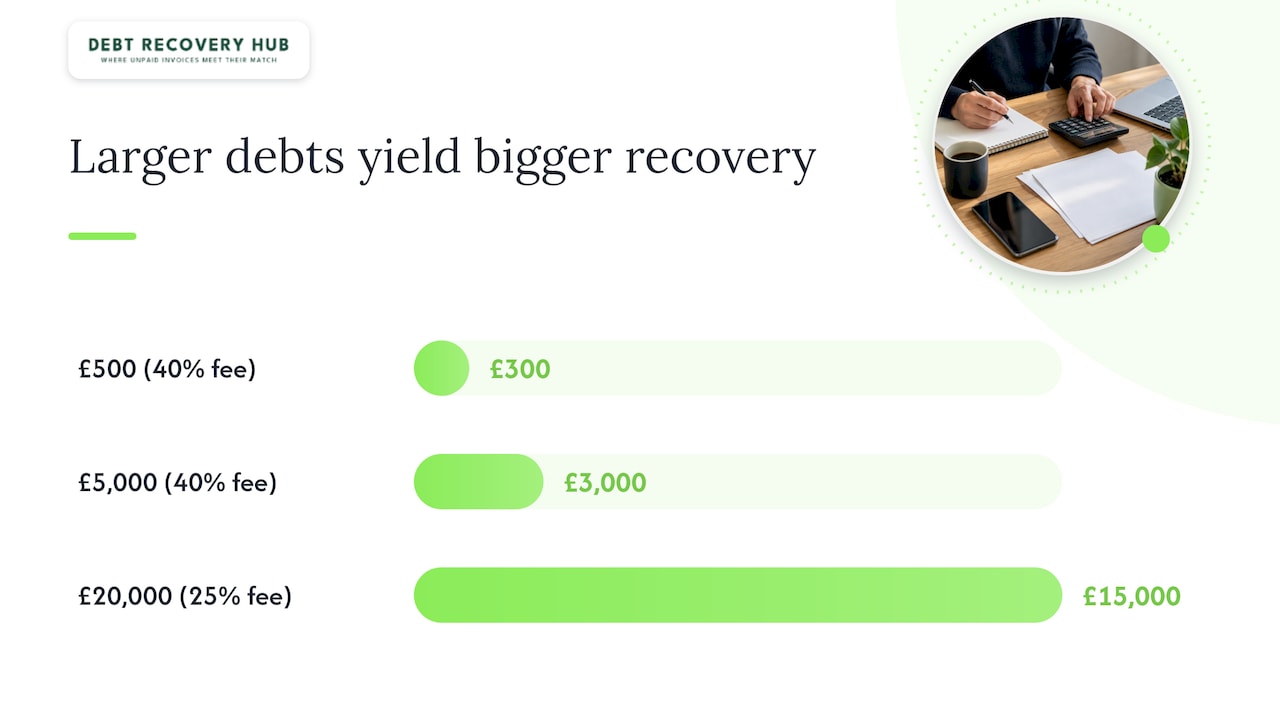
A simple worked example shows how the economics shift with debt size:
- On a £500 invoice at a 40% contingency fee, you recover £300, which may not justify the relationship damage for a customer you hoped to keep.
- On a £5,000 invoice at the same 40% rate, you recover £3,000, a sum that usually outweighs the cost of losing a non-paying customer.
- On a £20,000 invoice at a lower 25% rate (often available for larger or more straightforward cases), you recover £15,000, which makes referral an easy decision once internal outreach has failed.
The pattern holds generally: the larger the balance, the more sense a contingency fee makes, while small, disputed or relationship-sensitive accounts are often better handled with a payment plan or a final internal warning first.
How to choose and vet a collection agency
Not every agency suits every case, so a short vetting process before you sign anything is worth the time. Checking an agency’s compliance history, sector experience and fee transparency upfront avoids a second round of frustration on top of the original unpaid debt.
- Confirm the agency’s data protection practices and, where relevant, its regulatory standing under FCA rules for consumer debt collection.
- Ask for experience with your specific debt type, whether that is commercial invoices, rent arrears or cross-border recovery.
- Request a clear, written fee structure with no hidden charges for tracing or litigation referral.
- Ask how complaints are handled and request references from businesses in a similar sector.
Beyond credentials, ask pointed performance questions: What is the recovery rate for debts of a similar age to yours? What is the average number of days to recover a comparable balance? How often do cases escalate to litigation, and what proportion of those succeed? An agency that cannot answer these with specifics is worth treating cautiously.
Pro Tip: Insist on a written reporting cadence, a clear point where you must approve any escalation to litigation, and an explicit exit clause before you hand over a single file.
Your contract should also cover confidentiality and GDPR handling of customer data, since the agency will be processing personal and financial information on your behalf. Our guide to choosing a debt collector and our FCA compliance checklist both go into more depth on what to ask before you commit.
Alternatives and steps to try first
An agency is not always the right first move. Collections software and structured escalation playbooks work well for current accounts and customers who have a track record of paying, just late, since automated reminders and staged follow-ups often resolve the issue without any third-party cost.
- Offer a formal payment plan before escalating, particularly where the customer has a genuine cash-flow problem rather than a refusal to pay.
- Try mediation or another form of alternative dispute resolution where a misunderstanding, rather than an inability to pay, is at the heart of the delay.
- Use collections software for cooperative, current customers rather than paying a contingency fee for a debt that basic reconciliation could resolve.
- Reserve agency referral for confirmed insolvency, prolonged silence, or debts you have already written off internally.
Our guide to recovering unpaid invoices walks through the reconciliation and outreach steps worth exhausting before you spend money on a referral fee.
How a platform helps you find a vetted match
Once internal routes are exhausted, a platform gathers the details that matter for a good match: debt type, amount, age and location. That intake is used to connect users with vetted agencies suited to their specific case rather than leaving them to contact providers at random. Benefits include a faster, more informed match and professional handling from an agency chosen for the situation, though the quality of any individual case still depends on the debtor’s circumstances. Before requesting a match, gather your invoices, correspondence history and any proof of prior outreach attempts.
A judgement call worth getting right
Most businesses escalate too late rather than too early, chasing a difficult customer for months past the point where an agency would have recovered more. The discipline that actually pays off is following the pre-action steps properly and recording every contact attempt, because that paperwork protects your legal options regardless of which way the case goes.
— Jack
Ready to find the right agency for your case?
The next step can be straightforward: provide the debt type, amount, age and location, and be matched with vetted agencies suited to the situation rather than searching blindly. This can save time precisely when a debt is ageing past the point where delay costs recovery value.

Before you submit a case, have these ready:
- Copies of the original invoice or agreement and any amendments.
- A dated record of every contact attempt and the customer’s responses.
- Proof that a letter before action has already been sent, where applicable.
Good invoicing habits from the outset also reduce how often you reach this point. Firms such as specialist bookkeeping services for sole traders can help tighten up record-keeping so fewer invoices drift into dispute territory. When you are ready, start with our Business Debt Recovery page to request a match.
This article is general information, not a substitute for advice from a qualified financial advisor. Consult a qualified financial professional about your own circumstances before acting on anything here.
FAQ
Is it worth it to hire a collection agency?
For small or disputed balances, a payment plan or mediation often recovers more of the original sum without the fee.
What should you not say to a collection agency?
Avoid admitting the debt is disputed if it is not, and never give a firm payment date you cannot meet, since broken promises weaken your negotiating position. Keep communication factual and in writing wherever possible so there is a clear record if the case proceeds further.
How long does a company have to wait before sending you to collections?
There is no fixed legal waiting period before a creditor can refer a debt to an agency, but most businesses wait until an invoice is 90 to 120 days overdue, according to practitioner guidance. Creditors must still send a proper letter before action under the pre-action protocol before any court proceedings follow.
How long before a debt becomes uncollectible in the UK?
In England and Wales, the Limitation Act 1980 generally prevents legal action on a simple contract debt six years after it became payable. Scotland applies separate prescription rules, so the position can differ depending on where the debt arose.
Sources
- Gov
- Pre-Action Protocol for Debt Claims (draft) – Ministry of Justice
- When to use a collection agency (and when to use software) – Monk